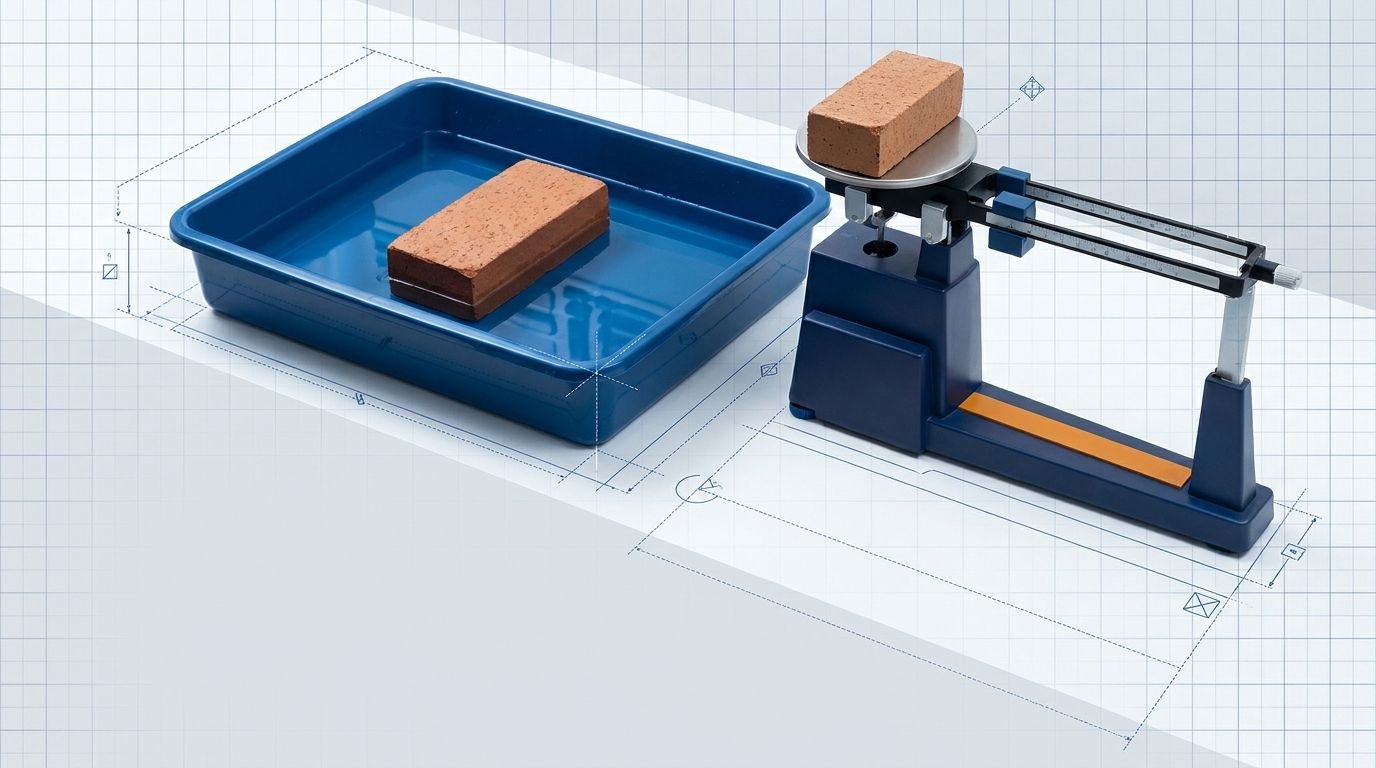
Water Absorption Test of Bricks
Updated
The water absorption test measures exactly how much water a brick soaks up over 24 hours submerged — and that single number predicts whether the brick will resist rising damp, hold onto its mortar joint properly, and survive freeze-thaw or salt-crystallisation cycles over the building's lifetime. It's a straightforward gravimetric test under IS 3495 (Part 2), but the number it produces is one of the more consequential quality indicators for masonry durability.
24-hour immersion
The test method
≤ 20% by weight
Common burnt clay bricks
Lower = denser, better
What the result means
What water absorption is actually a proxy for
A brick's water absorption isn't tested because absorbing water is inherently bad in isolation — it's tested because absorption is a direct, measurable proxy for the brick's internal porosity, and porosity drives almost every durability problem a brick can develop over decades of service:
- A porous, high-absorption brick lets damp travel through it more readily (contributing to rising damp problems even where the DPC is correctly placed), is weaker in compression because the same porosity that lets in water also means less solid material carrying load, and is more vulnerable to freeze-thaw damage or salt-crystallisation spalling in the pores near its surface.
- A very dense, low-absorption brick resists all of that — but if absorption is too low, the brick can fail to draw moisture out of fresh mortar during laying, weakening the mortar-to-brick bond because the joint never properly "keys" into the brick's surface pores.
The test therefore isn't looking for the absolute minimum absorption — it's checking that absorption stays within a sensible band that avoids both failure modes.
The test procedure (IS 3495 Part 2)
- 1
Oven-dry the brick
Dry the brick in an oven at 105–115°C until it reaches constant weight (no further weight loss between successive weighings), ensuring all moisture is fully driven out.
- 2
Cool and weigh dry
Cool the brick to room temperature and weigh it precisely — this is the dry weight, W1.
- 3
Immerse fully
Submerge the brick completely in clean water at room temperature for exactly 24 hours.
- 4
Remove and surface-dry
Remove the brick from the water and wipe off all surface (free) water with a damp cloth, without squeezing out absorbed water from within the brick.
- 5
Weigh wet
Weigh the brick again within a few minutes of removal — this is the wet weight, W2.
- 6
Calculate absorption
Water absorption (%) = (W2 − W1) ÷ W1 × 100.
The IS limit and what it means
For common burnt clay building bricks, water absorption should not exceed 20% by weight after 24 hours of immersion. Higher-class, better-fired bricks are held to progressively lower limits, since a well-fired brick is inherently denser and less porous.
A well-fired common brick sits comfortably within the 20% IS limit; under-fired bricks from the cooler edges of a kiln batch commonly exceed it and should be sorted out before use.
Why this test is a good sorting tool, not just a pass/fail gate
Because a single kiln firing produces bricks of genuinely varying quality — the core of the stack fires hotter and more completely than the edges — water absorption testing is often used on a working site not just as a one-time acceptance check, but as a sorting criterion: bricks testing well within the limit go into structural or exposed work, while higher-absorption bricks from the same batch might be reserved for less critical, protected applications, or rejected outright if they exceed the limit by a meaningful margin. This is standard, sensible practice rather than a sign the whole batch is defective — it reflects the genuine variability inherent in traditional kiln firing.
How this compares across brick types
Water absorption is one of the clearest quantitative differences between traditional and manufactured bricks — see fly ash bricks vs red bricks for the fuller comparison. Fly ash bricks, made by pressing and curing rather than firing, are inherently denser and more consistent, typically testing well below common red bricks on this measure. Neither is automatically "better" in every respect (low absorption in fly ash bricks means special plaster-bonding treatment is needed), but on this specific test, fly ash bricks generally give a more predictable, lower-absorption result.
Frequently asked questions
What is the water absorption test of bricks? It measures how much water a brick absorbs by weighing it oven-dry, submerging it fully in water for 24 hours, then weighing it again wet. The percentage weight increase over the dry weight is the water absorption — a direct proxy for the brick's internal porosity and durability.
What is the limit of water absorption for bricks? For common burnt clay bricks, absorption should not exceed 20% by weight after 24 hours of immersion, per IS 3495. Higher-quality, better-fired brick classes are held to progressively stricter (lower) limits.
Why is water absorption of bricks important? A highly porous, high-absorption brick lets damp travel through more easily, is generally weaker in compression, and is more vulnerable to freeze-thaw and salt-crystallisation damage over time. Low, well-controlled absorption within the code limit generally indicates a denser, more durable, better-fired brick.
How do you calculate water absorption of a brick? Water absorption (%) = (wet weight − dry weight) ÷ dry weight × 100, using the precise oven-dry weight and the weight measured immediately after 24 hours of full immersion and surface-drying.
Do fly ash bricks absorb less water than red bricks? Yes, typically. Fly ash bricks commonly test at roughly 6–12% absorption, meaningfully lower than common red bricks, which can range up to the 20% IS limit or occasionally beyond it if under-fired.
Can a brick have absorption that's too low? In principle, extremely low absorption can slightly reduce how well mortar keys into the brick's surface during laying, since the brick draws less water out of the fresh mortar to help it grip — but this is a much smaller practical concern than excessive absorption, and is generally managed through proper masonry technique rather than being a rejection criterion.
Should bricks be wetted before laying regardless of their absorption test result? Yes — wetting bricks before laying is standard practice for all but very low-absorption units, since it prevents the brick from drawing too much water out of the fresh mortar too quickly, which would weaken the mortar's own hydration and the resulting bond.
CivilSite Editorial Team✓ Engineer reviewed
Written and reviewed by practising civil engineers with 10+ years of Indian residential construction experience.