Specific Gravity & Water Absorption of Aggregate
Updated
The specific gravity of aggregate — around 2.6 to 2.9 for normal-weight stone — tells you the density of the individual particles, while the water absorption tells you how genuinely porous those particles are. The two properties are measured together in the same test procedure and both feed directly into concrete mix design, where getting them wrong quietly distorts the mix proportions and the effective water–cement ratio. Both are determined under IS 2386 (Part 3). This page explains what each property means, how it's measured, and what the results actually tell you about the aggregate.
2.6 – 2.9
Typical specific gravity range for stone
< ~2% absorption
Indicates sound, dense stone
IS 2386 (Part 3)
The governing test method
Why these two properties genuinely matter in mix design
Specific gravity is used in mix design to convert between the mass and the volume of aggregate and to work out the expected yield of the concrete — since a mix is often designed by volume but batched by weight (or vice versa), the specific gravity is the number that reliably links the two. Water absorption reveals how porous the aggregate is, and this has a direct, practical consequence: porous aggregate soaks up mix water into its own pores, so if the mix design doesn't explicitly allow for that absorption, the aggregate effectively steals water from the paste and the real, effective water–cement ratio ends up different from the intended one. Highly porous aggregate can also be less durable in its own right. Very low absorption combined with a specific gravity around 2.7 together indicate sound, dense, sound stone.
The test procedure (IS 2386 Part 3)
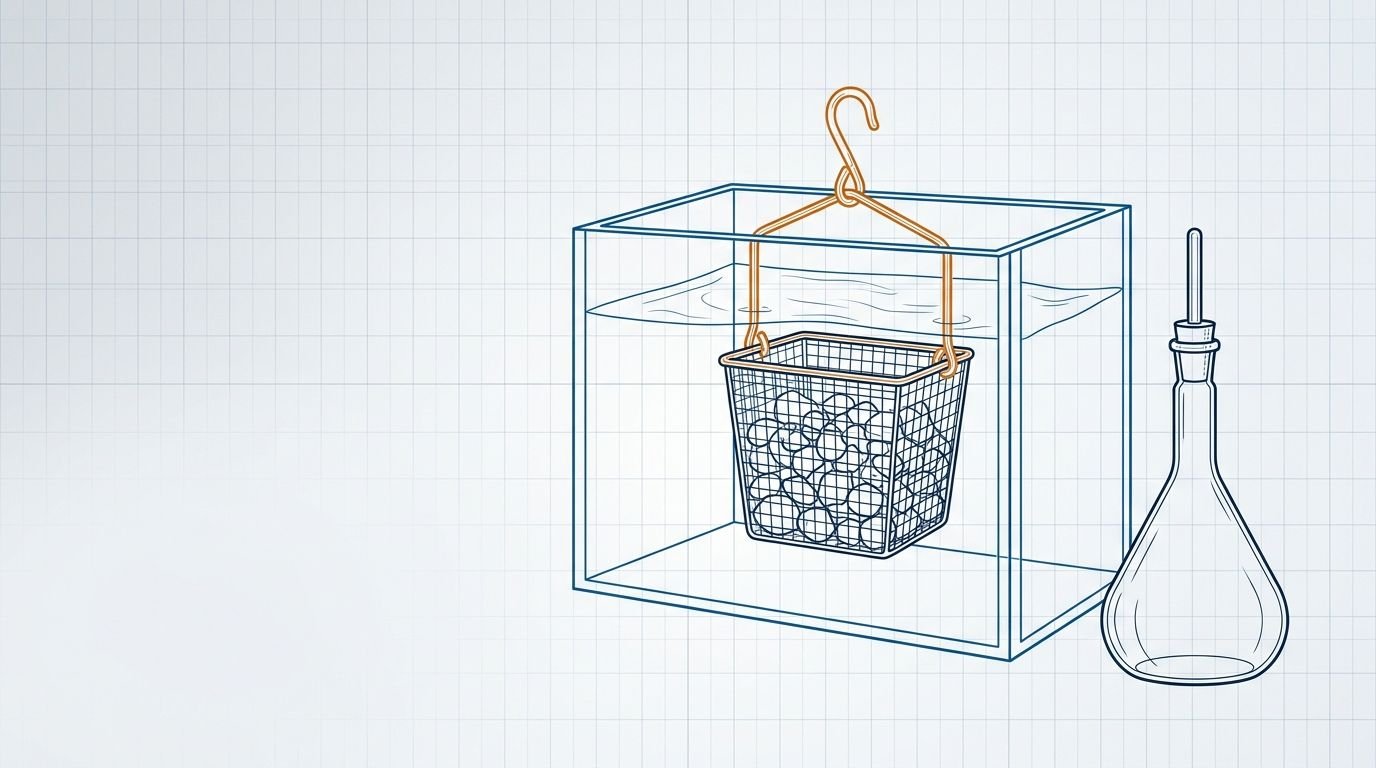
For coarse aggregate, the wire-basket (water displacement) method is common; for fine aggregate, a pycnometer is used instead:
- 1
Soak the aggregate
Soak the aggregate in water for 24 hours so its pores fill completely
- 2
Weigh saturated surface-dry
Surface-dry the particles and weigh them saturated and surface-dry (W_ssd)
- 3
Weigh in water
Weigh the saturated aggregate submerged in water (W_water)
- 4
Oven-dry and weigh
Oven-dry the aggregate fully and weigh it dry (W_dry)
- 5
Calculate both values
Compute specific gravity and water absorption from the three weights
The full 24-hour soak matters — it's what saturates the pores so the saturated-surface-dry weight is genuinely representative rather than partially dry.
Specific gravity = W_dry ÷ (W_ssd − W_water) Water absorption (%) = (W_ssd − W_dry) ÷ W_dry × 100
What the values actually mean
Typical interpretive ranges — a specific gravity near 2.7 with absorption under 2% indicates dense, sound aggregate suited to ordinary concrete.
- Specific gravity 2.6–2.9 → normal-weight aggregate suited to ordinary structural concrete.
- Water absorption under about 2% → dense, sound aggregate. Higher absorption indicates porous stone that demands more water, distorts the mix if not allowed for, and may be less durable over time.
Why the two properties are always measured together, not separately
It's worth understanding why IS 2386 measures specific gravity and water absorption in a single combined procedure rather than as two independent tests: both derive from the very same three weights (dry, saturated-surface-dry, and submerged), so measuring them together is simply efficient — one soak, one set of weighings, two results. But it's also conceptually right that they travel together, because they describe two sides of the same physical reality: specific gravity tells you how dense the solid part of the particle is, while water absorption tells you how much pore space that particle contains. A dense, non-porous aggregate has a high specific gravity and low absorption; a porous one has lower specific gravity and higher absorption. Read alongside the aggregate strength and shape tests — crushing value, impact value and sieve analysis — they complete the picture of an aggregate's suitability. See the IS 383 aggregates standard for the broader quality framework.
Frequently asked questions
What is the specific gravity of aggregate? For normal-weight stone aggregate it's about 2.6 to 2.9 — the density of the aggregate particles relative to water. It's used in concrete mix design to convert between the mass and volume of aggregate and to work out the concrete's yield.
What is the water absorption of aggregate? It's the percentage increase in the aggregate's weight after 24 hours of soaking, relative to its dry weight — a direct measure of the particles' porosity. Good, sound stone absorbs less than about 2%.
How is the specific gravity of aggregate calculated? Specific gravity = oven-dry weight ÷ (saturated surface-dry weight − weight in water). Fine aggregate is tested using a pycnometer; coarse aggregate using a wire basket submerged in water — both derive from the same three weights.
Why is water absorption of aggregate important? Because porous aggregate soaks up mix water into its own pores, so the water–cement ratio must explicitly allow for it or the effective ratio ends up wrong. High-absorption aggregate can also be less durable and affects the mix's yield and workability.
What does a high specific gravity indicate? A higher specific gravity generally indicates denser, stronger aggregate with lower porosity — desirable for good, durable concrete — which is exactly why it usually goes hand in hand with a low water absorption figure.
CivilSite Editorial Team✓ Engineer reviewed
Written and reviewed by practising civil engineers with 10+ years of Indian residential construction experience.