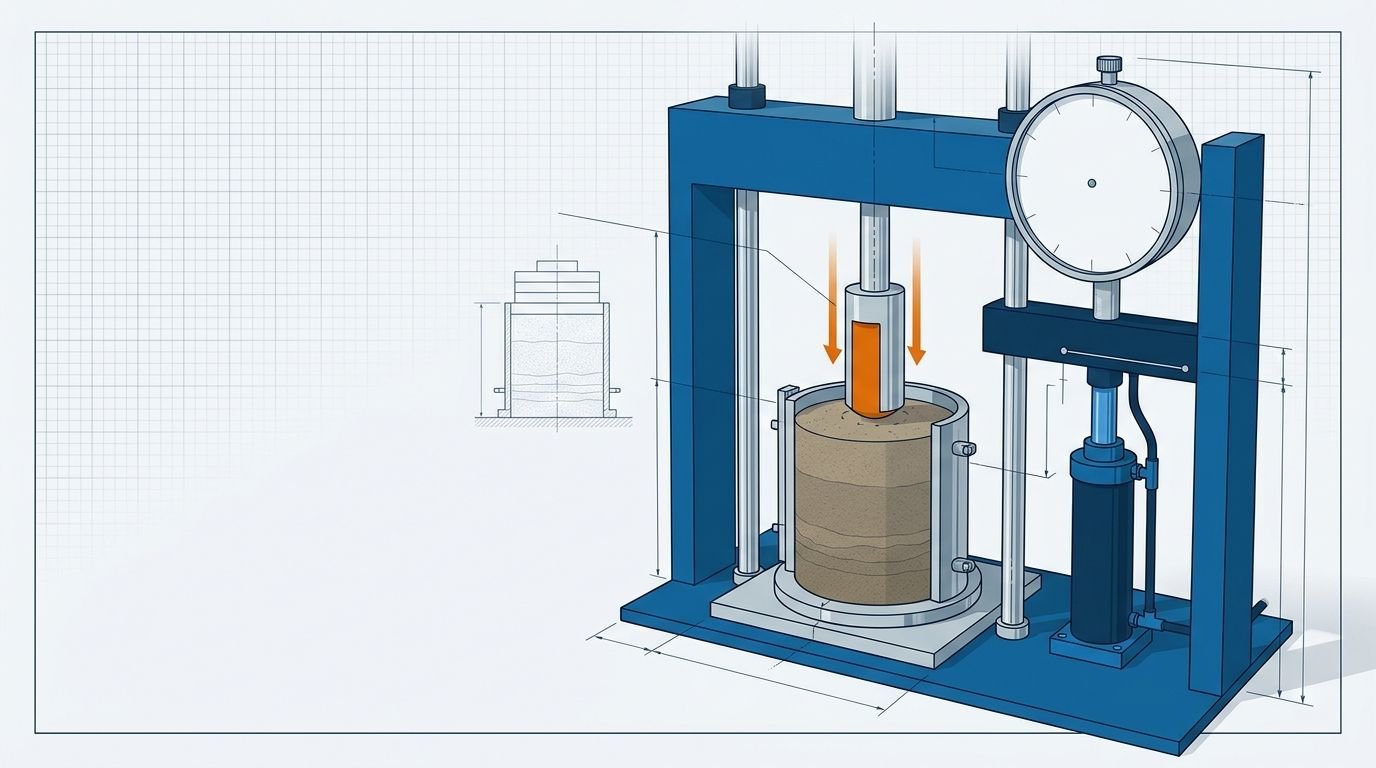
California Bearing Ratio (CBR) Test
Updated
The CBR test grades how strong a soil sub-grade is for supporting a road, by comparing the load the soil takes for a standard penetration against the load a standard crushed rock takes for the same penetration. The resulting percentage feeds directly into pavement design charts, which convert it into the required thickness of the pavement layers above — so a genuinely weak sub-grade demands a thicker, more expensive pavement, and a strong one needs less. It follows IS 2720 (Part 16). This page explains why it matters, the procedure, and how the result is read and used.
Test load ÷ standard load × 100
The CBR percentage
Read at 2.5 & 5 mm penetration
The two standard read points
Sets the pavement thickness
The result’s ultimate use
Why the sub-grade strength genuinely drives pavement cost
A road's layered structure exists precisely to spread concentrated wheel loads out and down, progressively, until they reach the natural sub-grade soil at a pressure that soil can safely bear. This means the weaker the sub-grade, the thicker the pavement above it must be to spread the load adequately before it reaches that weak soil — and conversely, a strong sub-grade lets you build a thinner, cheaper pavement. The CBR value grades exactly this sub-grade strength, and IRC pavement-design charts then convert the CBR directly into layer thicknesses, making the CBR test one of the single most cost-consequential soil tests in road construction.
The test procedure (IS 2720 Part 16)
- 1
Compact the sample
Compact the soil into the CBR mould, usually at its optimum moisture content (OMC)
- 2
Soak for 4 days
Soak the compacted sample for 4 days to simulate the worst saturated field condition
- 3
Load the plunger
Place the sample under a standard-area plunger and push it in at a steady rate
- 4
Record load at set penetrations
Record the load at 2.5 mm and 5.0 mm penetration
- 5
Compute CBR against the standard
Divide each load by the standard crushed-stone load at the same penetration, ×100
The 4-day soak deliberately tests the soil in its worst, saturated state — designing to the soaked CBR guards against the sub-grade weakening in the monsoon after the road is built.
CBR (%) = Test load ÷ Standard load × 100
The CBR at 2.5 mm penetration usually governs; both the 2.5 mm and 5.0 mm values are checked, and normally the 2.5 mm value is taken (with a re-check specified if the 5.0 mm value comes out higher).
Typical values and how the result is used
Illustrative typical soaked-CBR ranges — actual pavement design uses the site-specific measured CBR against IRC design charts, not these bands alone.
- Soft clay → a low CBR (just a few percent), demanding a genuinely thick pavement above it.
- Well-graded gravel / good sub-grade → a high CBR, needing far less pavement thickness.
The soaked CBR value is used with IRC pavement-design charts to fix the thickness of the sub-base, base and surfacing layers. It pairs naturally with the Proctor test (whose OMC the CBR sample is compacted at) and, for building-foundation soils rather than road sub-grades, with the standard penetration test and plate load test.
Why the soaked condition, not the as-compacted one, is what's designed for
A point worth understanding is why the CBR sample is deliberately soaked for four days before testing, rather than tested at the moisture it was compacted at. A road's sub-grade, once built and buried, will inevitably take up moisture over its life — during monsoons, from a rising water table, from water seeping through the pavement — and a saturated sub-grade is genuinely weaker than the same soil freshly compacted at its OMC. Testing the soaked sample means the pavement is designed for the weakest realistic state the sub-grade will actually reach in service, rather than for an optimistic as-built condition that won't persist. This is exactly the same conservative philosophy behind soaking that makes the CBR a trusted basis for pavement design in a monsoon climate.
Frequently asked questions
What is the California Bearing Ratio test? It's a penetration test that grades a soil sub-grade's strength by comparing the load it takes for a standard penetration against the load a standard crushed rock takes for the same penetration. The result, a percentage, is used to design road pavement thickness.
How is CBR calculated? CBR (%) = test load ÷ standard load × 100, measured at 2.5 mm and 5 mm penetration of a standard plunger. The 2.5 mm value usually governs, with a re-check specified if the 5 mm value comes out higher.
Why is the CBR sample soaked for 4 days? The sample is soaked to test the soil in its worst, saturated condition — because a buried sub-grade inevitably takes up moisture over its life and is weaker saturated than freshly compacted. Designing to the soaked CBR means designing for the weakest realistic state the sub-grade will actually reach.
What is CBR used for? It's used to design flexible road pavements — the CBR value of the sub-grade is converted, via IRC design charts, into the required thickness of the sub-base, base and surfacing layers above it.
What is a good CBR value? Higher is better. Soft clays give low single-digit CBR values that demand thick pavements, while well-graded gravels give high values that need much less pavement — which is why sub-grade quality directly drives pavement cost.
CivilSite Editorial Team✓ Engineer reviewed
Written and reviewed by practising civil engineers with 10+ years of Indian residential construction experience.