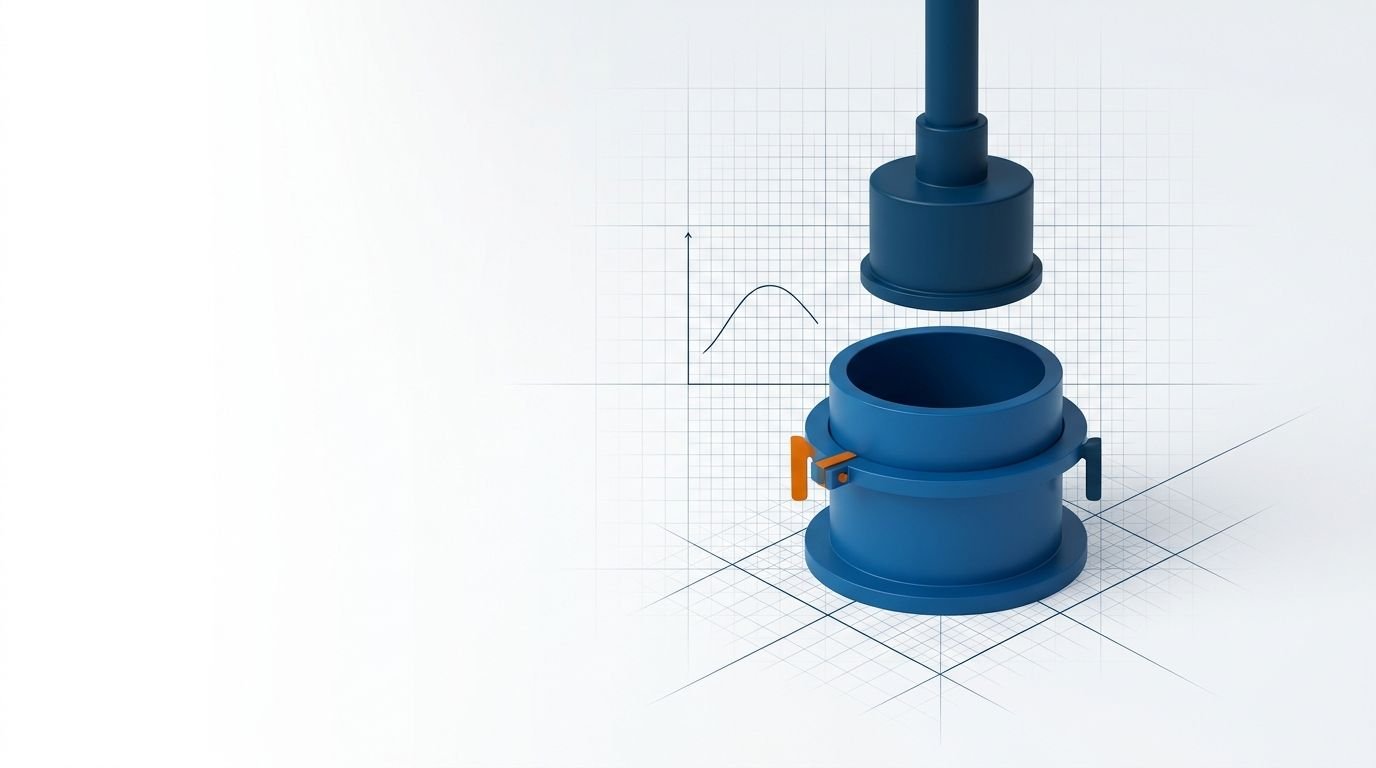
Proctor Compaction Test
Updated
The Proctor test finds the exact moisture content at which a given soil will compact to its densest possible state — its optimum moisture content (OMC) — together with the maximum dry density (MDD) it reaches at that moisture. Compacting fill at that specific moisture gives the strongest, most stable ground, which is why the test underpins essentially all earthwork, sub-grade and fill-foundation work. It follows IS 2720 (Parts 7 and 8). This page explains why the result matters, the procedure, and how the OMC and MDD are actually used on site.
Dry density vs moisture curve
What the test plots
Peak = MDD at the OMC
The key result read off the curve
Compact fill at the OMC
How the result is applied on site
Why the moisture content genuinely matters for compaction
Filled and sub-grade soil must be compacted to be strong and to settle as little as possible over time. But — and this is the crucial, non-obvious insight the Proctor test captures — soil compacts best at one particular moisture content, not simply "as dry as possible" or "as wet as possible". If the soil is too dry, there isn't enough water to lubricate the grains so they can slide into a dense packing, and the compaction effort can't densify it fully. If the soil is too wet, water fills the voids between grains and, being incompressible, physically prevents the grains from packing closer together — so density actually falls again. Between those two extremes lies the optimum moisture content (OMC), where the soil reaches its maximum dry density (MDD), and the Proctor test's whole job is to find that sweet spot for the specific soil in question.
The test procedure (IS 2720 Part 7 / Part 8)
- Take the soil and mix it to a chosen starting moisture content.
- Compact it into the standard mould in layers, giving each layer a set number of blows with the standard rammer — a light rammer for the standard Proctor test, a heavier rammer (more compactive effort) for the modified Proctor test.
- Weigh the compacted soil, measure its actual moisture content, and compute its dry density.
- Repeat the whole process at several different moisture contents, deliberately spanning from too dry to too wet.
- Plot dry density against moisture content — the resulting curve rises to a distinct peak (the MDD) at the OMC and then falls away as the soil becomes too wet.
A schematic of the characteristic Proctor curve shape (relative dry density), showing density rising to a single peak at the OMC then falling as the soil becomes too wet.
How the Proctor result is actually used on site
- On site, the fill is placed and compacted at (or very near) the OMC specifically to reach the MDD the lab test identified — which is why site teams check and adjust the moisture of imported fill before compacting it, rather than compacting it at whatever moisture it happens to arrive at.
- Field compaction is then verified against the lab result: the degree of compaction = field dry density ÷ MDD × 100, and a specification (commonly 95% of MDD) must be achieved. Field density itself is measured by the core-cutter or sand-replacement method (see IS 456 plain and reinforced concrete for related field testing context).
Why the Proctor test connects to so much other geotechnical work
The Proctor result isn't an isolated lab curiosity — it's the reference against which nearly all compacted earthwork is judged, which is why it links directly to several other tests on this site. It underpins earthwork quality control, foundations placed on engineered fill, and road sub-grade preparation. It pairs with the CBR test for pavement design (the CBR sample is itself typically compacted at the Proctor OMC), and with the standard penetration test for assessing in-situ, undisturbed soil rather than placed fill. Understanding the Proctor result is genuinely foundational to understanding how compacted ground is specified and checked.
Frequently asked questions
What is the Proctor compaction test? It's a laboratory test that finds the moisture content at which a given soil compacts to its greatest density — the optimum moisture content (OMC) — together with the maximum dry density (MDD) it reaches at that moisture.
What are OMC and MDD? OMC (optimum moisture content) is the moisture content at which a soil compacts to its densest possible state. MDD (maximum dry density) is that greatest dry density. Both are read directly off the peak of the Proctor curve.
What is the difference between the standard and modified Proctor test? The modified Proctor test uses a heavier rammer and applies more compactive effort than the standard test, producing a higher MDD at a lower OMC. The modified test suits heavily loaded fills such as road sub-grades, which will experience greater compaction in service.
How is the Proctor result used on site? Fill is compacted at or near the OMC specifically to reach the MDD the lab identified. Field compaction is then checked as a percentage of that MDD (for example, a specification of 95%), verified by the core-cutter or sand-replacement field density method.
Why is compaction so important for fill and sub-grades? Compaction increases a soil's density and strength while reducing its later settlement and its permeability, so that fills, foundations placed on fill, and road sub-grades all stay stable and don't settle or weaken excessively over the structure's life.
CivilSite Editorial Team✓ Engineer reviewed
Written and reviewed by practising civil engineers with 10+ years of Indian residential construction experience.