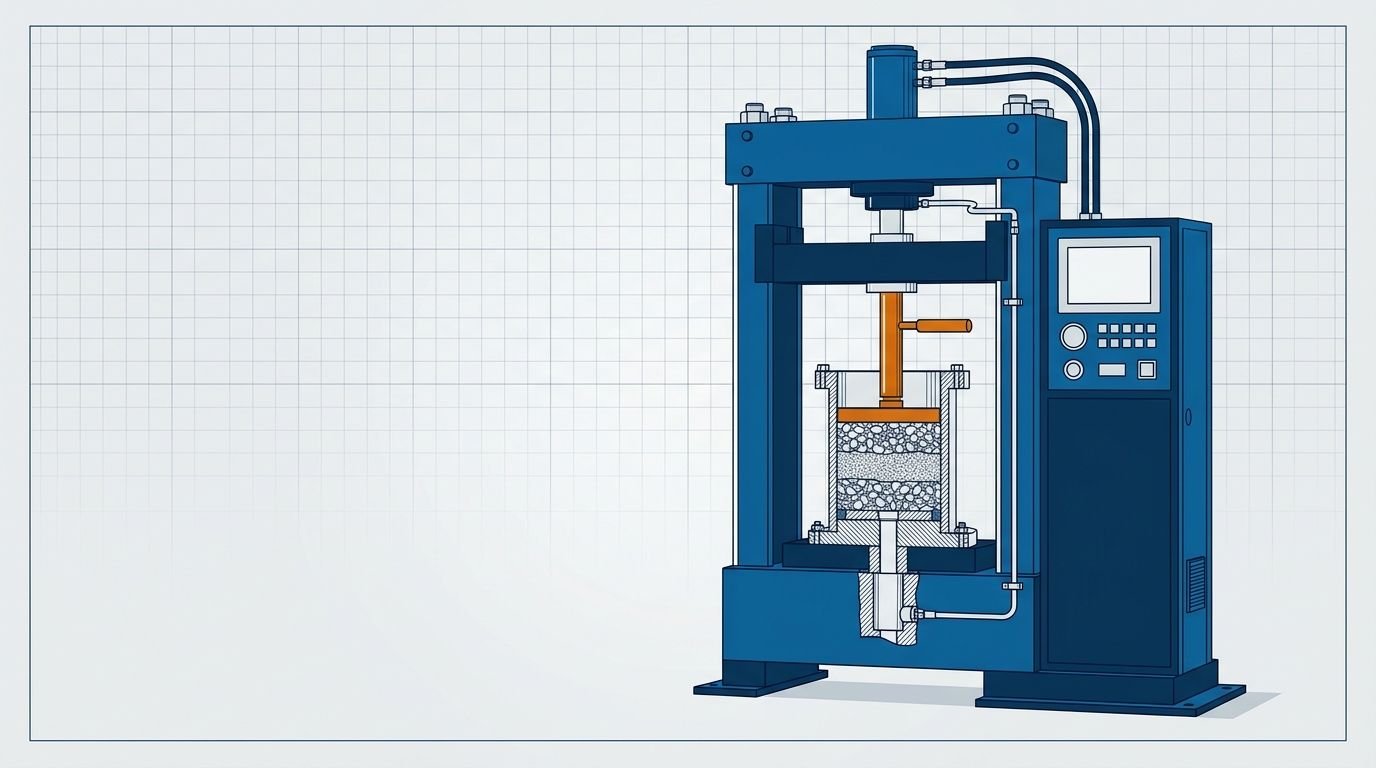
Aggregate Crushing Value Test
Updated
The aggregate crushing value (ACV) measures how much an aggregate crushes under a slowly applied compressive load — a lower value means a stronger, harder aggregate that resists being crushed under sustained pressure. It's one of the key strength checks required for aggregate used in structural concrete and road surfaces, carried out under IS 2386 (Part 4), and it directly answers a question that matters structurally: will this specific aggregate hold up under the sustained load a slab, beam or road surface will actually place on it over its service life.
40-tonne load
Applied uniformly over 10 minutes
Fines ÷ total × 100
The ACV formula
≤ 30% wearing / ≤ 45% other
The two governing limits
Why the crushing value matters more than intuition suggests
Aggregate makes up the large majority of concrete's total volume — typically 70–80% — which means the inherent strength of the aggregate itself sets a genuine ceiling on how strong the finished concrete can ever be, regardless of how carefully the cement paste and mix design are handled. Weak, easily-crushed aggregate cannot be compensated for by extra cement; it remains the weak link in the composite material. The crushing value test exists specifically to grade an aggregate source's resistance to crushing under load before it's ever batched into concrete, which matters most acutely for road surfaces and structural concrete elements that must reliably carry high sustained stresses throughout their design life.
The procedure, step by step (IS 2386 Part 4)
- 1
Sample preparation
Take aggregate passing a 12.5 mm sieve and retained on a 10 mm sieve, oven-dried
- 2
Fill the mould
Fill the standard cylindrical mould in three layers, tamping each layer 25 times
- 3
Record initial weight
Weigh the total sample as filled — this is W1
- 4
Apply the load
Place the plunger and apply a 40-tonne load uniformly over 10 minutes in a compression testing machine
- 5
Sieve the crushed sample
Release the load, remove the sample, and sieve it on a 2.36 mm sieve
- 6
Weigh the fines
Weigh the material passing the 2.36 mm sieve — the crushed fines — this is W2
The 40-tonne load must be applied uniformly over the full 10 minutes, not suddenly — a rushed load application skews the result toward a falsely high crushing value.
Once both weights are recorded, the aggregate crushing value is calculated directly:
Aggregate crushing value (%) = W2 ÷ W1 × 100
The specification limits, and why they differ by application
Road and runway wearing surfaces face repeated, concentrated wheel loading directly at the surface, which is why they carry a tighter (lower) limit than general structural concrete.
For aggregate used in concrete for wearing surfaces (roads, runways), the crushing value should not exceed 30%. For other structural concrete, it should not exceed 45%.
The tighter limit for wearing surfaces isn't arbitrary — a road or runway surface takes repeated, concentrated wheel loading directly at the exposed top layer, with essentially no depth of material to spread that load before it reaches the aggregate particles themselves, which is exactly why that application demands a demonstrably stronger, less crushable aggregate than a structural beam or column buried within a building, where the aggregate is never subjected to that kind of direct, repeated surface contact loading.
Reading the crushing value alongside the other aggregate strength tests
A low ACV genuinely indicates a stronger aggregate — but the crushing value alone doesn't fully characterise an aggregate's suitability, since it measures resistance specifically to a slowly applied load, not the sudden shock loading an aggregate also experiences in practice (handling, compaction, traffic impact). For that reason, the crushing value is routinely read alongside the aggregate impact value, which measures resistance to sudden impact rather than steady pressure, and the flakiness and elongation index, which checks particle shape rather than material strength — together, the three tests give a much more complete picture of an aggregate source's genuine suitability than any single test on its own. See also the IS 383 aggregates standard for the broader aggregate quality requirements these tests feed into.
Frequently asked questions
What is the aggregate crushing value test? It measures how much an aggregate crushes under a slowly applied 40-tonne compressive load. The fines produced, passing a 2.36 mm sieve, expressed as a percentage of the original sample weight, is the crushing value — a lower value means a stronger aggregate.
What is the limit of aggregate crushing value? Not more than 30% for aggregate used in concrete for wearing surfaces (roads, runways), and not more than 45% for other structural concrete — the tighter limit reflecting the more demanding, direct surface loading a wearing course experiences.
How is aggregate crushing value calculated? It is the weight of crushed material passing the 2.36 mm sieve, divided by the total original sample weight, multiplied by 100 — expressed simply as W2 ÷ W1 × 100.
What load is applied in the crushing value test, and for how long? A load of 40 tonnes is applied uniformly over a full 10 minutes through the plunger in a compression testing machine — the gradual, uniform application specifically distinguishes this from the sudden impact loading used in the separate aggregate impact value test.
What does a low crushing value indicate, and why should it be checked alongside other tests? A low aggregate crushing value indicates a harder, stronger aggregate that resists crushing well under sustained load, which gives stronger concrete — but since it measures only resistance to slow loading, it's typically checked alongside the impact value (sudden shock resistance) and the flakiness/elongation index (particle shape) for a fuller picture of aggregate quality.
CivilSite Editorial Team✓ Engineer reviewed
Written and reviewed by practising civil engineers with 10+ years of Indian residential construction experience.