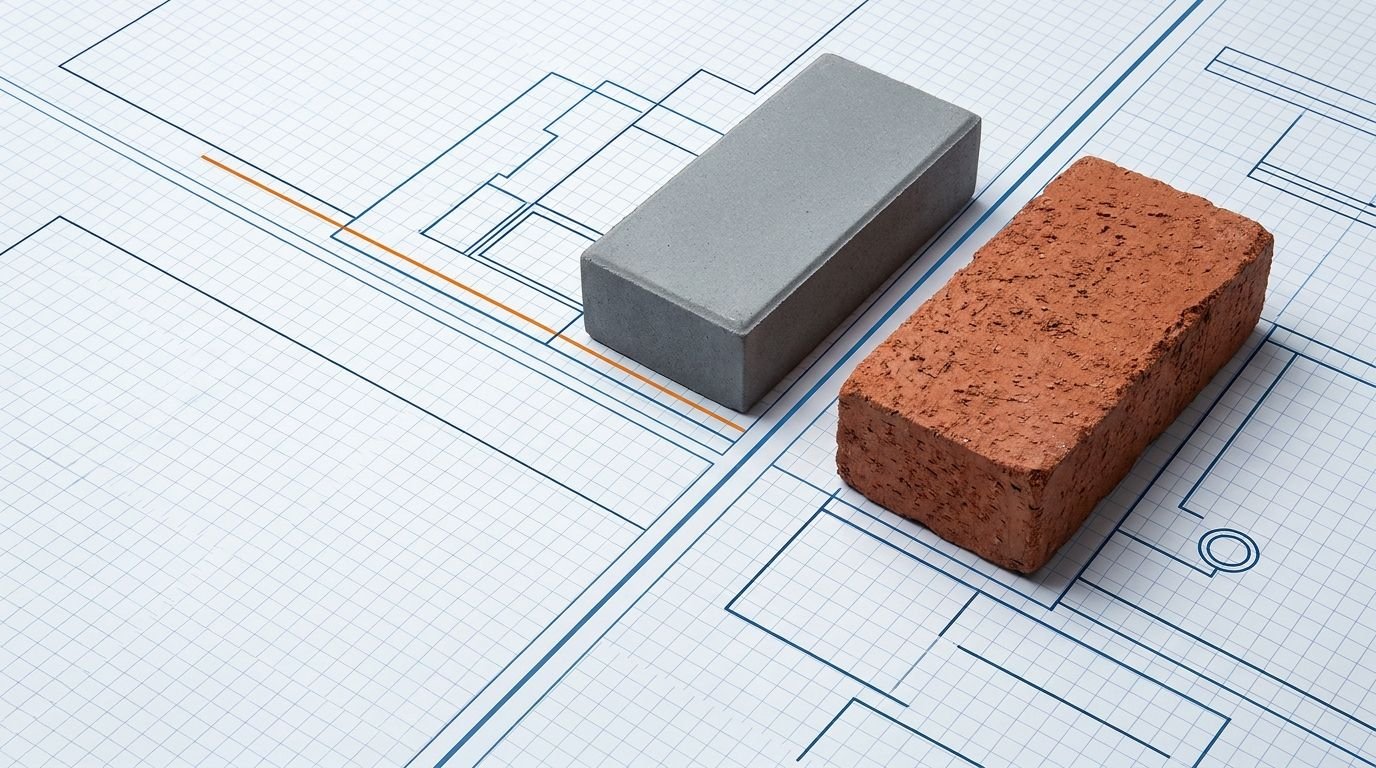
Fly Ash Bricks vs Red Bricks
Updated
Fly ash bricks are moulded and cured from fly ash, cement and sand under controlled conditions; red bricks are moulded from clay and fired in a kiln — and fly ash bricks come out stronger, smoother and greener, while red bricks bond mortar and plaster more readily and remain the more forgiving choice for irregular hand-built work. This page compares the two in depth, because the "which brick" decision sets the tone for the whole wall — mortar consumption, plaster bond, weight on the frame, and the long-term look of the finished house.
Fly ash = ash + cement + sand
Pressed & cured
Red = clay, kiln-fired
Traditional
Both ~8–9 / sq ft
For a 9-inch wall
How each brick is actually made
Red (burnt clay) bricks follow the oldest process in construction: clay is dug, tempered with water, moulded (by hand or machine), dried, and then fired in a kiln at high temperature. The firing vitrifies part of the clay, giving the brick its characteristic strength and colour, but the process is inherently variable — clay composition differs by pit, firing temperature varies across the kiln, and hand-moulded bricks are never perfectly uniform in size or shape.
Fly ash bricks are made without any firing at all. Fly ash (a fine ash by-product captured from coal power-plant chimneys), cement, sand and a little lime are mixed, pressed into moulds under high pressure, and then cured — either by steam (autoclaving) or by simply keeping them moist for several weeks, similar to curing concrete. The pressing step is what gives fly ash bricks their very consistent, true-faced geometry — every brick from a batch is essentially identical in size.
Comparing compressive strength
N/mm². Ordinary burnt clay bricks are commonly Class 3.5–7.5 under IS 1077; fly ash bricks to IS 12894 typically run higher and more consistently, though both vary by manufacturer and should be verified by the compressive strength test before use in structural masonry.
The wider strength range for red bricks reflects the inherent variability of clay and kiln firing — a single kiln can produce both well-fired, strong bricks from its hot core and under-fired, weaker "chapdi" bricks from its cooler edges, which is exactly why sorting fired bricks by quality is standard practice. Fly ash bricks, made under controlled pressing and curing, come out far more uniform from batch to batch.
Fly ash bricks vs red bricks at a glance
| Property | Fly ash brick | Red (clay) brick |
|---|---|---|
| Made from | Fly ash + cement + sand + lime | Clay, kiln-fired |
| Process | Pressed and cured (no firing) | Moulded and kiln-fired |
| Strength | Higher, more uniform | Lower, more variable |
| Weight | Lighter | Heavier |
| Water absorption | Lower (~6–12%) | Higher (up to ~20%) |
| Shape & size | Very uniform, true faces | Slightly irregular, hand-variation |
| Mortar consumption | Lower (true faces need thinner joints) | Higher |
| Plaster bond | Needs a keyed surface or bonding agent | Bonds easily to the rough, porous face |
| Efflorescence risk | Lower | Higher (soluble salts in some clays) |
| Eco impact | Reuses industrial waste; no topsoil used | Consumes fertile topsoil; kiln emissions |
| Cost | Often lower, especially near thermal plants | Variable, rising with topsoil restrictions |
Why fly ash bricks need special plaster treatment
The pressing process that gives fly ash bricks their strength and uniformity also gives them a very smooth, dense, low-porosity face — the opposite of the rough, absorbent surface of a red brick that grips wet plaster mechanically as it dries. Plaster applied directly to a smooth fly ash wall can debond or crack in patches over time. The standard fixes are:
- Rake the joints slightly deeper than usual during masonry so the plaster has a mechanical key to grip.
- Apply a bonding coat or spatter dash (a thin, rough cement-sand slurry flicked onto the wall and allowed to partially cure) before the main plaster coat.
- Some masons scratch or key the brick face lightly before plastering as an additional measure.
Skipping this step is the single most common site mistake with fly ash brick walls, and it is entirely avoidable with a five-minute prep step per wall.
The environmental argument, honestly stated
Fly ash bricks are often marketed as simply "eco-friendly," which oversimplifies a real trade-off. Fly ash is a genuine industrial waste product produced in enormous quantities by coal power plants — using it in bricks diverts it from landfill (ash ponds) where it can otherwise leach into groundwater. Red brick manufacturing, by contrast, consumes agricultural topsoil (a slow-renewing resource) and the kilns burn coal or biomass directly, releasing particulate emissions. On balance, fly ash bricks have a materially lower environmental footprint per brick, which is why several states actively encourage or mandate their use near thermal power stations — but neither brick is impact-free, and responsibly fired red brick (using non-agricultural clay, efficient kilns) narrows the gap.
Which is better — by use
- Structural and general residential walls — fly ash bricks give higher, more uniform strength and use noticeably less mortar and plaster thanks to their true faces, which often offsets any price premium.
- Where quick plaster bond and construction forgiveness matter most (small budget, less-skilled labour) — red bricks grip mortar and plaster readily with no extra prep step.
- Eco-conscious or regulation-driven projects, especially near thermal power plants — fly ash bricks are usually the required or strongly preferred choice.
- Heritage or traditional-style construction — red brick remains the material of choice for its established look and craft tradition.
Both typically work out to about 8–9 bricks per square foot of standard 9-inch wall, though exact counts depend on the specific brick size used. Estimate your wall's material with the masonry calculator, compare against AAC blocks as a third option, and see brick sizes and types for the full dimensional reference.
Frequently asked questions
Which is better, fly ash bricks or red bricks? Fly ash bricks are generally stronger, more uniform, lighter, absorb less water, use less mortar, and are more eco-friendly. Red bricks bond with mortar and plaster more easily with no extra prep and remain more forgiving for hand-built or irregular work. Fly ash bricks are increasingly preferred for the walls of a modern RCC-framed house.
Are fly ash bricks stronger than red bricks? Generally yes, and more consistently so. Fly ash bricks commonly test in the 7–12 N/mm² range with low batch-to-batch variation, while ordinary kiln-fired red bricks typically run 3.5–7 N/mm² and vary more because of inconsistent clay quality and kiln firing.
Do fly ash bricks need plaster? Yes, like any masonry they are plastered, but their smooth, dense face needs a keyed surface or a bonding/spatter-dash coat for good plaster adhesion — skipping this step is the most common cause of plaster debonding on fly ash brick walls.
Which brick absorbs less water? Fly ash bricks absorb less water (roughly 6–12%) than red bricks (up to about 20%), which helps resist rising damp and efflorescence — though very low absorption can also mean the mortar joint needs to be worked carefully to ensure a full, well-bonded fill.
Are fly ash bricks cheaper than red bricks? Often yes, especially near thermal power plants where fly ash is abundant and cheap to source. They also save money indirectly through lower mortar and plaster consumption, since their true, uniform faces need thinner, more consistent joints.
Do fly ash bricks cause efflorescence? Less often than red bricks. Efflorescence is caused by soluble salts migrating to the surface as water evaporates, and fly ash bricks generally contain fewer of these salts than clay, which can carry natural soluble minerals depending on the source pit.
Can fly ash and red bricks be used in the same wall? It's not recommended for a single continuous wall — the bricks differ in size, absorption and strength, which can create uneven mortar joints and inconsistent plaster bond. Keep each wall or wall section to one brick type.
CivilSite Editorial Team✓ Engineer reviewed
Written and reviewed by practising civil engineers with 10+ years of Indian residential construction experience.