Aggregate Impact Value Test
Updated
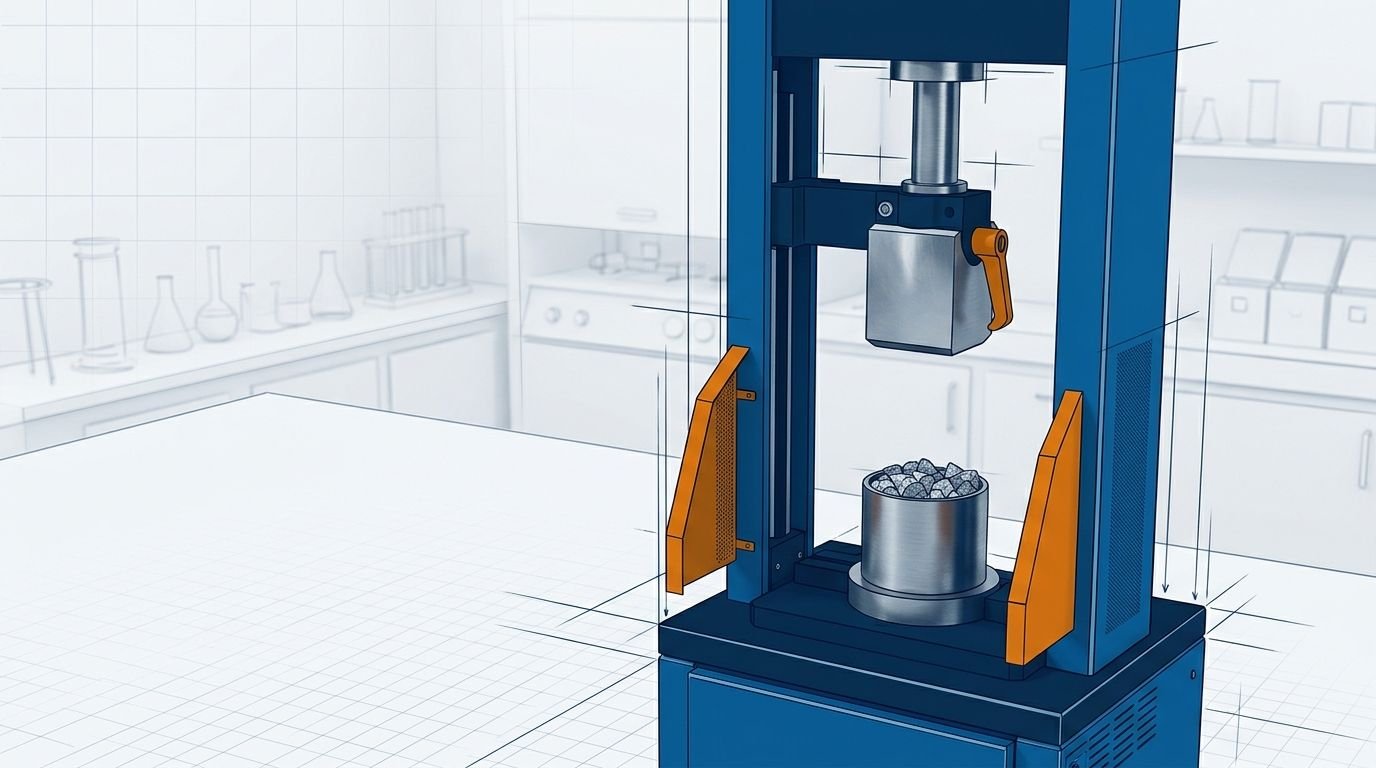
The aggregate impact value (AIV) measures an aggregate's resistance to sudden shock or impact loading — as distinct from the slow, steady load of the crushing test — and a lower value means a genuinely tougher aggregate that better absorbs sudden blows without breaking down. It's carried out under IS 2386 (Part 4) and is notably quicker to perform than the crushing test, which is one reason it's often used as a first-pass field check before a full crushing value test is arranged.
15 hammer blows
The standard impact loading
Fines ÷ total × 100
The AIV formula
≤ 30% wearing / ≤ 45% other
The two governing limits
Why impact resistance is a genuinely different property from crushing resistance
Aggregate used in roads and structural elements doesn't only experience steady, sustained loading — it also takes real sudden impact, from traffic passing over a road surface, from vibration and impact during compaction, and from rough handling during transport and placing. An aggregate that performs well under the crushing test's slow, gradually-increasing load can still perform poorly under sudden impact, because the two failure mechanisms genuinely stress the internal structure of the particle differently — which is exactly why the impact value test exists as a distinct, separate check rather than being assumed from the crushing value alone. The impact value specifically grades an aggregate's toughness against shock, complementing the crushing value rather than duplicating it.
The procedure, step by step (IS 2386 Part 4)
- 1
Sample preparation
Take aggregate passing a 12.5 mm sieve and retained on a 10 mm sieve, oven-dried
- 2
Fill the test cup
Fill the cup of the impact testing machine in layers, compacting each; record total weight W1
- 3
Apply the blows
Apply 15 blows of the standard hammer, each a genuine free fall onto the aggregate
- 4
Sieve the sample
Remove the sample from the cup and sieve it on a 2.36 mm sieve
- 5
Weigh the fines
Weigh the material passing the 2.36 mm sieve — the impact-generated fines — this is W2
The hammer must be allowed genuinely free fall for each of the 15 blows — any restraint on the fall understates the true impact delivered and skews the result.
Once both weights are recorded, the aggregate impact value is calculated directly:
Aggregate impact value (%) = W2 ÷ W1 × 100
Toughness classification, and the specification limits
A general toughness classification by AIV band — the two hard specification limits below still govern actual acceptance, regardless of which descriptive band a result falls in.
The AIV broadly grades toughness across these bands, but the two figures that actually govern acceptance on a real project are the specification limits:
Not more than 30% for aggregate used in concrete for wearing surfaces (roads, runways). Not more than 45% for other structural concrete.
A lower AIV consistently means a tougher aggregate, better able to withstand sudden shock without breaking down into weak fines that reduce the aggregate's effective size grading and structural contribution.
Why crushing value and impact value are checked together, not interchangeably
It's a common misunderstanding to treat the crushing and impact tests as redundant checks of "the same thing" simply because both produce a percentage-of-fines result using an almost identical 2.36 mm sieving step. In practice, an aggregate can genuinely pass one test comfortably while performing poorly on the other, since slow crushing resistance and sudden impact resistance stress the particle's internal structure in different ways — which is exactly why both are specified as separate, independent checks rather than one being accepted as a substitute for the other. Check the impact value alongside the crushing value and the flakiness and elongation index for particle shape, and refer to the IS 383 aggregates standard for the complete aggregate quality framework these tests sit within.
Frequently asked questions
What is the aggregate impact value test? It measures an aggregate's resistance to sudden impact loading. A sample is struck with 15 hammer blows in free fall, and the fines produced (passing a 2.36 mm sieve), expressed as a percentage of the original sample weight, is the impact value.
What is the limit of aggregate impact value? Not more than 30% for aggregate used in concrete for wearing surfaces (roads, runways), and not more than 45% for other structural concrete — the same governing limits used for the aggregate crushing value.
How many blows are given in the impact value test, and why does the free fall matter? Fifteen blows of the standard hammer are applied to the aggregate sample, each a genuine free fall onto the material — any restraint on that fall would understate the true impact energy delivered and produce a falsely low, unrepresentative result.
What is the actual difference between crushing value and impact value? The crushing value measures resistance to a slowly applied, gradually increasing compressive load; the impact value measures resistance to sudden shock delivered by hammer blows. Both are ultimately measured by sieving the resulting fines on a 2.36 mm sieve, but they stress the aggregate's internal structure in genuinely different ways and are not interchangeable.
What does a low aggregate impact value mean in practice? A low impact value means a genuinely tough aggregate that resists shock and sudden impact well, which is desirable for road surfaces subject to repeated traffic loading and for structural concrete exposed to handling and compaction impact during construction.
CivilSite Editorial Team✓ Engineer reviewed
Written and reviewed by practising civil engineers with 10+ years of Indian residential construction experience.