Types of Piles
Updated
A pile is a slender structural column driven or cast deep into the ground specifically to carry a building's load past a layer of weak soil down to a firmer stratum — and piles are classified along three genuinely independent axes: how they actually carry that load, what material they're made of, and how they're physically installed. This page sets out the main pile types, the deeper foundation detail sitting beneath the broader types of foundations discussion.
Carries load past weak soil
A pile’s fundamental job
End-bearing vs friction
How it actually carries load
Driven vs bored
How it is physically installed
By load transfer — how the pile actually carries the load
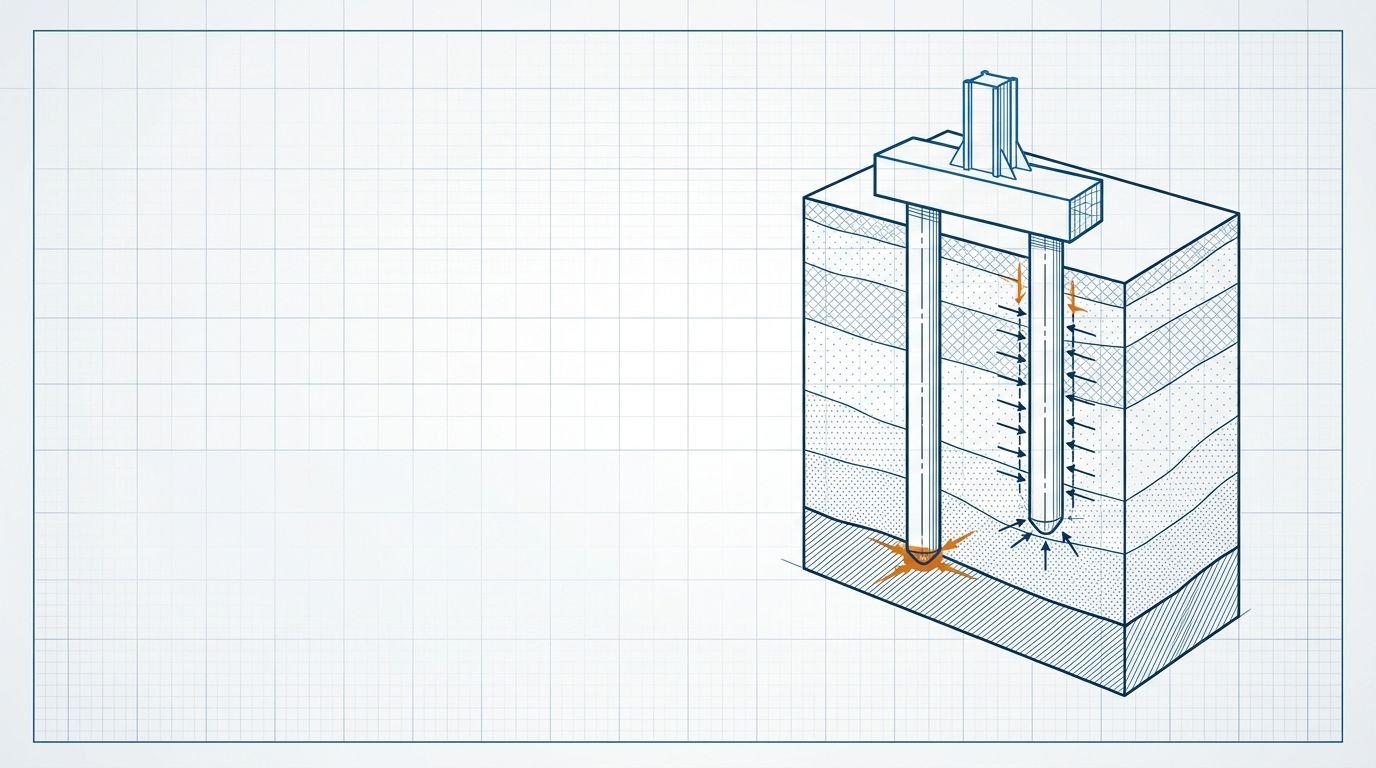
- End-bearing piles pass straight through soft, weak soil and rest their tip on a genuinely firm stratum below — rock, or a dense sand/gravel layer — carrying the load mainly at the tip, working structurally much like an ordinary column standing on firm ground rather than floating within soil.
- Friction piles carry the load through skin friction — the resistance generated along the pile's entire surface against the surrounding soil — used specifically where a firm bearing stratum lies too deep to reach economically. In practice, most piles carry load through some combination of both mechanisms rather than purely one or the other, but the dominant mechanism still determines how the pile is actually designed.
- End-bearing pile — tip resistance80%
- End-bearing pile — skin friction20%
Illustrative split between tip resistance and skin friction — the actual proportion depends on soil profile and pile length.
- Friction pile — skin friction85%
- Friction pile — tip resistance15%
A friction pile relies overwhelmingly on skin resistance since no firm bearing stratum is reached within economic depth.
By material
| Material | Notes |
|---|---|
| Concrete (RCC) | The most common pile type — either precast and driven, or cast-in-situ and bored |
| Steel | H-sections or hollow pipe sections; strong, driven to significant depth |
| Timber | Traditional, reserved for light loads and only below the permanent water table (to prevent decay) |
| Composite | Two materials joined into one pile, e.g. a concrete upper section over a steel lower section |
By installation method
- Driven (displacement) piles — precast concrete or steel piles hammered or vibrated into the ground, physically displacing the surrounding soil as they advance. This method is comparatively fast and gives immediate, verifiable driving resistance as a quality check, but generates real noise and vibration — a genuine constraint on sites near existing structures or in dense urban areas.
- Bored / cast-in-situ (replacement) piles — a hole is first bored to the required depth, reinforcement is lowered into it, and concrete is then cast in place. This method is markedly quieter and causes far less vibration, making it the practical choice for tight urban sites and where larger pile diameters or greater individual pile capacities are needed than driven piles can economically achieve.
A group of piles under one column is tied together at the top by a pile cap — a thick reinforced concrete block that spreads the column's load evenly across every pile in the group rather than loading any single pile disproportionately.
Why the choice between driven and bored is rarely just about cost
The driven-versus-bored decision is frequently framed as a simple cost comparison, but the genuine deciding factors are usually site constraints rather than price alone. Driven piling near an existing building risks vibration-induced settlement or cracking in that neighbouring structure — a real, documented risk on dense urban infill sites — which alone rules it out regardless of any cost advantage. Bored piling, conversely, requires the borehole to remain stable (often needing a temporary casing or drilling mud) until concrete is placed, which adds genuine technical complexity in loose, collapsing, or waterlogged soils where a driven pile would face no equivalent difficulty. The soil profile and the surrounding site conditions, not a simple cost table, are what actually decide which installation method is feasible before cost is even weighed.
Where piles are actually used instead of shallow footings
Piles are used specifically where the surface soil is weak, filled, or waterlogged, where the building's loads are unusually high (a high-rise, an industrial structure), or where a genuinely firm bearing stratum lies too deep for a shallow footing to reach economically — common in soft coastal and river-basin soils across parts of India. On reasonably good soil at shallow depth, footings remain cheaper and are the preferred choice; piling is a response to soil that footings genuinely cannot handle, not a default upgrade. Confirm the actual ground condition with a proper soil investigation and check the governing capacity with the soil bearing capacity calculator before assuming either shallow or deep foundations without site data.
Frequently asked questions
What are the types of piles used in foundation construction? By load transfer: end-bearing and friction piles. By material: concrete, steel, timber and composite piles. By installation: driven (displacement) and bored/cast-in-situ (replacement) piles.
What is the difference between end-bearing and friction piles? An end-bearing pile carries load mainly through its tip, resting on a firm stratum beneath weak soil. A friction pile carries load mainly through skin friction along its length against the surrounding soil, used where a firm bearing stratum is too deep to reach economically.
What is the difference between driven and bored piles? Driven piles are precast and hammered or vibrated into the ground, displacing soil as they go. Bored piles are cast in place within a pre-drilled hole, which is quieter, causes less vibration, and suits tight urban sites and larger pile diameters better than driven piling.
When are pile foundations used instead of ordinary footings? When the surface soil is weak, filled or waterlogged, when building loads are very high, or when a firm bearing stratum lies too deep for a shallow footing to reach economically. On reasonably good soil, shallow footings are cheaper and are used instead.
What is a pile cap, and why is it necessary? A pile cap is a thick reinforced concrete block that ties a group of piles together at the top and spreads the column's load evenly across every pile in that group, rather than allowing one pile in the group to carry a disproportionate share of the total load.
CivilSite Editorial Team✓ Engineer reviewed
Written and reviewed by practising civil engineers with 10+ years of Indian residential construction experience.