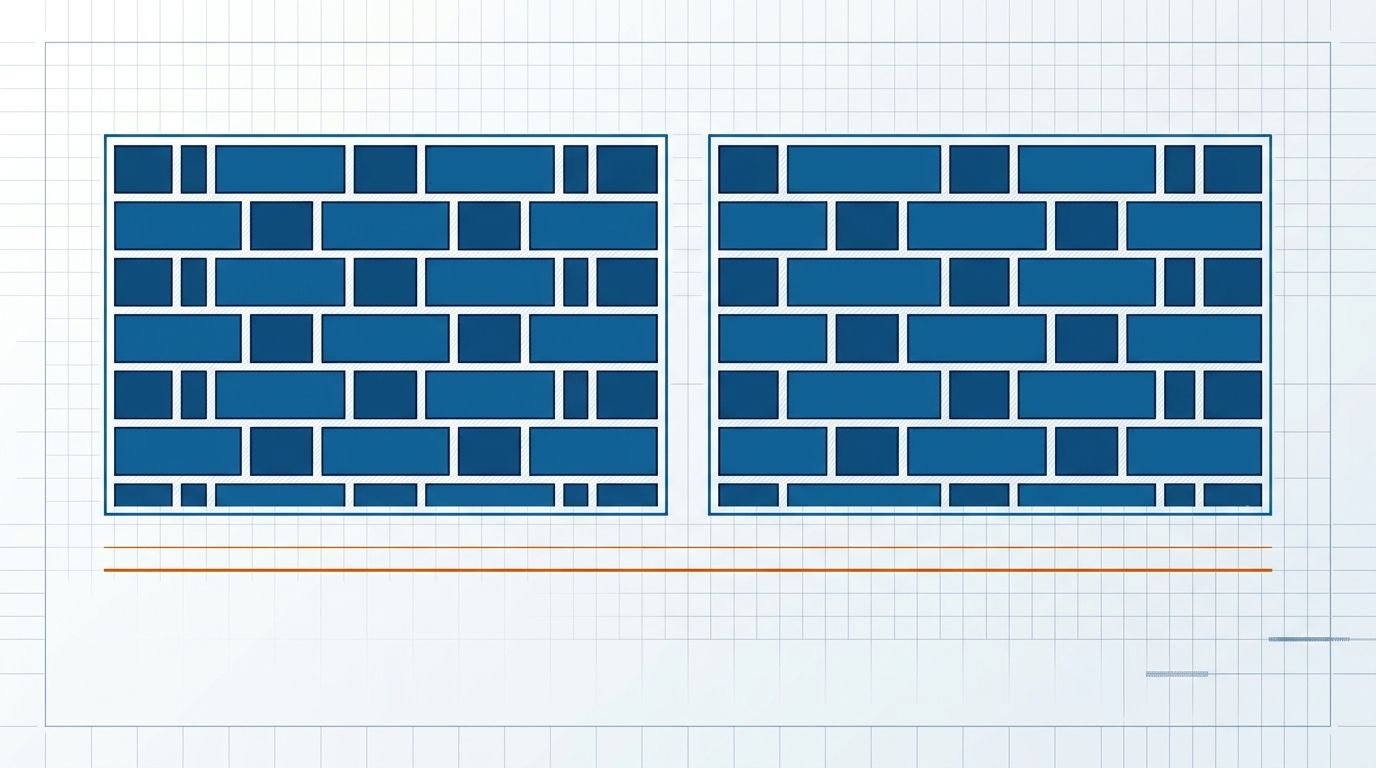
Types of Bonds in Brick Masonry
Updated
A "bond" is the deliberate pattern in which bricks are laid so that the vertical joints in one course never line up with the vertical joints in the course above — because a continuous vertical joint running through several courses creates a genuine weak plane the wall can crack or split along. The bond ties every brick into the surrounding bricks, turning individual units into one continuous structural mass. This page covers the common brick bonds actually used on Indian sites and exactly where each belongs.
Overlapping every joint
What a bond fundamentally does
Header + stretcher faces
The two brick orientations
English = strongest
For load-bearing walls
The two faces of a brick, and why the distinction matters
A brick can be laid showing either its long face — the stretcher — or its short end — the header — into the visible wall surface. Every bond pattern is simply a deliberate arrangement of these two orientations, laid course after course so that the joints in one course are broken (overlapped) by solid brick in the course directly above, rather than by another joint sitting exactly above the one below it.
Common brick bonds compared
Relative structural strength ranking for load-bearing brickwork, not an absolute engineering scale — actual strength depends on brick grade, mortar and workmanship.
| Bond | Arrangement | Where used |
|---|---|---|
| Stretcher bond | All bricks laid as stretchers, in every course | Half-brick (4½″) partition walls |
| Header bond | All bricks laid as headers, in every course | One-brick curved walls, footings |
| English bond | Alternate full courses of headers and of stretchers | Strongest — load-bearing one-brick walls |
| Flemish bond | Headers and stretchers alternating within each course | Good appearance; face and feature walls |
| Rat-trap bond | Bricks laid on edge, forming internal cavities | Economical, insulating walls |
English bond is considered the strongest of the common bonds and is the standard choice for load-bearing one-brick (9″) walls, since alternating full courses of headers and stretchers gives the maximum possible overlap between adjacent courses. Flemish bond trades a small amount of that strength for a more decorative, uniform appearance and uses fewer facing bricks per course, which is why it's frequently chosen for visible external face walls even on structures where English bond carries the actual load internally. Stretcher bond is reserved for thin half-brick walls, which describes most of the infill walls between the columns of an ordinary RCC-framed building — these walls carry only their own weight, not the building's structural load, so the lighter bond is entirely adequate. Rat-trap bond deliberately leaves cavities inside the wall by laying bricks on edge rather than flat, which genuinely reduces both brick and mortar consumption while improving the wall's thermal insulation — a real, functional trade rather than a purely decorative variant.
Rules that make a bond actually work structurally
- Break every vertical joint — a continuous straight vertical joint through two or more courses is the single defect a bond exists to prevent, and its presence anywhere in load-bearing brickwork is a genuine structural defect, not a cosmetic one.
- Lap by a quarter or half brick between successive courses, so that load applied at any point on the wall's top spreads sideways across multiple bricks below rather than concentrating on the ones directly beneath it.
- Use closers — specially cut partial bricks — at wall ends and corners specifically to maintain the bond pattern and the required lap right up to the wall's edge, rather than letting the pattern break down or leave an unsupported partial joint at the termination.
How the actual bond choice interacts with wall thickness
The bond isn't chosen independently of wall thickness — the two decisions are linked. A half-brick (stretcher-bond) wall is inherently only one brick-width thick and cannot physically accommodate a header running through it, which is exactly why stretcher bond is the only sensible choice for that thickness. A full one-brick wall has the depth to accommodate headers running through its thickness, which is what makes English and Flemish bond possible there in the first place — the header brick literally ties the two wythes of the wall together front-to-back, something a stretcher-only wall structurally cannot do. This is why upgrading a partition from half-brick to one-brick thickness for extra strength also genuinely changes which bonds become physically available for it, not merely which one looks better.
Estimate a wall's bricks and mortar requirement with the masonry calculator, and see brick sizes and types and the related comparison of brick vs block masonry for the broader masonry material choice these bonds get applied to.
Frequently asked questions
What are the types of bonds in brick masonry? Stretcher bond, header bond, English bond, Flemish bond and rat-trap bond are the common types used on Indian sites. Each arranges headers and stretchers so the vertical joints between courses are always overlapped rather than aligned.
Which brick bond is the strongest? English bond is generally considered the strongest of the common bonds and is the standard choice for load-bearing walls. It lays alternate full courses of headers and stretchers, which gives the maximum practical overlap and interlock between courses.
What is the difference between English and Flemish bond? English bond alternates entire courses of headers and stretchers and is structurally stronger. Flemish bond alternates headers and stretchers within each individual course, giving a more decorative, uniform appearance at a small cost in overall strength — which is why it's often chosen for visible face walls.
Why is a bond necessary in brickwork at all? Because a continuous, unbroken vertical joint running through multiple courses creates a genuine weak plane the wall can crack or split along under load. A bond deliberately overlaps every joint so the bricks act together as one continuous mass rather than as loosely stacked, independent columns.
What is a stretcher bond used for, and why not English bond everywhere? Stretcher bond, with all bricks laid lengthwise, is used for half-brick (4½″) partition and infill walls — the walls between the columns of a framed building, which carry only their own weight. English bond needs the full one-brick thickness to accommodate headers running through the wall, so it simply isn't physically achievable on a thinner half-brick partition regardless of whether extra strength is wanted there.
CivilSite Editorial Team✓ Engineer reviewed
Written and reviewed by practising civil engineers with 10+ years of Indian residential construction experience.