Los Angeles Abrasion Test
Updated
The Los Angeles abrasion test measures how well an aggregate resists being worn down by the combined action of grinding and impact — a property that genuinely matters most for road surfaces, where passing traffic constantly abrades the exposed stone. A lower LA value means a harder, more wear-resistant aggregate. The test follows IS 2386 (Part 4), and it's distinct from the crushing and impact tests because it measures resistance to sustained abrasion rather than a single crushing load or a single impact blow. This page explains what it measures, the procedure, and the limits that govern aggregate acceptance.
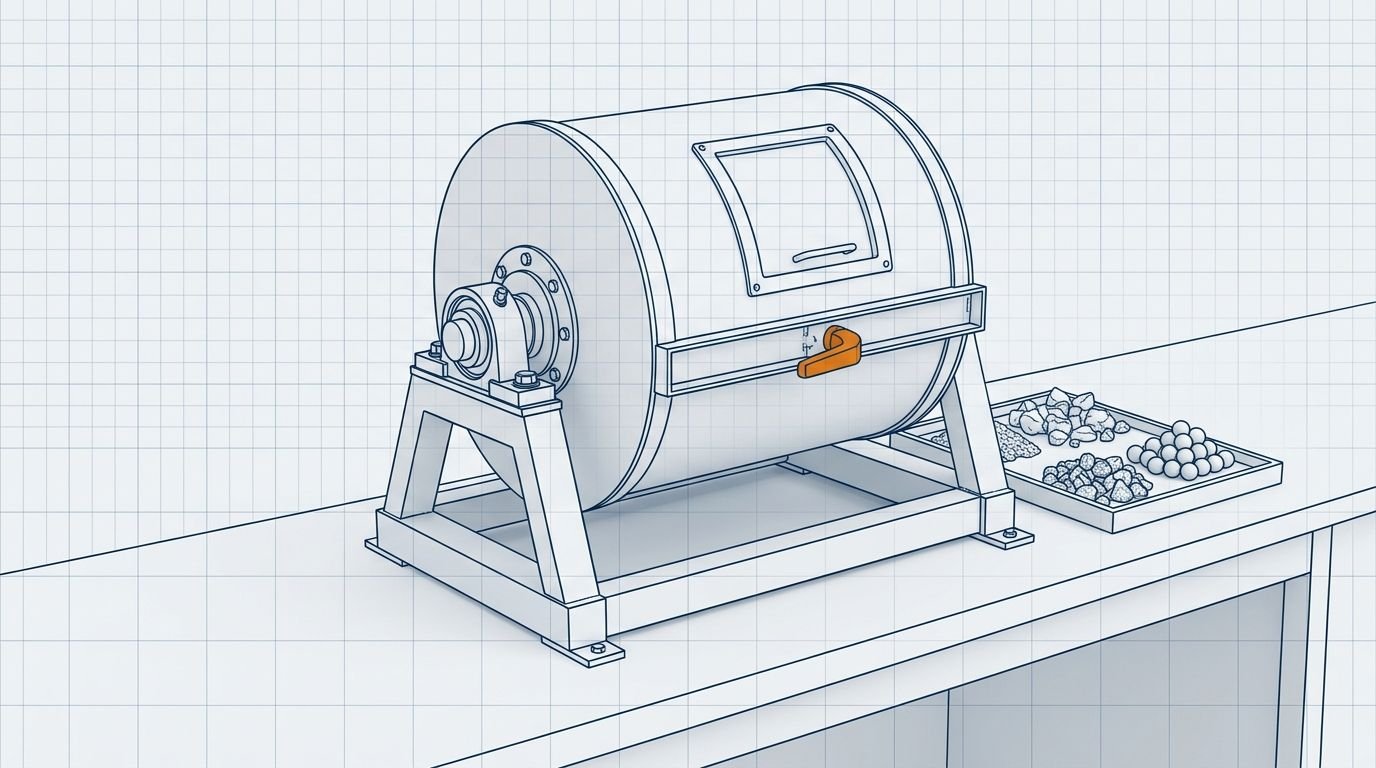
Steel balls in a rotating drum
The abrasive charge
Fines ÷ total × 100
The LA value formula
≤ 30% wearing / ≤ 50% other
The governing limits
Why abrasion resistance is a genuinely distinct property
Aggregate exposed in a road surface isn't just loaded and impacted — it's continuously ground and abraded by the passage of traffic, day after day, for years. Weak or soft stone gradually wears away under this sustained grinding action, and as it does, the road surface deteriorates, ravels and ultimately fails. The Los Angeles test grades this specific abrasion resistance, and it genuinely complements — rather than duplicates — the crushing value (resistance to a slow, steady load) and impact value (resistance to a single sudden shock), since an aggregate can perform acceptably on those two tests yet still wear away too readily under the prolonged grinding the LA test specifically simulates.
The test procedure (IS 2386 Part 4)
- 1
Prepare the graded sample
Take a graded aggregate sample of known weight W1 and place it in the Los Angeles drum
- 2
Add the steel-ball charge
Add the specified charge of steel balls — the number depends on the aggregate grading
- 3
Rotate the drum
Rotate at the set speed for the specified revolutions (commonly 500–1,000), tumbling aggregate and balls together
- 4
Sieve the sample
Remove the sample and sieve it on a 1.7 mm sieve
- 5
Weigh the worn-away fines
Weigh the fines passing the 1.7 mm sieve — the material abraded away — this is W2
The number of steel balls in the charge and the number of revolutions both depend on the aggregate grading being tested — using the wrong charge for the grading invalidates the result.
Los Angeles abrasion value (%) = W2 ÷ W1 × 100
The specification limits
Road and runway wearing surfaces carry the tighter limit since their aggregate is directly exposed to continuous traffic abrasion; buried structural aggregate is not.
For aggregate used in concrete for wearing surfaces (roads, runways), the LA value should not exceed about 30%. For other, non-wearing concrete, up to about 50% may be allowed.
The much tighter limit for wearing surfaces reflects exactly what the test simulates: aggregate exposed at a road surface takes the full brunt of continuous traffic abrasion, whereas aggregate buried within a structural concrete member never experiences that grinding action at all, so the durability demand on it is genuinely lower. A lower LA value consistently indicates a harder, tougher aggregate that resists wear.
Why the LA test rounds out the aggregate strength picture
The three aggregate strength-and-durability tests each capture a genuinely different mode of degradation, and it's worth being clear on how the LA test fits: the crushing value answers "does it survive a slow, heavy load?", the impact value answers "does it survive a sudden shock?", and the Los Angeles abrasion value answers "does it survive prolonged grinding and wear?". For road-surfacing aggregate in particular, that third question is often the most decisive of the three, since traffic abrasion is the dominant degradation mechanism a road surface actually faces over its life. Read it alongside the other two tests and the IS 383 aggregates standard.
Frequently asked questions
What is the Los Angeles abrasion test? It measures an aggregate's resistance to abrasion by tumbling it together with a charge of steel balls in a rotating drum, then finding the percentage worn away (passing a 1.7 mm sieve). A lower value means a harder, more wear-resistant aggregate.
What is the limit of the Los Angeles abrasion value? About 30% maximum for aggregate used in wearing surfaces such as roads and runways, and up to about 50% for other, non-wearing concrete — the tighter limit reflecting the continuous traffic abrasion a road surface actually faces.
How is the LA abrasion value calculated? It's the weight of fines produced (the material passing the 1.7 mm sieve after tumbling) divided by the original sample weight, multiplied by 100 — expressed as W2 ÷ W1 × 100.
Why is the abrasion test especially important for roads? Because passing traffic constantly grinds and abrades the exposed road surface, and aggregate with poor abrasion resistance simply wears away over time, causing the surface to deteriorate. That's why the LA value is tightly limited specifically for road-surfacing aggregate.
What does a low Los Angeles abrasion value mean? A low LA value indicates a hard, tough aggregate that resists grinding and impact well over sustained exposure — desirable for durable road surfaces and long-lasting concrete alike.
CivilSite Editorial Team✓ Engineer reviewed
Written and reviewed by practising civil engineers with 10+ years of Indian residential construction experience.