Types of Waterproofing
Updated
Waterproofing keeps water out of the parts of a building it would otherwise ruin — terraces, bathrooms, sunk slabs, water tanks and basements — and the actual method chosen is a direct response to where the water is and, critically, how much pressure it's under, not a single universal product applied everywhere. Water merely pooling on a flat roof needs a fundamentally different defence than water pushing sideways against a basement wall below the water table. This page covers the waterproofing methods actually specified on Indian residential drawings and exactly which exposure each is built for.
Keep water out, at the source
The underlying job
Surface ponding vs hydrostatic pressure
What decides the method
Terrace · bathroom · tank · basement
The four recurring wet zones
Common waterproofing methods
| Type | What it is | Where used |
|---|---|---|
| Integral (admixture) | A waterproofing compound mixed directly into the concrete or mortar | Slabs, tanks, plaster — the first line of defence |
| Cementitious coating | A cement-polymer slurry brushed onto the surface | Bathrooms, tanks, sunk slabs |
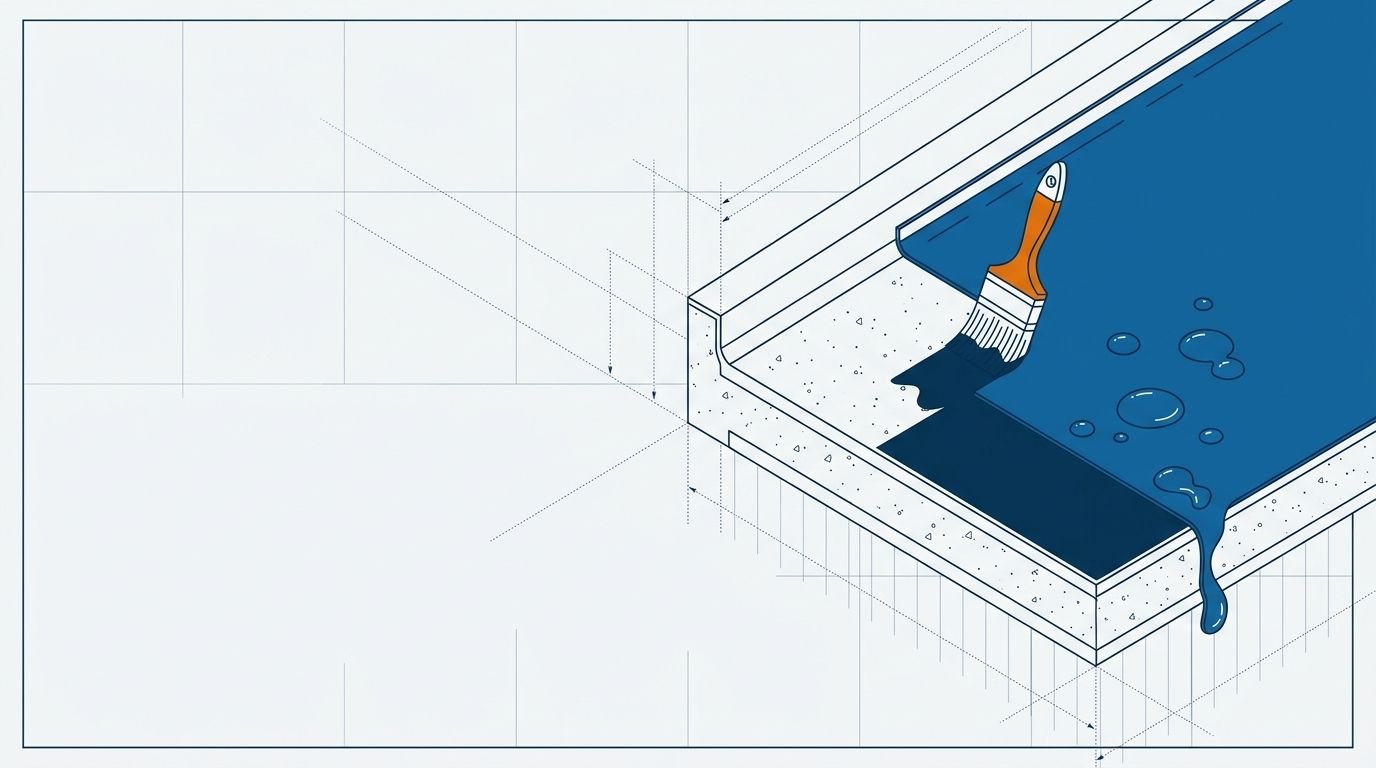
| Liquid-applied (acrylic/PU) | A liquid membrane rolled or brushed on, curing to a seamless film | Terraces, balconies, bathrooms |
| Bituminous membrane (APP/SBS) | Torch-applied or self-adhesive bitumen sheets | Terraces, basements, foundations |
| Crystalline | Chemicals that grow crystals inside concrete, blocking its pores | Water tanks, basements, retaining walls |
| Box-type | A continuous membrane wrapping the entire basement structure | Basements sitting below the water table |
- 1
Surface preparation
Clean the slab, remove loose material and repair any cracks or honeycombing
- 2
Screed to slope
Lay a sloped screed so water actually drains to the outlet instead of ponding
- 3
Apply the membrane
Liquid-applied or bituminous membrane, in the required number of coats/layers
- 4
Protect the membrane
A protective screed or tile layer over the membrane, since it is easily punctured
- 5
Flood test
Pond water on the surface for 24–48 hours before handover, checking the ceiling below for leaks
The screed-to-slope step is frequently skipped on budget jobs — it is the step most responsible for waterproofing failing prematurely.
Where each method actually gets used, and why
- Terrace / roof → liquid-applied (acrylic or PU) or a bituminous membrane, always laid over a screed built to a genuine fall so ponded water actually drains to an outlet rather than sitting on the membrane indefinitely — standing water is what eventually finds and exploits any weak point in a membrane, so the slope matters as much as the membrane material itself.
- Bathrooms & sunk slabs → cementitious coating and integral waterproofing, applied before tiling, since the water exposure here is intermittent but the finished surface (tile) makes any later repair genuinely disruptive.
- Water tanks → integral waterproofing in the concrete itself, plus crystalline or cementitious coating on the inner faces, because a tank holds standing water under constant, sustained contact and simply cannot be allowed to leak at all.
- Basements below groundwater → box-type membrane or crystalline waterproofing specifically built to resist hydrostatic pressure — water actively pushing inward against the structure, not merely sitting on a surface — which is a fundamentally more demanding exposure than any of the above.
Surface ponding vs hydrostatic pressure — the distinction that actually governs the choice
The single biggest factor separating a light waterproofing treatment from a heavy-duty one is whether the water is merely ponding on a surface (a terrace, a bathroom floor) or actively pushing under pressure against a structural element (a basement wall below the water table, a water tank holding a full head of water). Ponding water waits passively for a weak point; pressurised water actively forces its way through any gap, crack, or pinhole in a membrane, which is exactly why basement and tank waterproofing use more robust, continuous systems — box-type membranes or crystalline treatments that work through the concrete itself — rather than the surface-applied coatings adequate for a terrace. Integral waterproofing, mixed directly into the concrete, forms the base defence common to nearly every application in the table above, with a surface membrane or coating layered on top specifically where the exposure is worse than integral treatment alone can handle.
How waterproofing differs from a damp-proof course
Waterproofing is often confused with a DPC (damp-proof course), but the two solve genuinely different problems. A DPC is a thin horizontal barrier laid at plinth level specifically to stop rising capillary damp — groundwater wicking upward through masonry via capillary action, a slow, continuous process independent of any ponding or pressure. Waterproofing, by contrast, resists water that is ponding on a surface or actively pushing under pressure at a specific location — a terrace, a bathroom, a tank, a basement wall. A house genuinely needs both: a DPC to stop damp rising from the ground into the walls, and waterproofing at every location where water directly contacts a surface or structural element from above or from the side. For current market rates, see the waterproofing cost page.
Frequently asked questions
What are the types of waterproofing? Integral (admixture), cementitious coating, liquid-applied (acrylic/PU) membrane, bituminous membrane, crystalline and box-type waterproofing. Each suits a different type and severity of water exposure.
Which waterproofing is best for a terrace? A liquid-applied acrylic or polyurethane membrane, or a torch-applied bituminous membrane, laid over a sloped screed so water actually drains rather than pooling. Integral waterproofing mixed into the slab concrete itself acts as a useful first line of defence underneath it.
What is integral waterproofing, and why is it used almost everywhere? Integral waterproofing is a compound mixed into the concrete or mortar itself, making the material more water-resistant from within rather than relying purely on a surface coating. It forms the base layer of protection common to slabs, tanks and plaster, with a surface treatment added on top wherever the exposure demands more.
Which waterproofing is used for water tanks, and why does it need more than one method? Integral waterproofing in the concrete, combined with a crystalline or cementitious coating on the inner faces, because a tank holds standing water in constant, sustained contact and genuinely cannot be allowed to leak — a single method alone is rarely considered adequate margin for that exposure.
Is waterproofing the same as a DPC? No. A DPC stops rising capillary damp at plinth level through a slow, continuous wicking process, while waterproofing resists water ponding on a surface or actively pushing under pressure at terraces, bathrooms, tanks and basements. A house typically needs both, addressing two genuinely different water paths into the structure.
CivilSite Editorial Team✓ Engineer reviewed
Written and reviewed by practising civil engineers with 10+ years of Indian residential construction experience.