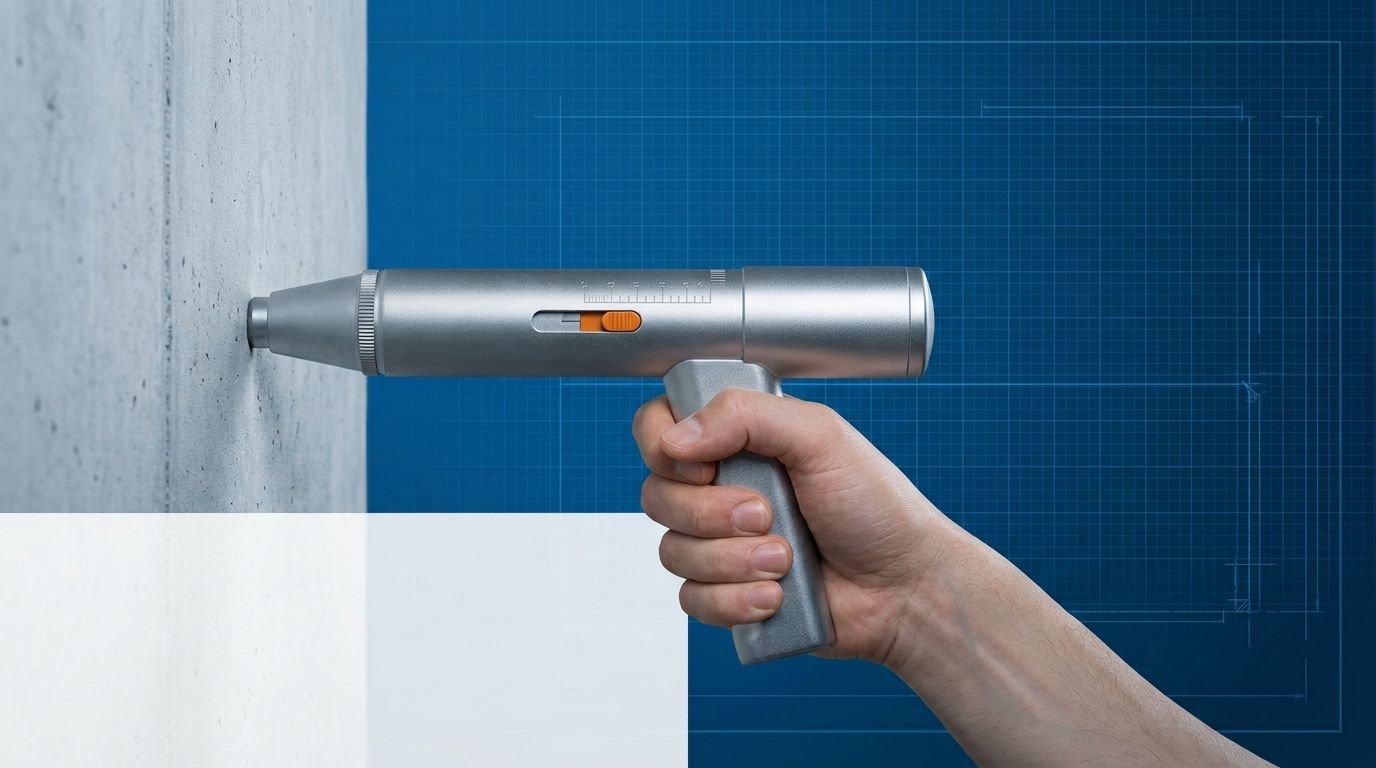
Rebound Hammer Test
Updated
The rebound hammer test estimates the strength of hardened concrete without damaging the structure at all — a spring-loaded hammer strikes the concrete surface, and how far the mass rebounds indicates the surface hardness and, through a calibration curve, the estimated compressive strength. It's a non-destructive test (NDT) governed by IS 13311 (Part 2), and its central appeal is exactly that: assessing existing, in-place concrete without coring or breaking anything, which matters enormously when the concrete under question is already part of a completed structure.
Non-destructive (NDT)
No coring, no structural damage
Rebound number → strength
Via a calibration curve
Reads surface hardness only
The test’s central limitation
How the instrument actually works
Inside the Schmidt (rebound) hammer, a spring-loaded mass strikes a plunger held firmly against the prepared concrete surface. A hard, genuinely strong concrete surface absorbs comparatively little of the impact energy, so the mass rebounds further; a soft, weaker or more porous surface absorbs more of that energy, so the mass rebounds less. The rebound number (R) is read directly off the instrument's built-in scale and is then converted to an estimated compressive strength using the instrument's own calibration curve — a relationship the manufacturer establishes empirically between rebound number and known concrete strength, which is why a hammer's calibration curve genuinely matters and periodic re-calibration against known reference specimens is standard practice.
The procedure, step by step (IS 13311 Part 2)
- 1
Select and prepare the surface
Choose a smooth, clean, dry area; grind off plaster, paint or loose material
- 2
Position the hammer
Hold the hammer perpendicular to the surface and press steadily until it fires
- 3
Take multiple readings
Take commonly 10–12 readings spread over the test area, spaced apart
- 4
Discard outliers
Discard readings that deviate significantly from the cluster before averaging
- 5
Read the calibration chart
Convert the averaged rebound number to estimated strength using the chart for that hammer angle
Discarding outlier readings before averaging is not optional housekeeping — a single anomalous reading (from a hidden aggregate particle or a surface void directly under the plunger) can meaningfully skew the estimated strength if included.
What genuinely affects the reading, beyond the concrete's actual strength
- Surface condition — roughness, residual moisture, and surface carbonation (a natural chemical change in the outer layer of older concrete) all shift the rebound number independent of the concrete's true internal strength, which is exactly why surface preparation before testing matters as much as the test itself.
- Hammer angle — readings genuinely differ between horizontal strikes, upward strikes and downward strikes purely due to gravity's effect on the internal spring mechanism, which is why the calibration chart provides separate correction curves for each orientation rather than a single universal curve.
- Aggregate directly beneath the plunger — if the plunger happens to strike directly over a hard aggregate particle just beneath the surface, that single reading reads artificially high compared to the concrete's true average strength — exactly the kind of anomaly the outlier-discarding step in the procedure exists to catch.
Why the rebound hammer is best treated as a screening tool, not a final verdict
Because the test physically measures only the surface hardness of the concrete — the plunger never penetrates more than a few millimetres — the rebound hammer is genuinely best used for comparing uniformity across a structure and for screening areas that warrant closer investigation, rather than as the sole, final measure of a structure's strength. A structure showing consistent rebound readings across its surface is likely uniformly cast and cured; a structure with erratic, widely varying readings across otherwise similar elements flags areas that deserve further investigation — but neither conclusion should be treated as a substitute for direct strength verification where it genuinely matters. It's routinely paired with the ultrasonic pulse velocity method (which probes deeper into the concrete rather than just the surface) and confirmed against the cube test or extracted cores wherever the strength assessment carries real structural or legal consequence — see IS 456 plain and reinforced concrete for the broader code context this NDT method sits within.
Frequently asked questions
What is the rebound hammer test? It is a non-destructive test that estimates the strength of hardened concrete by striking the surface with a spring-loaded hammer and reading how far it rebounds — the rebound number, which correlates with surface hardness and, via a calibration curve, with compressive strength.
How does a rebound hammer actually work? A spring-loaded mass strikes a plunger held against the concrete surface. A harder, stronger surface absorbs less impact energy and makes the mass rebound further, giving a higher rebound number, which is converted to an estimated strength using the instrument's own calibration curve.
What is the rebound hammer test typically used for? For assessing concrete uniformity and quality without any structural damage, screening suspect or questionable areas for closer investigation, and estimating in-situ strength — almost always alongside other confirmatory tests, not as the sole measure.
What factors affect the rebound hammer reading, beyond the concrete's true strength? Surface roughness and residual moisture, surface carbonation, the angle the hammer is held at, and any hard aggregate particle sitting directly beneath the plunger all affect the rebound number independent of the concrete's actual strength, which is why multiple readings are taken, outliers discarded, and the angle correction applied before interpreting a result.
Is the rebound hammer test accurate enough to rely on alone? It gives a genuinely useful estimate and is excellent for comparing uniformity across a structure, but because it reads only the surface, critical strength assessments with real structural consequence are confirmed with cube tests or extracted cores rather than relying on the rebound number alone.
CivilSite Editorial Team✓ Engineer reviewed
Written and reviewed by practising civil engineers with 10+ years of Indian residential construction experience.