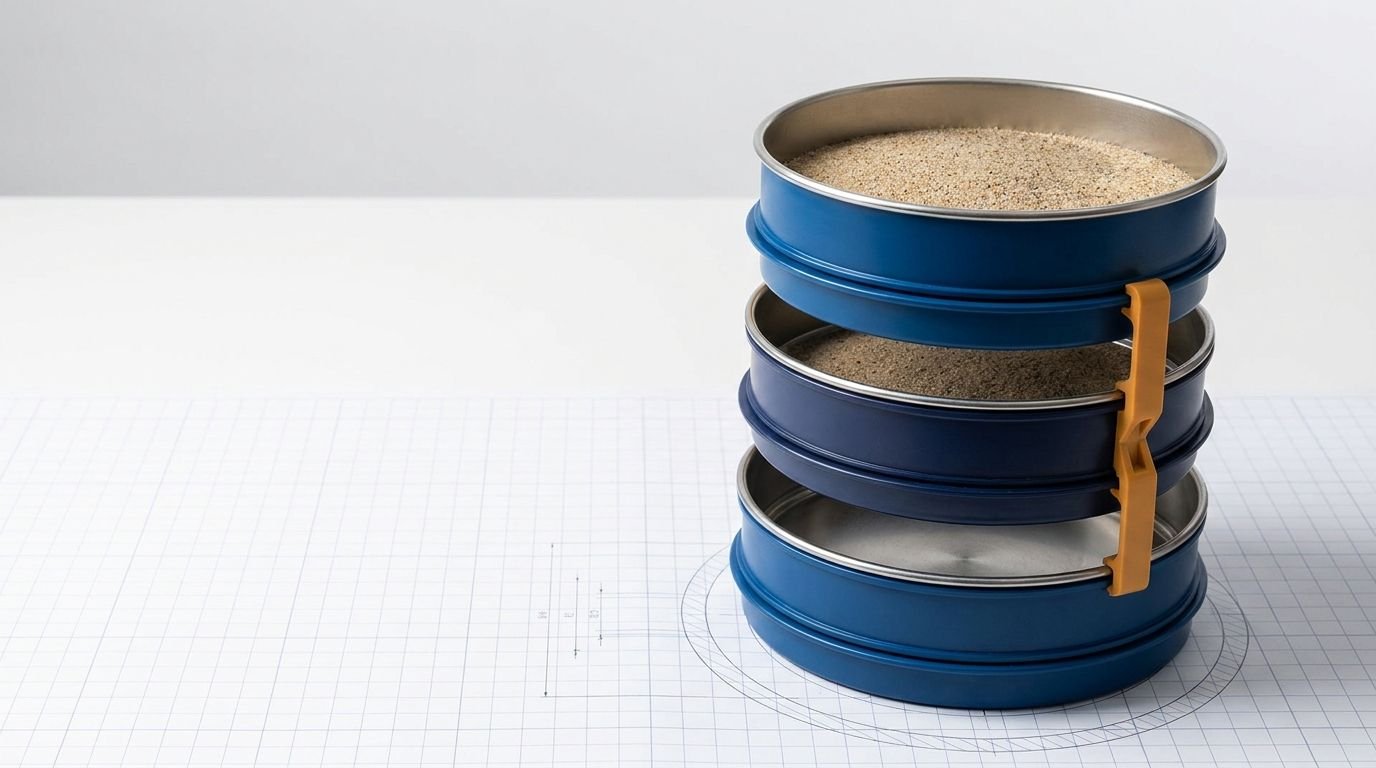
Sieve Analysis of Fine Aggregate
Updated
Sieve analysis grades sand by passing a dry sample through a nested stack of standard sieves and weighing exactly what stays on each one — the result gives two numbers, the fineness modulus and the grading zone, that together predict how well the sand will actually perform in concrete before you ever mix a single batch. It follows IS 2386, with the grading-zone classification defined by IS 383.
4.75 mm → 150 micron
The standard sieve set
FM = Σ cum. % retained ÷ 100
Fineness modulus formula
Zones I–IV
The four grading bands
Why sand's particle-size spread matters more than its average size
It's tempting to think of sand quality as simply "fine" versus "coarse," but that misses the actual engineering point. What matters most for concrete is how well-graded the sand is — whether it contains a good spread of particle sizes from coarse down to fine, so smaller grains fill the gaps between larger ones and the whole mass packs densely with minimal voids between particles. Poorly graded sand — say, mostly one narrow size range with almost nothing in between — leaves larger gaps that then have to be filled with extra cement paste instead of sand, which is both more expensive and can make the mix harsher and less workable. Sieve analysis is how that grading is actually quantified, rather than judged by eye.
The test procedure
- 1
Take a dry sample
Oven-dry a representative sand sample (commonly 1,000 g) to remove all moisture, which would otherwise cause particles to clump and distort the sieving.
- 2
Stack the sieves
Arrange the standard IS sieves — 4.75 mm, 2.36 mm, 1.18 mm, 600 μm, 300 μm and 150 μm — in order from coarsest on top to finest at the bottom, with a collecting pan underneath.
- 3
Sieve the sample
Pour the sample onto the top sieve and shake the stack (by machine or by hand) for a set duration until no significant further material passes through.
- 4
Weigh each retained fraction
Weigh the sand retained on each individual sieve, plus what collects in the bottom pan.
- 5
Calculate percentages
Work out the percentage retained on each sieve, then the cumulative percentage retained down the stack, and the percentage passing each sieve.
- 6
Derive fineness modulus and zone
Sum the cumulative percentages retained and divide by 100 for the fineness modulus; compare the percentage-passing profile against the IS 383 tables to identify the grading zone.
Fineness modulus — turning a size distribution into one number
The fineness modulus (FM) compresses an entire particle-size distribution into a single comparable number:
Fineness modulus = (sum of cumulative percentages retained on the standard sieves) ÷ 100
A higher FM means, on average, the sand's particles skew coarser; a lower FM means they skew finer. For fine aggregate suitable for concrete, FM typically falls between about 2.2 and 3.2 — sand near the finer end (2.2–2.6) suits plastering and finer finishing work, while sand toward the coarser end (2.9–3.2) is generally preferred for structural concrete, where it packs more efficiently against the coarse aggregate.
The four grading zones (IS 383)
Illustrative FM bands for each zone — the actual zone classification is determined by comparing the full percentage-passing profile against the IS 383 grading limit tables at each sieve size, not by fineness modulus alone.
IS 383 formally classifies sand into four grading zones (I to IV) based on the full percentage passing each individual sieve — Zone I is the coarsest overall grading, Zone IV the finest. Zones I through III are generally considered suitable for concrete work without special adjustment; Zone IV sand, being very fine, tends to raise the water and cement demand of a mix noticeably and needs extra care in proportioning if used.
What a well-graded vs poorly-graded result actually means on site
| Grading result | What it means in practice |
|---|---|
| Well-graded, smooth distribution across sieves, FM ~2.6–3.0, Zone II | Good general-purpose concrete sand — packs efficiently, workable mix |
| Gap-graded (missing a whole size range) | Leaves voids that must be filled with extra cement paste — costlier, potentially harsher mix |
| Too fine overall (Zone IV, low FM) | Higher water and cement demand, more drying shrinkage risk |
| Too coarse overall (very high FM) | Harsh, less cohesive mix, prone to segregation and bleeding |
Sieve analysis should always be run alongside a check for silt content — grading and cleanliness are two separate quality questions, and sand can be well-graded yet still unusable if it's carrying too much clay and dust (see M-sand vs river sand for the silt-content field test). Pair this with the IS 383 aggregates standard for the full tabulated grading limits, and estimate quantities with the concrete calculator.
Frequently asked questions
What is sieve analysis of fine aggregate? It is grading sand by passing a dry, weighed sample through a stack of standard sieves (4.75 mm down to 150 μm) and weighing what's retained on each, to determine the fineness modulus and identify which of the four IS 383 grading zones the sand falls into.
How do you calculate fineness modulus? Add up the cumulative percentages retained on each of the standard sieves and divide the total by 100. A higher resulting value indicates coarser sand overall; a lower value indicates finer sand.
What is the fineness modulus of good concrete sand? Typically between about 2.6 and 3.0 for general structural concrete, corresponding to Zone II sand under IS 383 — though sand from 2.2 up to 3.2 across all four zones can be used with appropriate mix adjustments.
What are the grading zones of sand? IS 383 defines four zones, I through IV, ranked from coarsest (Zone I) to finest (Zone IV) overall grading, based on the percentage of material passing each standard sieve. Zones I to III generally suit concrete directly; Zone IV is very fine and needs extra care in mix proportioning.
Why is sieve analysis important for concrete quality? Well-graded sand — with a good spread of particle sizes — packs densely with fewer voids between grains, needing less cement paste and water for a given workability, which gives stronger, more economical and more durable concrete than poorly graded or gap-graded sand.
What happens if sand is gap-graded? Gap-graded sand is missing a significant portion of one or more particle-size ranges, leaving voids that have to be filled with extra cement paste rather than sand itself — this typically increases cost, can make the mix harsher to work, and may increase shrinkage.
Can sieve analysis be done on site without a lab? A basic version can be done with a set of standard sieves and a scale, which many well-equipped sites keep on hand for quick checks, but precise, code-compliant sieve analysis with proper machine shaking and calibrated sieves is normally performed at a materials-testing laboratory.
CivilSite Editorial Team✓ Engineer reviewed
Written and reviewed by practising civil engineers with 10+ years of Indian residential construction experience.