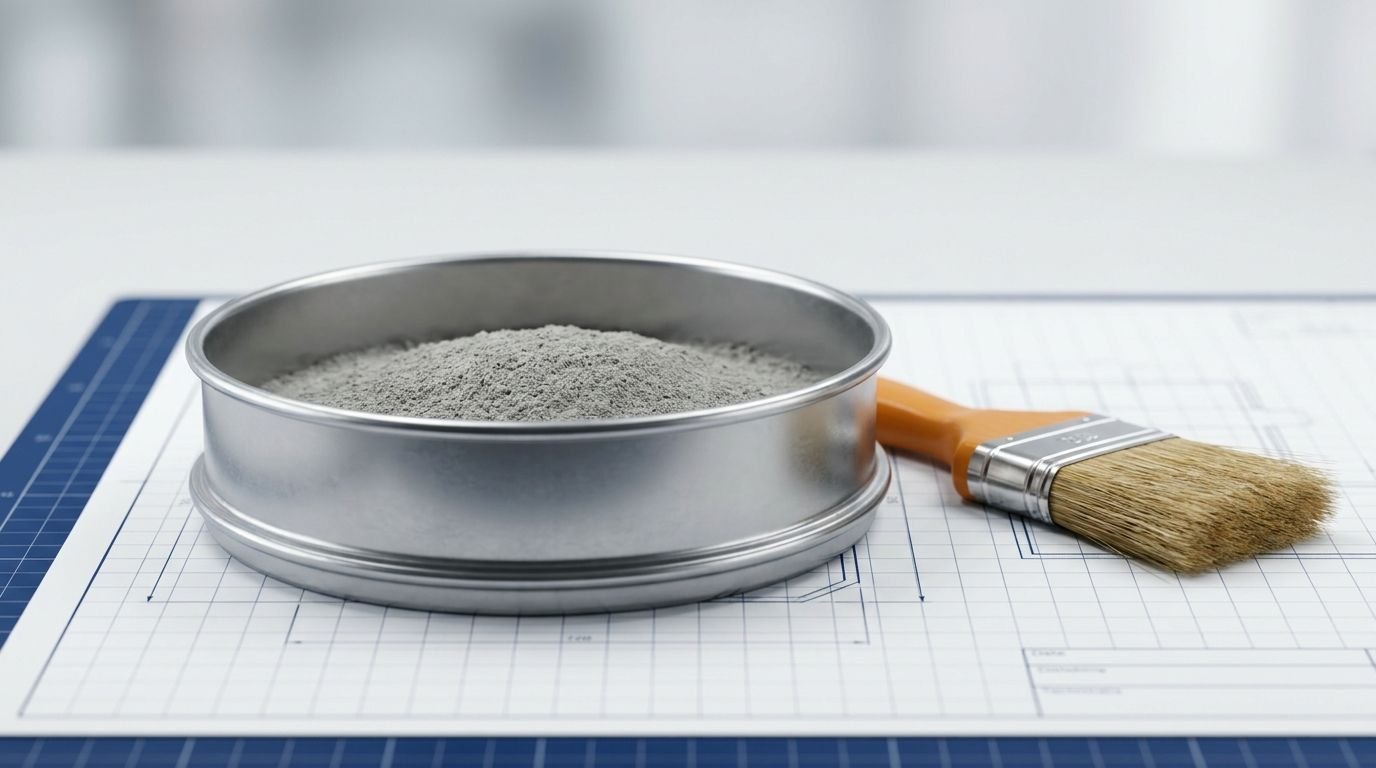
Fineness Test of Cement
Updated
The fineness test measures how finely cement has been ground — and that single physical property quietly controls how fast it sets, how much strength it gains early on, and how much heat it generates while doing so. Fineness is checked either by sieving on a 90-micron sieve for a quick field check, or more precisely by the Blaine air-permeability method used in cement quality-control labs, both under IS 4031.
90-micron sieve
Dry sieving method
Residue ≤ 10%
For OPC
Blaine (m²/kg)
Specific surface
Why fineness controls almost everything else about a cement
Cement doesn't react with water as a solid lump — it reacts at the surface of each individual grain, where water molecules can actually reach the reactive compounds inside. Grind the same mass of clinker finer, and you dramatically increase its total surface area exposed to water, without changing its chemical composition at all. That single change cascades into several real behavioural differences:
- Faster hydration — more exposed surface means the chemical reaction gets underway faster across the whole batch.
- Higher early strength — because more of the cement is actively reacting sooner, strength develops faster in the first days after casting.
- Faster setting — the same surface-area effect speeds up the stiffening of the fresh paste.
- More heat of hydration — faster reaction releases its heat over a shorter time window, so the temperature rise (and the thermal-cracking risk in thick pours) is more pronounced.
- More drying shrinkage, if taken too far — very fine cement demands more water for workability, and that extra water eventually has to leave the concrete, taking volume with it.
Fineness is therefore a genuine engineering trade-off that cement manufacturers control deliberately, not a simple "finer is always better" parameter — IS 4031 specifies both a minimum practical fineness (so the cement reacts adequately) and, implicitly through other property limits, keeps it from being ground so fine that shrinkage and heat become problems.
Method 1 — dry sieving (IS 4031 Part 1)
- 1
Weigh the sample
Take exactly 100 g of the cement sample to be tested, free of lumps.
- 2
Place on the sieve
Transfer the sample onto a clean, dry 90-micron IS sieve.
- 3
Sieve continuously
Sieve by gentle wrist agitation for about 15 minutes, periodically breaking up any air-set lumps with a soft brush, without forcing material through the mesh.
- 4
Weigh the residue
Carefully weigh the material remaining on the sieve after sieving is complete.
- 5
Calculate the fineness
Fineness (residue %) = weight of residue ÷ 100 (original sample weight) × 100.
The residue on the 90-micron sieve should not exceed 10% by mass for ordinary Portland cement. A higher residue indicates coarser grinding — meaning slower reaction, lower early strength, and slower setting than a properly fine-ground cement of the same type.
Method 2 — Blaine air permeability (IS 4031 Part 2)
The sieve test is a useful field check, but it can't distinguish between cements that are both under 10% residue — a huge range of genuinely different fineness levels all pass the same simple threshold. The Blaine apparatus solves this by measuring specific surface area directly: a compacted bed of cement of known mass and density is placed in a permeability cell, and the apparatus times how long a fixed volume of air takes to pass through it under a controlled pressure drop. Finer cement packs a denser network of smaller pores, which resists airflow more — so a longer air-passage time corresponds to a finer, higher-surface-area cement. The result is expressed in square metres per kilogram (m²/kg), and this is the number that actually appears on a cement manufacturer's quality certificate, because it's far more discriminating than a pass/fail sieve residue.
What the results mean in practice
| Fineness indicator | What it tells you |
|---|---|
| High residue on 90-micron sieve (near or above 10%) | Coarse cement — slower strength gain, slower set |
| Low residue, well under 10% | Reasonably fine cement, adequate reactivity |
| Low Blaine specific surface (m²/kg) | Coarser grinding — confirmed quantitatively |
| High Blaine specific surface (m²/kg) | Very fine cement — fast strength gain, but watch heat and shrinkage |
Fineness works alongside the other core cement tests to build a full quality picture: consistency establishes the reference water content, setting time confirms the cement stiffens and hardens within acceptable windows, and soundness checks it won't expand destructively after setting. None of these tests alone tells the full story — a cement lab runs all of them together on every batch. See the cement types under IS 269 / IS 1489 for how fineness requirements differ slightly between OPC and blended cements like PPC.
Frequently asked questions
What is the fineness test of cement? It measures how finely cement has been ground, either by sieving 100 g of the sample on a 90-micron sieve and weighing what remains (residue), or by the Blaine air-permeability method, which gives a precise specific surface area in m²/kg.
What is the limit for fineness of cement? By the dry sieving method, the residue retained on the 90-micron sieve should not exceed 10% by mass for ordinary Portland cement. A residue above this indicates the cement is too coarsely ground.
Why is fineness of cement important? Finer cement has more surface area exposed to water, so it hydrates faster and gains early strength more quickly, with a better bond to aggregate and reinforcement. Ground too fine, however, it demands more mixing water, generates more heat, and can increase drying shrinkage — so fineness is a controlled balance, not simply maximised.
What is the Blaine value of cement? The Blaine value is the specific surface area of the cement, expressed in m²/kg, measured by timing how long air takes to pass through a compacted bed of the cement sample. A higher Blaine value means finer cement and generally faster strength development.
Which is more accurate, sieving or Blaine? The Blaine air-permeability method is significantly more precise and discriminating, and is the value reported on cement quality certificates. The 90-micron sieve test is a simpler, faster pass/fail field check, useful for quick verification but not for fine quantitative comparison between cements.
Does fineness affect the water demand of concrete? Yes. Finer cement has more surface area to wet, so a mix using very fine cement typically needs slightly more water (or a plasticiser) to achieve the same workability as an equivalent mix with coarser cement, which is one reason fineness isn't simply maximised without limit.
Can I test cement fineness on site without lab equipment? The 90-micron sieve test can be done with basic equipment and is sometimes used as a quick field check, but the Blaine method requires specialised laboratory apparatus and is normally only performed at a cement testing lab or the manufacturer's quality-control facility.
CivilSite Editorial Team✓ Engineer reviewed
Written and reviewed by practising civil engineers with 10+ years of Indian residential construction experience.