Types of Foundations in Construction
Updated
A foundation transfers the building's load to the soil safely, and the type you use depends on the load, the soil's bearing capacity and how deep firm ground lies. Foundations split into two families — shallow (near the surface, for good soil) and deep (reaching down to firm strata, for weak soil or heavy loads). This guide covers the common types, when each is used, and how the safe bearing capacity drives the choice.
Shallow & Deep
The two families
Load ÷ SBC
What sizes it
Below firm strata
Where it must rest
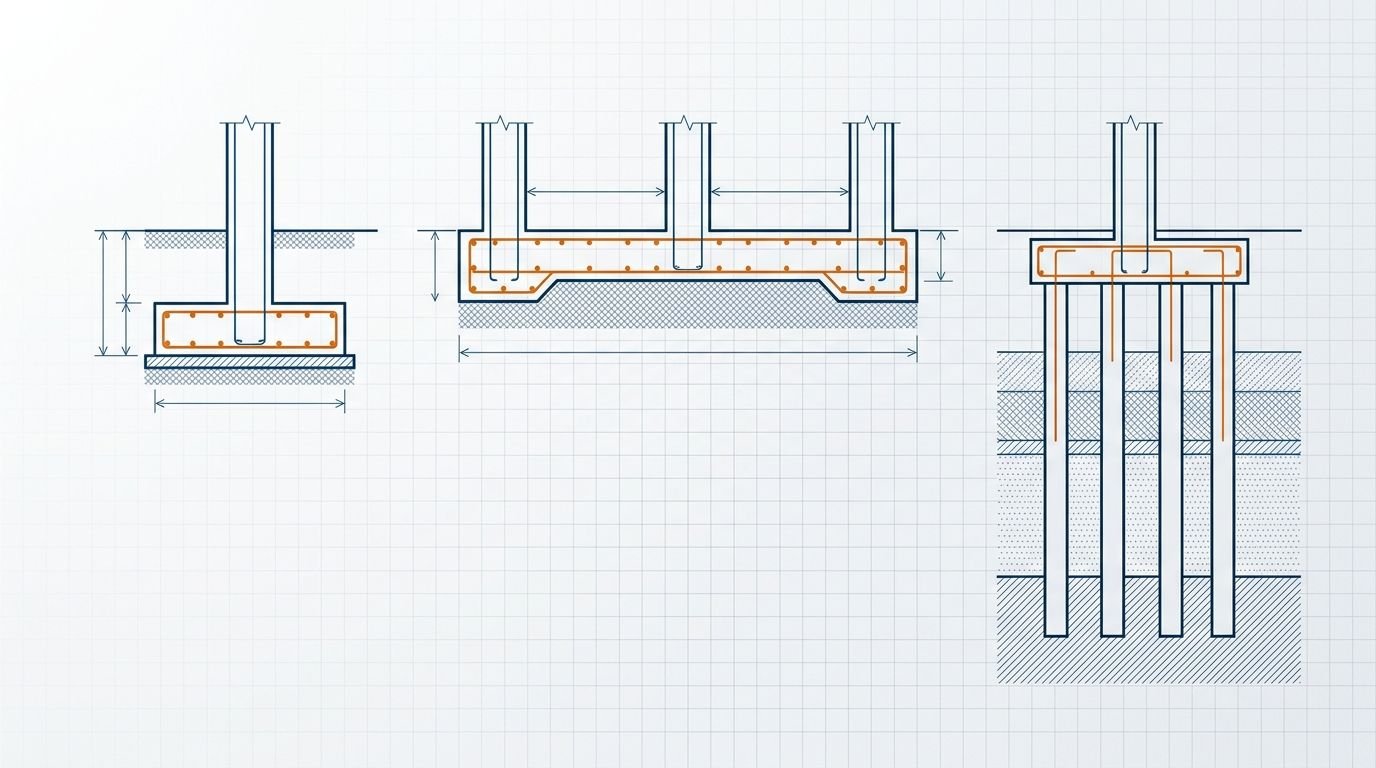
Shallow foundations
Used where firm soil is close to the surface — most low-rise housing.
| Type | What it is | Where used |
|---|---|---|
| Isolated (pad) footing | A single pad under one column | Framed houses on good soil — the common case |
| Combined footing | One footing under two or more close columns | Columns near a boundary or too close to separate |
| Strip footing | A continuous footing under a load-bearing wall | Load-bearing masonry houses |
| Raft (mat) foundation | One thick slab under the whole building | Weak soil, or heavy/closely-spaced columns |
An isolated footing is the default for a framed house; a raft spreads the load over the whole footprint when the soil is poor or the columns are heavy, keeping the pressure on the ground low.
Deep foundations
Used where surface soil is weak and firm strata lie far below, or for heavy structures.
| Type | What it is | Where used |
|---|---|---|
| Pile foundation | Slender columns driven or cast deep into the ground | Soft/filled soil, high loads, high water table |
| Pier foundation | Large-diameter bored shafts carrying heavy loads | Bridges, heavy buildings |
| Well (caisson) foundation | A sunk hollow shell filled and founded deep | Bridge piers in rivers |
Piles carry load either by end bearing on firm strata at their tip, by skin friction along their length, or both.
How the type is chosen
The decision follows the soil and the load:
- Good soil, light load → isolated or strip footing at shallow depth.
- Weak soil or heavy/close columns → raft.
- Weak soil to great depth, or very heavy load → piles.
Always found below the zone of seasonal moisture change and, in cold regions, below the frost line. The foundation depth guide covers minimum depths, and the soil bearing capacity calculator estimates the SBC that sizes the footing. Get a real SBC from a soil test, not a table.
Frequently asked questions
What are the two main types of foundation? Shallow foundations and deep foundations. Shallow foundations (isolated, combined, strip and raft) sit near the surface on good soil; deep foundations (pile, pier and well) reach down to firm strata for weak soil or heavy loads.
Which foundation is best for a house? For a normal framed house on good soil, isolated (pad) footings under each column are the usual and economical choice. Load-bearing houses use strip footings; poor soil may need a raft.
When is a raft foundation used? A raft is used when the soil is weak, the columns are heavy or closely spaced, or the total footing area would otherwise cover most of the plot. It spreads the load over the whole footprint to keep soil pressure low.
What is the difference between shallow and deep foundations? Shallow foundations transfer load to soil near the surface and are used where firm ground is close. Deep foundations, like piles, carry load down to firm strata far below and are used where surface soil is weak or loads are very high.
How deep should a house foundation be? At least below the seasonal moisture-change zone — commonly 1 to 1.5 m for a small house on firm soil, and deeper for weak soil or in frost regions. The exact depth follows the soil investigation.
CivilSite Editorial Team✓ Engineer reviewed
Written and reviewed by practising civil engineers with 10+ years of Indian residential construction experience.