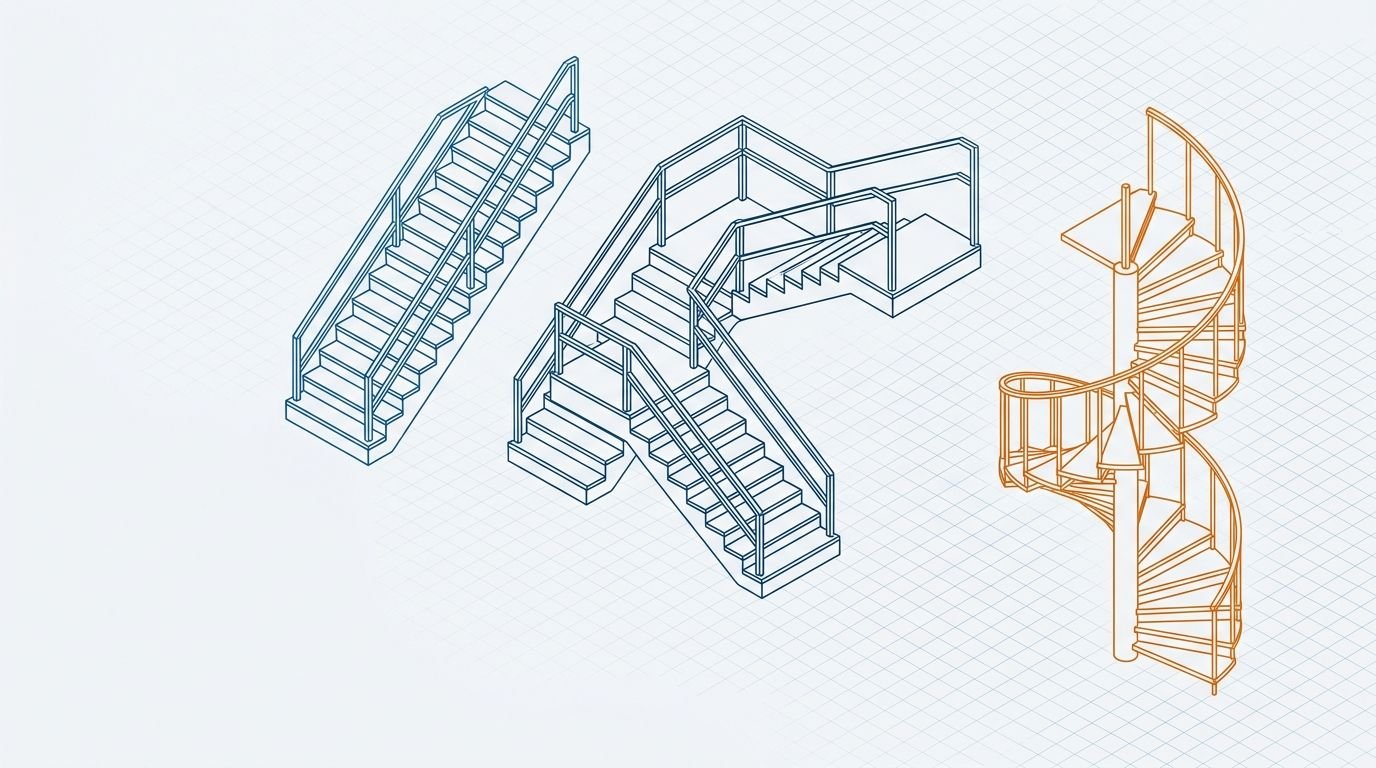
Types of Staircases
Updated
A staircase is chosen for the space it fits, the direction it must turn and how it looks — and every type still follows the same comfort rule for riser and tread. This guide covers the common staircase layouts used in Indian homes, where each suits, and the dimension rules that keep any of them comfortable and safe.
Space & turn
What picks the type
2R + T ≈ 550–650 mm
The comfort rule
Riser ≤ ~190 mm
For a home
Common staircase types
| Type | Layout | Where it suits |
|---|---|---|
| Straight | A single flight, no turn | Long, narrow spaces; simple and cheap |
| Dog-legged | Two flights with a 180° turn and a mid-landing | The common Indian house stair — compact |
| Open-well (open newel) | Flights around a central gap | Wider stairwells, better look and light |
| Quarter-turn | One 90° turn (with landing or winders) | Corner locations |
| Half-turn | A 180° turn (dog-legged or open-well) | Compact plans |
| Spiral | Steps winding around a central column | Very tight spaces, terraces, accent stairs |
| Helical | A curved sweep with no central column | Showpiece stairs in large homes |
| Bifurcated | One wide flight splitting into two | Grand entrances |
The dog-legged stair is the workhorse of the Indian house — two flights and a half-landing folded into a compact stairwell. Spiral stairs save the most floor space but are the least comfortable to carry loads on.
The dimension rules every type follows
Whatever the layout, the steps must be comfortable:
- Comfort rule: 2 × Riser + Tread ≈ 550–650 mm.
- Riser (the height of each step): up to about 190 mm for a home; lower is easier.
- Tread (the depth you step on): about 250–300 mm.
- Headroom: at least 2.1 m clear above any step.
- Width: around 900 mm or more for a house stair.
Work these out for your own stair — number of risers, tread and concrete — with the staircase calculator, which applies the same comfort rule.
How to choose
- Simple and cheapest → straight flight, if the length is available.
- Compact house → dog-legged (half-turn).
- Better look and daylight → open-well.
- Very tight space → spiral.
Frequently asked questions
What are the main types of staircases? Straight, dog-legged (half-turn), open-well, quarter-turn, spiral, helical and bifurcated staircases are the common types. Homes most often use the dog-legged stair.
Which staircase is best for a house? The dog-legged (half-turn) staircase suits most Indian homes because it folds two flights into a compact stairwell. Where space allows, a straight or open-well stair is more comfortable.
What is a dog-legged staircase? A dog-legged staircase has two straight flights running in opposite directions with a half-landing between them, making a 180° turn. It is compact and very common in houses.
What is the standard riser and tread of a staircase? For a home, the riser is up to about 190 mm and the tread about 250–300 mm, set so that 2 × riser + tread falls between 550 and 650 mm for comfort.
Which staircase takes the least space? A spiral staircase takes the least floor space because the steps wind around a central column, though it is less comfortable for carrying loads than a straight or dog-legged stair.
CivilSite Editorial Team✓ Engineer reviewed
Written and reviewed by practising civil engineers with 10+ years of Indian residential construction experience.