Paver Block Calculator
Updated
Paver blocks for a driveway, path or yard are just the area divided by one block's area, plus a bit for cuts — this calculator does it for the common sizes. Enter the area and pick the paver, and it gives the number of blocks including wastage.
Paver Block Calculator
Number of paver blocks for a driveway, path or yard
Length × width of the area.
5–10% for edge cuts and breakage.
Paver blocks needed
5,250 blocks
100 m² · 200 × 100 mm (rectangular) · +5% wastage
Blocks
5,250
Blocks / m²
50
One block
200 × 100 mm
Area + wastage
105 m²
Lay pavers over a compacted base and sand bed, with edge restraints so they don't creep. Keep a few spares from the same lot for repairs. For a concrete driveway instead, see the concrete calculator.
Area ÷ block area
The count
50 / m²
For 200 × 100 mm
+5–10% wastage
For edge cuts
How the calculation works
Blocks = Area × (1 + wastage) ÷ one-block area
A 200 × 100 mm paver covers 0.02 m², so 50 blocks make one square metre. For 100 m² with 5% wastage:
- Blocks = 100 × 1.05 × 50 = 5,250 blocks
Blocks per square metre by size
| Paver size | Block area | Blocks per m² |
|---|---|---|
| 200 × 100 mm | 0.020 m² | 50 |
| 225 × 112.5 mm | 0.0253 m² | 39.5 |
| 250 × 250 mm | 0.0625 m² | 16 |
| 300 × 300 mm | 0.09 m² | 11.1 |
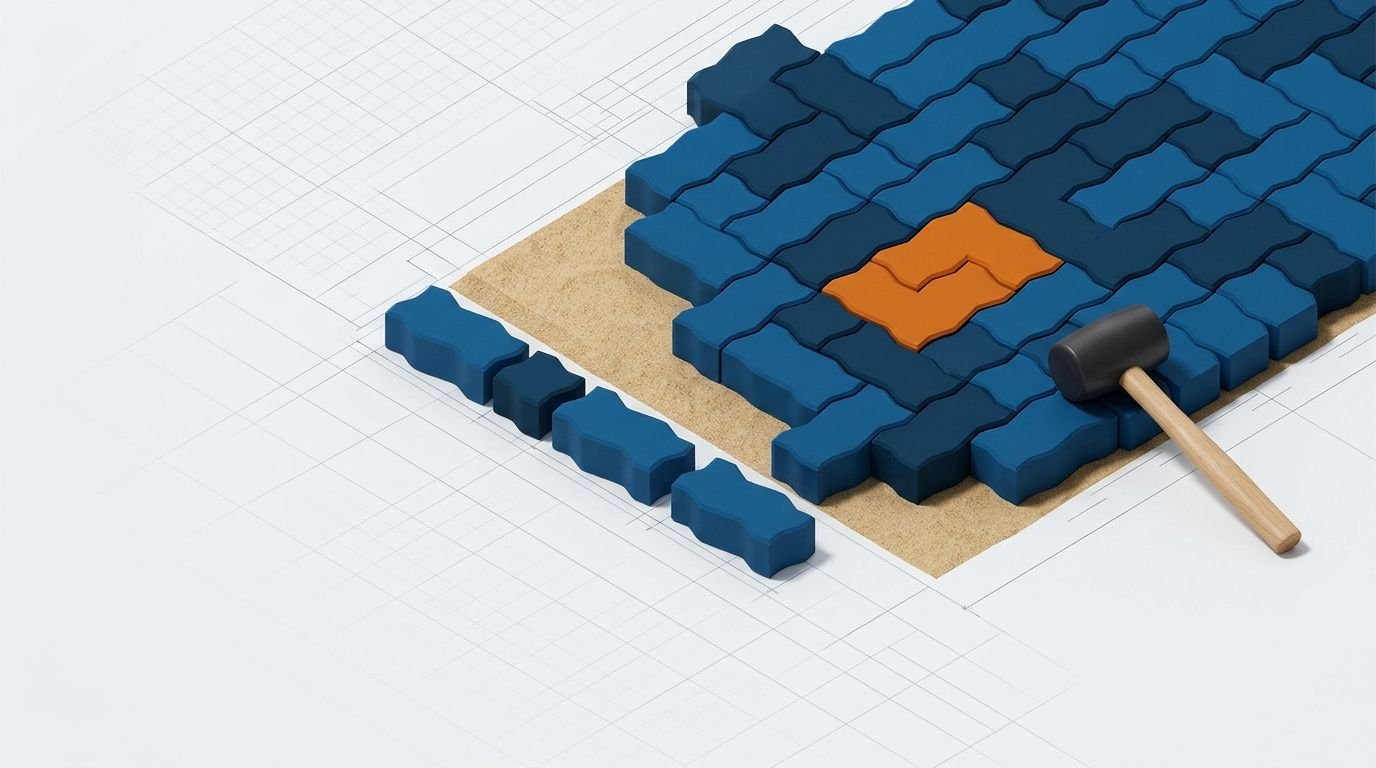
Larger pavers mean fewer blocks but each is heavier; interlocking I-shape (zigzag) pavers lock together and suit driveways with vehicle loads.
Laying pavers
Pavers sit on a compacted sub-base, a sand bedding layer and are held by edge restraints so they don't spread. Joints are filled with fine sand. Keep a few spares from the same lot for later repairs. For a poured concrete driveway instead, use the concrete calculator, and estimate any earthwork with the excavation calculator.
Frequently asked questions
How many paver blocks are in 1 square meter? For the common 200 × 100 mm paver, 50 blocks cover one square metre. Larger 300 × 300 mm pavers need about 11 per square metre.
How do I calculate the number of paver blocks? Divide the area by one block's area, then add wastage. For 200 × 100 mm pavers, that is area × 50 × (1 + wastage). For 100 m² with 5% wastage, 5,250 blocks.
How much wastage should I allow for pavers? Allow about 5–10% for edge cuts and breakage — more for curved or complex layouts with many cuts.
What size paver block is best for a driveway? Interlocking I-shape (zigzag) pavers, usually 225 × 112.5 mm and 60–80 mm thick, are preferred for driveways because they lock together and carry vehicle loads well.
What goes under paver blocks? A compacted sub-base, then a sand bedding layer, with edge restraints around the perimeter. Joints are filled with fine sand after laying.
CivilSite Editorial Team✓ Engineer reviewed
Written and reviewed by practising civil engineers with 10+ years of Indian residential construction experience.