Flakiness & Elongation Index
Updated
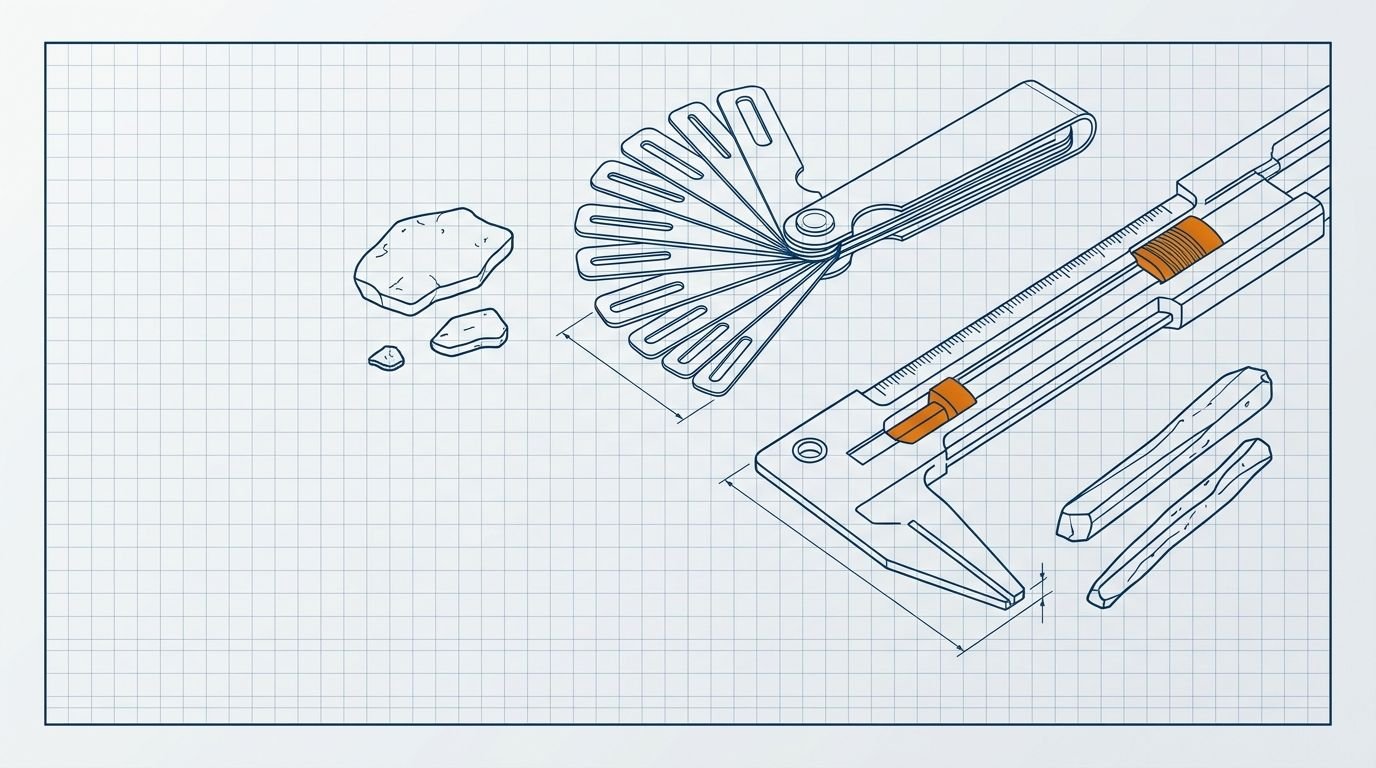
The flakiness and elongation indices measure how many aggregate particles by weight are the wrong shape for good concrete — genuinely flat (flaky) or genuinely long (elongated) — because particles of either shape are inherently weaker, pack poorly, and make the resulting concrete measurably harsher to work. Both indices are determined under IS 2386 (Part 1) using simple, purpose-made gauges rather than any judgement call on individual particles, which keeps the result objective and repeatable across labs.
Flaky = too thin
Least dimension < 0.6 × mean size
Elongated = too long
Greatest dimension > 1.8 × mean size
Rounded / cubical is ideal
For dense, workable concrete
Why particle shape genuinely matters, beyond just aggregate "strength"
Well-shaped cubical or rounded aggregate particles pack densely against each other, leaving minimal voids between them, and distribute applied load evenly across their contact points with neighbouring particles and the surrounding cement paste. Flaky (flat, thin) and elongated (long, needle-like) particles behave very differently under the same conditions: they break easily under load because their shape concentrates stress at thin points rather than spreading it, they create larger, irregular voids between particles that the cement paste must fill, and a mix containing a high proportion of them genuinely needs more water and cement to achieve workable, well-compacted concrete than the same mix using well-shaped aggregate — which is precisely why their proportion is limited by specification rather than left unregulated.
Flakiness index — the thickness gauge test
A particle is formally classified as flaky if its least dimension (thickness) is less than 0.6 times its mean sieve size for that particular size fraction.
- 1
Sieve the sample
Sieve the aggregate sample into its individual size fractions
- 2
Select the correct gauge slot
Each size fraction has a corresponding slot width on the thickness gauge, per IS 2386
- 3
Test each particle
Pass particles of each fraction through the gauge slot — flaky particles slip through, others are retained
- 4
Weigh the flaky fraction
Weigh the particles that passed through (the flaky ones) for each size fraction
- 5
Calculate the index
Sum the flaky weight across fractions, divide by the total original sample weight, ×100
The thickness gauge must be applied consistently to each individual particle — a particle that only barely slips through on one orientation but not another should be tested by its narrowest genuine dimension.
Flakiness index (%) = total weight of flaky particles ÷ total sample weight × 100.
Elongation index — the length gauge test
A particle is formally classified as elongated if its greatest dimension (length) is more than 1.8 times its mean sieve size.
- Take the same sized fractions used for the flakiness test (only the particles that were not flaky, per IS 2386's specified sequence).
- Pass each fraction through the corresponding gap of a length gauge — a frame with fixed gaps sized per fraction, per the code table.
- Elongated particles are held back by the gap (too long to pass through), rather than slipping through as in the flakiness test — the mechanics are reversed between the two gauges.
- Weigh the elongated particles retained, (W_elong).
Elongation index (%) = W_elong ÷ total weight × 100.
The specification limits
Actual limits vary by the specific specification and application; road-works limits are typically the tightest since surface aggregate directly bears traffic load.
For good concrete and road aggregate, the combined flakiness and elongation index is kept low — commonly limited to somewhere around 30–40% for road works, though the exact figure depends on the governing specification for that particular project. A well-graded, genuinely cubical aggregate source naturally keeps both indices down without any special processing, which is why source selection at the quarry stage matters as much as any downstream screening.
Why these two indices are checked separately from crushing and impact value
It's worth being explicit that flakiness and elongation measure something genuinely different from the crushing value and impact value tests: those two measure the intrinsic material strength of individual aggregate particles under load, while flakiness and elongation measure particle shape, independent of the material's inherent strength. An aggregate source can, in principle, produce individually strong particles (low crushing and impact values) that are nonetheless badly shaped (high flakiness/elongation), and a poorly-shaped batch will still under-perform in concrete even if each individual particle is materially strong — which is exactly why a complete aggregate quality assessment checks all of these properties together rather than relying on any single test. See the IS 383 aggregates standard for the full aggregate quality framework.
Frequently asked questions
What is the flakiness index of aggregate? It is the percentage by weight of aggregate particles whose least (thickness) dimension is less than 0.6 times their mean sieve size for that size fraction — the proportion of flat, flaky particles in the sample.
What is the elongation index of aggregate? It is the percentage by weight of particles whose greatest (length) dimension is more than 1.8 times their mean sieve size — the proportion of long, needle-like elongated particles in the sample.
Why are flaky and elongated particles undesirable in concrete? They break easily under load because their shape concentrates stress at thin points, create larger irregular voids between particles, and need more water and cement for workable compaction — giving harsher, less dense and structurally weaker concrete than well-shaped cubical or rounded aggregate.
How is the flakiness index measured on site or in a lab? By sieving the aggregate into size fractions and passing each fraction through the correspondingly sized slot of a thickness gauge — the flaky particles slip through the slot and are weighed as a percentage of the total sample.
What gauge is used for the elongation index, and how does it differ from the flakiness gauge? A length gauge with fixed metal gaps is used — the mechanics are the reverse of the flakiness test: elongated particles are held back by the gap rather than slipping through it, and are then weighed as a percentage of the total sample.
CivilSite Editorial Team✓ Engineer reviewed
Written and reviewed by practising civil engineers with 10+ years of Indian residential construction experience.