Soundness Test of Cement
Updated
Soundness is a cement's ability to set and harden without later expanding — an unsound cement looks completely fine when it's poured, sets normally, and then weeks or months later starts swelling from within, cracking and disrupting the very concrete it was meant to hold together. Because this failure mode is so delayed and so destructive when it happens, the soundness test exists specifically to force it to show up quickly, in a controlled lab setting, before a bad batch of cement ever reaches a structure.
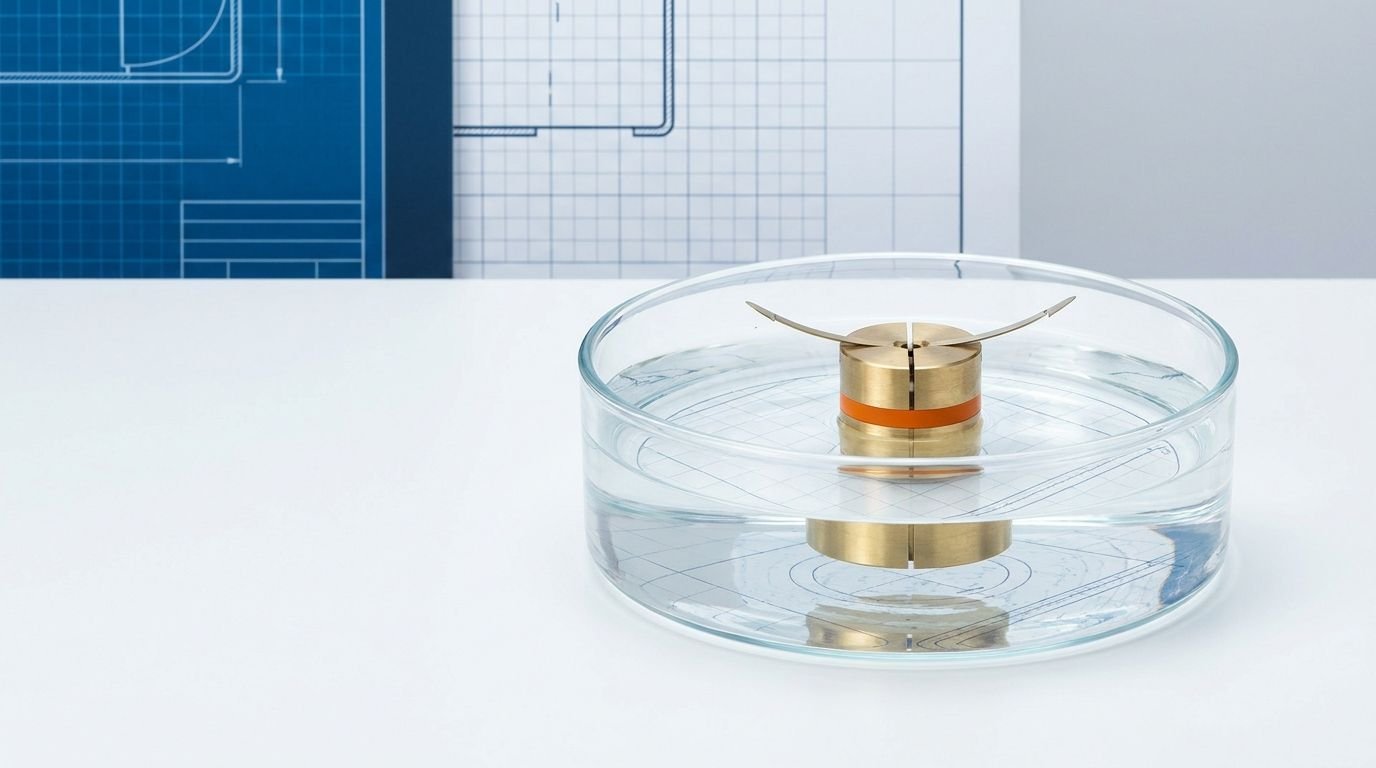
Le Chatelier apparatus
The test method
Free lime & magnesia
The root cause
Expansion ≤ 10 mm
The IS limit for OPC
Why unsoundness happens — the chemistry behind delayed expansion
Cement clinker is made by burning limestone and clay at very high temperature, and the process inevitably leaves some free (uncombined) lime (CaO) and magnesia (MgO) in the finished clinker — compounds that didn't fully react into the main cementing minerals during manufacture. These two compounds are chemically reactive with water, exactly like the main cement minerals are, but they react far more slowly — sometimes not showing any effect for weeks or months after the concrete has already set and hardened. When they finally do react, they expand as they hydrate, and because this happens after the surrounding concrete has already gone rigid, that expansion has nowhere to go — it pushes outward from within, cracking and disrupting concrete that otherwise looked completely sound. This is precisely why the property is called "soundness," and why it's tested for separately from ordinary strength and setting behaviour.
The Le Chatelier test, step by step
- 1
Prepare the paste
Make a cement paste at standard consistency and lightly oil the Le Chatelier mould — a small split brass cylinder with two thin indicator pointers extending from the split.
- 2
Fill the mould
Fill the mould with the paste on a glass plate, cover with another oiled glass plate, and place a small weight on top to keep it closed.
- 3
Store in water 24 hours
Submerge the assembled mould in water at room temperature for 24 hours and let the paste set.
- 4
Measure the initial gap (L1)
Remove the mould from water and measure the distance between the tips of the two indicator pointers.
- 5
Boil for 3 hours
Place the mould back in a water bath, bring it to boiling within a specified time, and keep it boiling for 3 hours — this accelerates the slow lime/magnesia reaction into a measurable timeframe.
- 6
Cool and re-measure (L2)
Cool the mould and measure the pointer-tip distance again.
- 7
Calculate expansion
Expansion = L2 − L1, the increase in the gap between the pointer tips caused by the accelerated reaction.
The Le Chatelier expansion should not exceed 10 mm for ordinary Portland cement. A result above this limit means the cement contains enough free lime or magnesia that it poses a genuine risk of delayed, destructive expansion once used in real concrete, and it should be rejected.
Why boiling is used to accelerate the test
The whole point of the test is to force a reaction that would otherwise take weeks or months in real concrete to happen within a few hours in the lab, so a bad batch can be caught before it's ever used. Boiling water dramatically speeds up the free-lime and magnesia reactions without changing what they fundamentally are — it's an accelerated simulation, not a different chemical process. This is a common and well-established principle in materials testing: compress the real-world timeframe of a slow failure mode into a practical lab procedure.
The autoclave test — catching what Le Chatelier can miss
The Le Chatelier method is highly effective at detecting expansion from free lime, but magnesia (MgO) reacts even more slowly than free lime does — slowly enough that even 3 hours of boiling may not fully reveal a magnesia-driven expansion problem. Where magnesia content is a specific concern, an autoclave test is used instead or in addition: the cement paste is subjected to high-pressure steam at an elevated temperature, which accelerates the magnesia reaction far more aggressively than boiling water alone. Total autoclave expansion is limited by the relevant standard, and MgO content itself is separately capped (commonly around 6% by mass) in cement specifications as a further safeguard.
How soundness fits into full cement quality testing
| Test | What it checks | Why it matters |
|---|---|---|
| Fineness | How finely ground | Controls reactivity, strength gain rate |
| Consistency | Water demand for standard paste | Baseline for setting-time and soundness tests |
| Setting time | How fast it stiffens and hardens | Determines the practical working window on site |
| Soundness | Whether it will expand after setting | Predicts long-term dimensional stability and cracking risk |
Soundness is arguably the most consequential of these four for structural safety, precisely because its failure mode is delayed and can be mistaken for other causes (thermal cracking, shrinkage) if the cement's soundness wasn't verified in advance. It's checked routinely on every batch at cement plants specifically because catching it after the fact — in a built structure — is vastly more expensive than catching it in the lab.
Frequently asked questions
What is the soundness test of cement? It checks whether cement will expand destructively after it has already set and hardened. Excess free lime and magnesia in the clinker hydrate very slowly and expand as they do, cracking hardened concrete weeks or months later — the soundness test uses the Le Chatelier apparatus, with accelerated boiling, to detect this risk quickly in the lab.
What is the limit of soundness of cement? By the Le Chatelier method, the expansion measured between the two indicator pointers should not exceed 10 mm for ordinary Portland cement. A result above this indicates unacceptable expansion risk.
What causes unsoundness in cement? Excess free (uncombined) lime (CaO) and magnesia (MgO) left over from imperfect clinker formation during manufacture. Both react with water far more slowly than the main cementing minerals, and expand as they finally do react — disrupting concrete that has already set and hardened around them.
What is the difference between the Le Chatelier and autoclave tests? The Le Chatelier test uses boiling water and is highly effective at detecting expansion driven mainly by free lime. The autoclave test uses high-pressure steam at elevated temperature and is more sensitive to expansion from magnesia, which reacts even more slowly than free lime does. Both limit the total expansion measured.
Why must soundness be tested at standard consistency? So the paste's stiffness matches the reference used in other cement tests, making the soundness result comparable and repeatable across different labs and cement batches rather than depending on an arbitrary, uncontrolled water content.
Can unsound cement be used if the expansion is only slightly over the limit? No — the soundness limit exists precisely because there's no reliable way to predict how much structural damage a given degree of delayed expansion will actually cause in a real, load-bearing structure. Cement failing the soundness test should be rejected outright, not used with an informal safety margin.
How long does the soundness test take? The full procedure takes about 27–28 hours in total: 24 hours of initial water storage to let the paste set, followed by 3 hours of boiling, plus cooling time before the final measurement — which is why soundness testing is done as a batch quality-control step well ahead of the cement reaching site, not as a same-day site check.
CivilSite Editorial Team✓ Engineer reviewed
Written and reviewed by practising civil engineers with 10+ years of Indian residential construction experience.