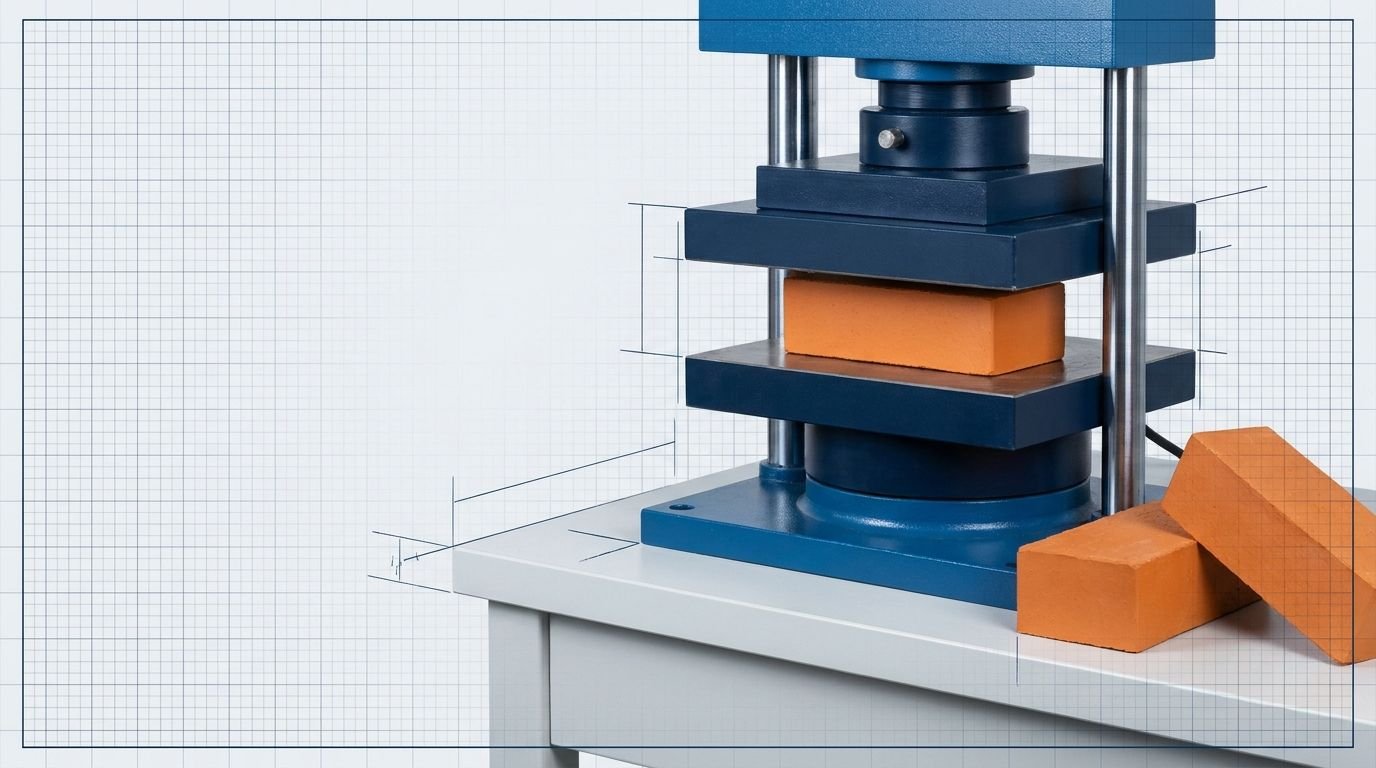
Compressive Strength Test of Bricks
Updated
The compressive strength test crushes a properly prepared brick between the platens of a testing machine to find exactly how much load it carries per unit area before failing — and this single number is so central to brick quality that it literally names the brick's official class. It follows IS 3495 (Part 1), and the minimum strength required for ordinary building bricks is one of the most-quoted numbers in Indian masonry practice.
Load ÷ area
Strength = N/mm²
≥ 3.5 N/mm²
Common bricks (minimum)
Class = strength
IS 1077 designation
Why bricks are graded by their crushing strength specifically
Bricks in a wall carry load almost entirely in compression — the weight of everything above pressing straight down through the masonry to the foundation. There's essentially no other load path in ordinary masonry construction, which is exactly why compressive strength, rather than any other mechanical property, is the single defining quality measure for a building brick. IS 1077 makes this explicit by naming brick classes directly after their minimum compressive strength — a "Class 7.5" brick simply means a brick guaranteed to reach at least 7.5 N/mm² in this exact test, and so on up the scale.
The test procedure (IS 3495 Part 1)
- 1
Select and prepare the brick
Select a representative sample brick and fill any frog (indentation) and surface voids flush with a 1:3 cement-sand mortar, giving a flat, even bearing surface.
- 2
Cure the capping mortar
Allow the capping mortar to cure for a specified period (commonly a few days) so it has adequate strength of its own before testing.
- 3
Immerse before testing
Immerse the prepared brick fully in water for 24 hours immediately before the test, so it is tested in a consistent, saturated condition.
- 4
Position in the machine
Place the brick flat between two 3-ply plywood sheets (to evenly distribute the load) within the compression testing machine.
- 5
Apply load steadily
Apply load at a controlled, steady rate — not suddenly — until the brick fails and can carry no further load.
- 6
Record and calculate
Record the maximum load reached, then calculate: compressive strength (N/mm²) = maximum load (N) ÷ loaded plan area of the brick (mm²).
Multiple bricks (commonly at least five) are tested from a sample, and the results are averaged — a single brick's result can be affected by a local flaw and isn't representative on its own.
Why the frog is filled with mortar first
This preparation step is easy to overlook but changes the result significantly if skipped. Many bricks have a frog — a shallow recessed indentation on one face — plus minor surface irregularities from moulding and firing. If tested as-is, the load from the compression machine's flat platen would concentrate unevenly on the brick's highest points rather than spreading across its full nominal area, giving an artificially low and unreliable strength reading, or even causing localised crushing that doesn't reflect the brick's true bulk strength. Filling the frog and any surface voids with mortar and letting it cure creates a genuinely flat, even bearing surface, so the applied load distributes evenly across the brick's actual cross-section — giving a result that reflects the brick's real structural capacity rather than an artefact of its surface shape.
The strength classes (IS 1077)
Each class name is literally its own guaranteed minimum compressive strength in N/mm², per IS 1077 — a simple, self-describing designation system used throughout Indian brick specifications and purchase orders.
For common burnt clay building bricks, the minimum acceptable compressive strength is 3.5 N/mm². Bricks below this threshold are considered substandard for general structural masonry, though they may occasionally be used for genuinely non-structural, protected applications at a buyer's own risk.
Choosing the right class for the job
- Class 3.5 — the basic minimum, suited to low-rise, lightly loaded non-structural masonry.
- Class 7.5 and above — commonly specified for load-bearing masonry and general residential construction where the walls carry meaningful structural load.
- Class 10–12.5+ — used where masonry carries heavier loads, such as multi-storey load-bearing structures or specific engineered applications.
The right class depends entirely on whether — and how much — the wall is actually expected to carry structural load, which links directly back to the choice between load-bearing and framed structures: in a framed building where masonry is pure infill, a lower class is often perfectly adequate, while true load-bearing masonry needs a class matched to the actual loads it will carry.
Frequently asked questions
What is the compressive strength test of bricks? It crushes a properly prepared brick — frog and voids filled flush with mortar — in a compression testing machine to find the maximum load it carries before failure, divided by its loaded plan area, giving the compressive strength in N/mm².
What is the minimum compressive strength of bricks? For common burnt clay building bricks, the minimum is 3.5 N/mm² under IS 1077. Higher classes — 5.0, 7.5, 10, 12.5 N/mm² and beyond — are specified where the masonry carries heavier structural loads.
How do you calculate compressive strength of a brick? Divide the maximum load at failure (in newtons) by the brick's loaded plan area (in mm²) to get strength in N/mm². Multiple bricks from the same sample are tested and the results averaged for a representative figure.
Why is the frog filled with mortar before testing? Filling the frog and any surface voids with mortar and letting it cure gives a flat, even bearing surface so the applied load spreads uniformly across the brick's true cross-section — testing without this step concentrates load on high points and gives an unreliable, artificially low result.
What does the class of a brick mean? Under IS 1077, a brick's class number is literally its guaranteed minimum compressive strength in N/mm² — a Class 7.5 brick is certified to reach at least 7.5 N/mm² in this exact test. The naming system is deliberately self-describing.
Are bricks tested wet or dry? Bricks are immersed in water for 24 hours immediately before compressive strength testing, so the result reflects the brick's strength in a consistent, saturated condition — the state most relevant to real site exposure, rather than an artificially dry lab condition.
Which brick class should I use for a two-storey house? For general load-bearing or heavily loaded masonry in a typical residential structure, Class 7.5 or higher is commonly specified, though the exact requirement depends on the structural design — for non-load-bearing infill in a framed building, a lower class can be acceptable since the walls carry only their own weight.
CivilSite Editorial Team✓ Engineer reviewed
Written and reviewed by practising civil engineers with 10+ years of Indian residential construction experience.