Plate Load Test
Updated
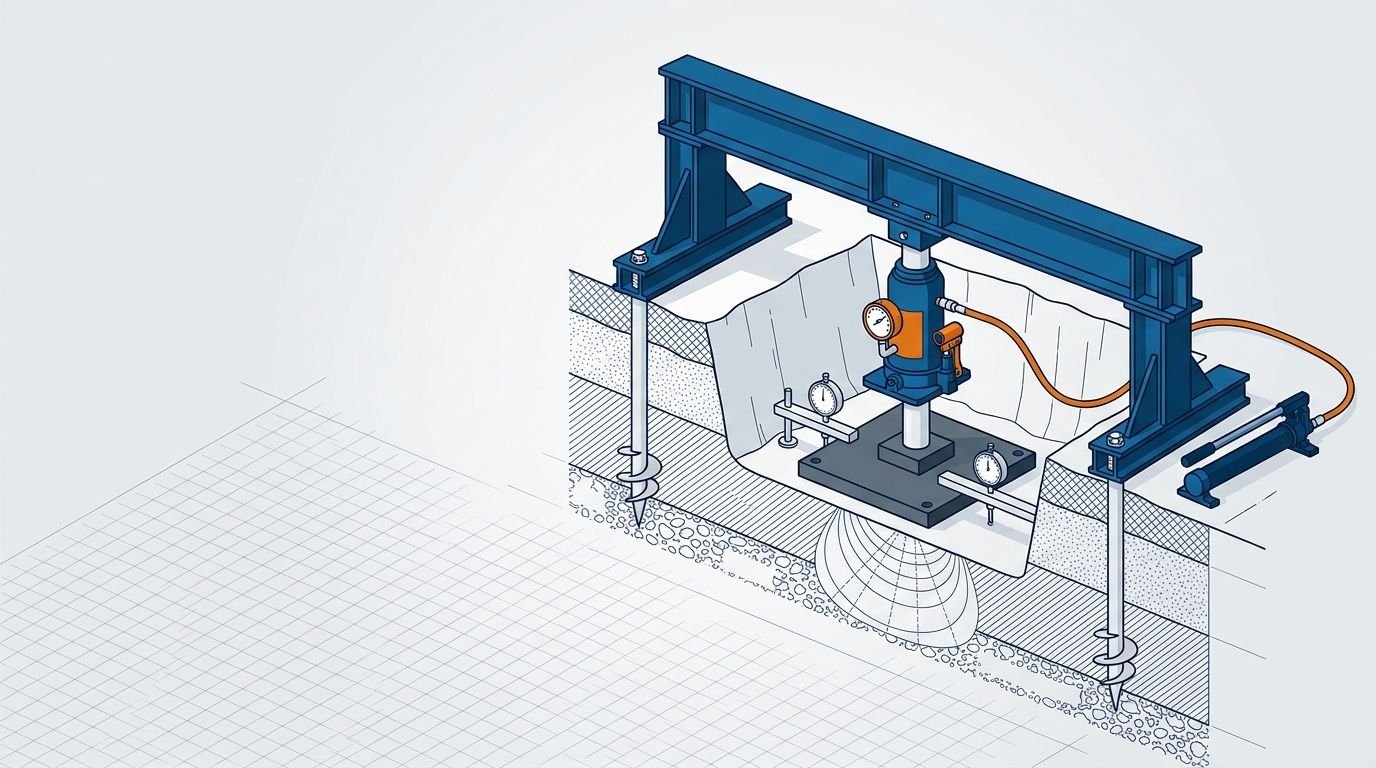
The plate load test measures a soil's bearing capacity and settlement directly in the field — a rigid steel plate is loaded in steps at foundation level and the settlement is recorded at each step, producing a load-settlement curve that describes how the actual ground behaves under load. It follows IS 1888 and is used to confirm the safe bearing capacity by direct measurement, rather than relying on theory or correlation alone. This page explains why it's done, the procedure, how the result is read, and — importantly — its genuine limitations.
Load a rigid steel plate
In a pit at foundation level
Measure settlement at each step
With dial gauges
Ultimate bearing & settlement
The two outputs
Why the plate load test is done at all
A soil investigation gives the safe bearing capacity two ways: from theory (the Terzaghi bearing-capacity equation) and from correlations against standard penetration test N-values. The plate load test does something genuinely different — it confirms the bearing capacity by direct physical measurement, loading the actual soil at the actual foundation level and watching exactly how much it settles. Because it measures rather than infers, it gives both the ultimate bearing capacity and the settlement expected under the working load, which is valuable independent confirmation of what theory and correlation predict.
The test procedure (IS 1888)
- 1
Excavate to foundation level
Dig a test pit down to the proposed foundation level and level the soil at the base
- 2
Place the bearing plate
Place a rigid square or circular steel bearing plate on the levelled soil
- 3
Apply load in increments
Apply load in equal increments using a jack against a loaded reaction frame or kentledge
- 4
Record settlement
At each increment, record the settlement with dial gauges once it has stabilised
- 5
Plot load vs settlement
Continue until the soil fails or a set settlement is reached, then plot load against settlement
Waiting for settlement to genuinely stabilise at each load increment before adding the next is essential — reading settlement too early understates it and produces an unsafe result.
Reading the result
- The ultimate bearing capacity is taken at the point where the load-settlement curve breaks — the point where the soil begins to settle rapidly for little additional load — and the safe bearing capacity is that ultimate value divided by a factor of safety.
- The same curve also gives the settlement expected under the working pressure, which matters independently of bearing capacity, since a foundation can be perfectly safe against bearing failure yet still settle unacceptably.
The critical limitation — the scale effect
Both stress the soil to roughly twice their loaded width — but because the footing is far wider, it stresses the soil to a far greater absolute depth, which is the whole basis of the scale-effect correction.
This is the point that matters most about the plate load test, and the reason it's never used in isolation: the test plate is small, so it only stresses the soil to a shallow absolute depth — roughly twice the plate's width. A real footing is far wider, so it stresses the soil to a far greater absolute depth. The consequence is genuinely important: a weak soil layer lying below the plate's shallow zone of influence, but within the much deeper zone a real footing would stress, is completely invisible to the plate load test yet would still affect the actual foundation. The plate result must therefore be corrected for the size difference (the "scale effect"), especially in clays and layered soils, and the test is used together with borehole data that reveals the deeper soil profile — never as a standalone substitute for it. Estimate the SBC first with the soil bearing capacity calculator.
Frequently asked questions
What is a plate load test? It's a field test in which a rigid steel plate is placed at foundation level and loaded in increments, with the settlement recorded at each step, to measure the soil's bearing capacity and settlement directly by physical measurement rather than by theory or correlation.
How is bearing capacity found from a plate load test? The load-settlement curve is plotted; the ultimate bearing capacity is read at the point where the curve breaks (rapid settlement for little added load), and the safe bearing capacity is that value divided by a factor of safety.
What is the main limitation of the plate load test? The plate is small and stresses the soil only to a shallow absolute depth, whereas a real footing stresses it far deeper. A weak layer below the plate's influence but within a footing's influence is invisible to the test — so the result must be corrected for the scale effect and used together with borehole data.
Which IS code covers the plate load test? IS 1888 covers the plate load test method for determining the bearing capacity and settlement of soil in the field.
What is the difference between the plate load test and the SPT? The plate load test loads a plate at foundation level and measures settlement directly, giving both bearing capacity and settlement. The SPT counts the blows to drive a sampler into soil in a borehole, giving an N-value correlated to strength. Both estimate bearing capacity and are commonly used together rather than as alternatives.
CivilSite Editorial Team✓ Engineer reviewed
Written and reviewed by practising civil engineers with 10+ years of Indian residential construction experience.