Types of Loads on a Structure
Updated
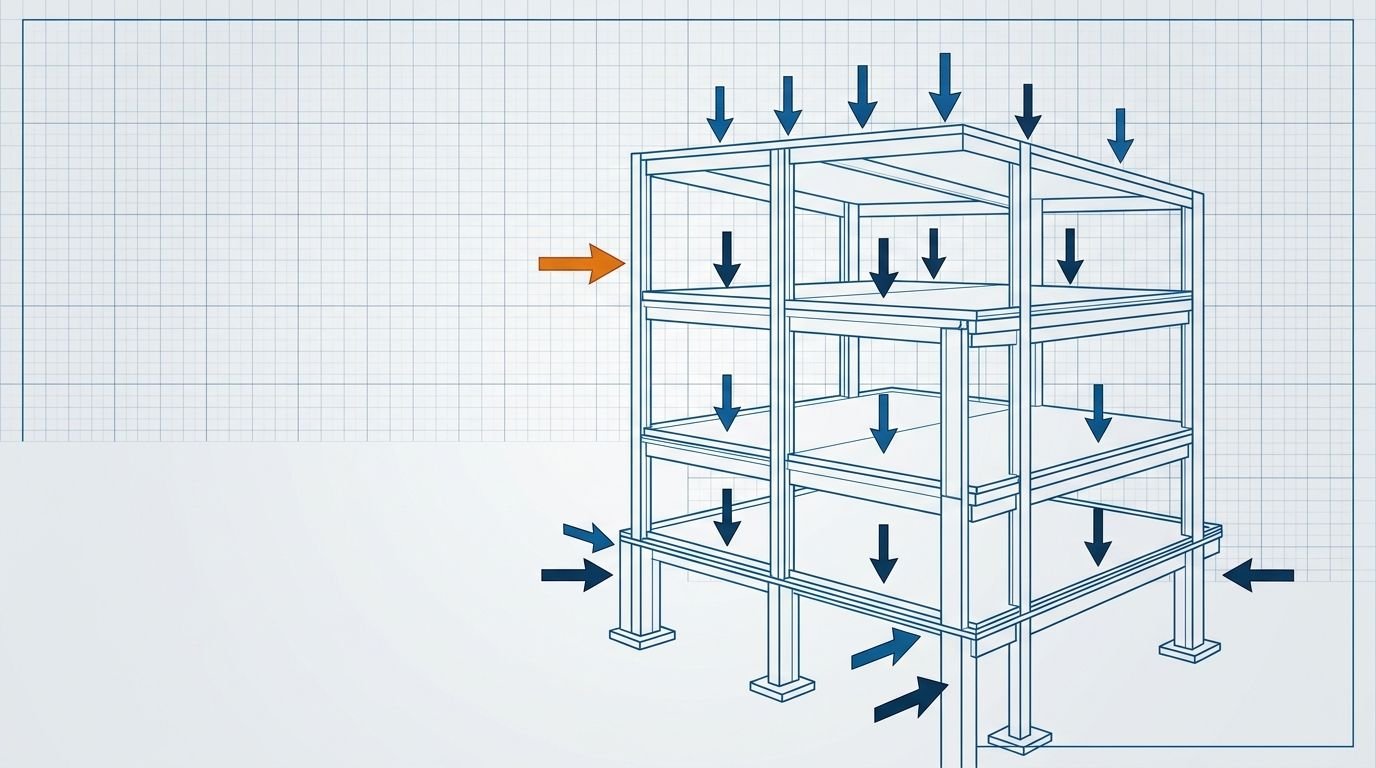
A structure is never designed for just one load acting alone — it must carry its own permanent weight, whatever is placed or moving on it, and the environmental forces of wind and earthquake, often all at once — and each of these categories is precisely defined and quantified by Indian standards rather than estimated by judgment. This page sets out the main load types, the codes that govern them, and how a designer actually combines them into a single safe design.
Dead + live + environmental
The three broad families
IS 875 & IS 1893
The governing standards
Combined with partial safety factors
Never designed in isolation
The main load types, and their governing code
| Load | What it is | Standard |
|---|---|---|
| Dead load (DL) | Permanent self-weight — structure, walls, finishes | IS 875 (Part 1) |
| Live / imposed load (LL) | Movable — people, furniture, stored goods | IS 875 (Part 2) |
| Wind load | Pressure and suction from wind | IS 875 (Part 3) |
| Seismic load | Inertia forces from an earthquake | IS 1893 |
| Snow load | Weight of accumulated snow (hill regions) | IS 875 (Part 4) |
| Special / other | Impact, dynamic, temperature, foundation settlement | IS 875 (Part 5) |
Illustrative values by occupancy category — the applicable code table gives the governing figure for a specific design.
Dead load vs live load — the everyday split
The most important distinction on any everyday design is dead load vs live load: dead load is the fixed, permanent weight that never changes over the building's life — the structural slab and beams, walls, floor finishes, fixed services — while live load is the variable weight the building experiences through its actual use — occupants, furniture, stored goods, moving equipment. IS 875 Part 2 tabulates live-load values by occupancy, and the difference matters: a residential room, an office floor, and a warehouse are all assigned meaningfully different live-load figures precisely because how a space gets used differs.
Wind and seismic loads — forces, not weights
- Wind load is not a fixed value like dead load — it depends on the site's basic wind speed (mapped regionally across India), the building's height, shape and exposure, and the surrounding terrain roughness. It acts as pressure on the face the wind strikes and suction on the opposite and side faces simultaneously, and taller or more exposed buildings see proportionally higher wind pressures.
- Seismic load is fundamentally different in character from every other load on this list — it isn't a weight sitting on the structure at all, but an inertia force generated by the building's own mass resisting sudden ground motion during an earthquake. A heavier building, counterintuitively, generates a larger seismic force on itself for exactly this reason. IS 1893 governs seismic design, and ductile detailing under IS 13920 ensures the structure can absorb that force without brittle, sudden failure.
Why these categories can't be substituted for each other
A common misunderstanding on smaller sites is treating "load" as a single generic number — but dead, live, wind and seismic loads behave in genuinely different ways and can't be lumped together casually. Dead load is permanent and known precisely from the drawings; live load is variable and only ever assigned a code-specified maximum the space is designed to safely hold, not its actual moment-to-moment weight; wind and seismic loads are directional, can reverse, and — critically for seismic loads specifically — depend on the building's own mass and stiffness rather than being an external weight applied to it at all. Designing only for dead and live load while ignoring wind or seismic loading (a shortcut sometimes taken informally on small low-rise buildings) leaves the structure without any margin against the lateral forces that actually cause the most severe structural failures in practice.
How loads combine in an actual design
Structures are never designed for one load type in isolation. IS 456 (and the relevant loading code) prescribes load combinations using partial safety factors that inflate each load type by a standardised margin to cover real-world uncertainty — for example 1.5 × (DL + LL) for the basic gravity case, and separate combinations that additionally include wind or seismic load, since these environmental forces don't necessarily act at their peak value simultaneously with peak live load. The design is then checked against every relevant combination, and the worst (governing) case sizes the member. See IS 875 design loads for the specific tabulated values used across these combinations.
Frequently asked questions
What are the types of loads on a structure? Dead load (permanent self-weight), live or imposed load (movable — people, furniture), wind load, seismic (earthquake) load, snow load, and special loads like impact and temperature effects.
What is the difference between dead load and live load? Dead load is the fixed, permanent weight of the structure and its finishes, known precisely from the drawings. Live load is the variable weight from occupancy — people, furniture and goods — assigned a code-specified maximum for the space rather than a fixed figure.
Which IS code covers loads on buildings? IS 875 covers dead loads (Part 1), imposed/live loads (Part 2), wind loads (Part 3), snow loads (Part 4) and special loads (Part 5). Earthquake loads are covered separately by IS 1893.
What is a seismic load, and why is it different from the others? A seismic load is the lateral inertia force a building experiences during an earthquake, generated by its own mass resisting the ground's sudden motion — unlike every other load type, it isn't an external weight applied to the structure but a force the structure generates on itself. It's designed for using IS 1893 and ductile detailing.
How are different loads combined in design, rather than checked one at a time? Structures are designed for combinations of loads with partial safety factors — for example 1.5 × (dead + live), and separate combinations that include wind or seismic load — and the member is sized against whichever combination governs, since environmental and gravity loads don't always peak together.
CivilSite Editorial Team✓ Engineer reviewed
Written and reviewed by practising civil engineers with 10+ years of Indian residential construction experience.