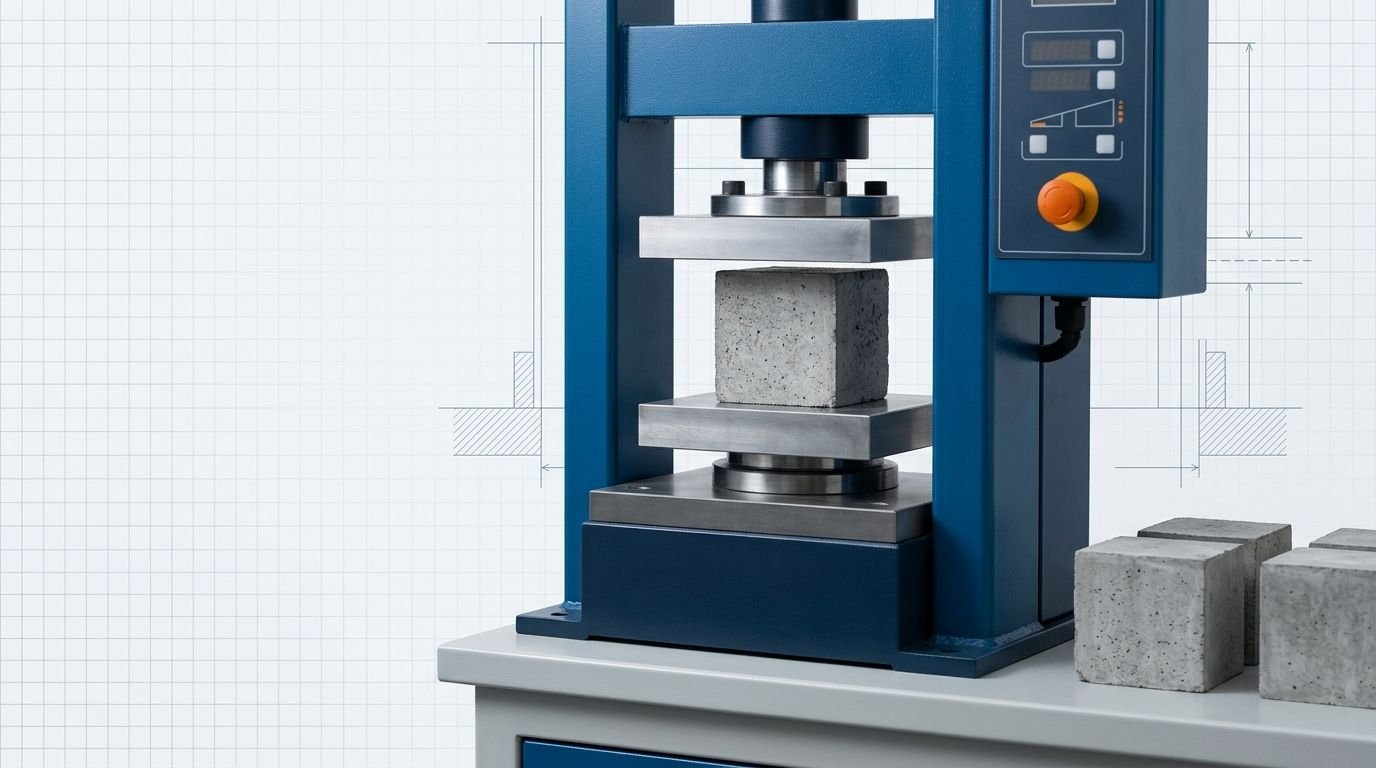
Concrete Cube Test (Compressive Strength)
Updated
The cube test is how concrete's strength is actually checked — cubes cast from the pour are crushed at 28 days, and their strength in MPa must meet the grade. It is the acceptance test behind every grade of concrete. This guide covers the procedure to IS 516, how to calculate the strength, and the IS 456 acceptance criteria.
150 mm cube
Standard specimen
7 & 28 days
When crushed
Load ÷ area
Strength = MPa
The procedure (IS 516)
- Sample fresh concrete from the pour and fill the 150 mm × 150 mm × 150 mm steel mould in three layers, tamping each 35 times (or vibrating).
- Finish the top level and store the mould undisturbed for 24 hours at site temperature.
- De-mould after 24 hours and cure the cubes in clean water until testing.
- Test in a compression testing machine — normally a set at 7 days and a set at 28 days — loading steadily until the cube fails.
- Record the maximum load at failure.
Cast at least three cubes per test so the average is representative. A 100 mm cube is allowed when the aggregate is small, with a size-correction factor.
How to calculate the strength
Compressive strength is the failure load divided by the cross-sectional area:
Strength (MPa) = Failure load (N) ÷ Area (mm²)
For a 150 mm cube the area is 150 × 150 = 22,500 mm². A cube failing at 450 kN gives 450,000 ÷ 22,500 = 20 MPa — an M20 result. To read strengths quoted the old way in kg/cm², use the kg/cm² to MPa converter.
What the numbers should reach
Concrete gains strength over time — roughly 65–70% at 7 days and the full characteristic strength at 28 days. The 7-day test is an early warning; the 28-day test is the acceptance test.
| Age | Approx. share of 28-day strength |
|---|---|
| 3 days | ~40% |
| 7 days | ~65–70% |
| 14 days | ~90% |
| 28 days | 100% |
IS 456 acceptance
Concrete is accepted on the characteristic strength — the value below which no more than 5% of results should fall. IS 456 sets acceptance criteria on the mean of test groups and individual results, with the mean required to exceed the grade strength by a margin. A single low cube does not by itself reject the concrete; the criteria work on the set.
Frequently asked questions
What is the size of a concrete cube for testing? The standard cube is 150 mm × 150 mm × 150 mm. A 100 mm cube may be used with small aggregate, applying a correction factor.
How is concrete compressive strength calculated? Divide the failure load by the cross-sectional area. For a 150 mm cube the area is 22,500 mm², so a failure load of 450 kN gives 20 MPa.
Why is the cube test done at 7 and 28 days? Concrete reaches about 65–70% of its strength at 7 days and its full characteristic strength at 28 days. The 7-day test is an early check; the 28-day test is the acceptance test.
What strength should M20 concrete reach? M20 concrete should reach a characteristic compressive strength of 20 MPa at 28 days on the standard cube test.
How many cubes are cast for one test? At least three cubes are cast per test so their average gives a representative result, usually with separate sets for the 7-day and 28-day ages.
CivilSite Editorial Team✓ Engineer reviewed
Written and reviewed by practising civil engineers with 10+ years of Indian residential construction experience.