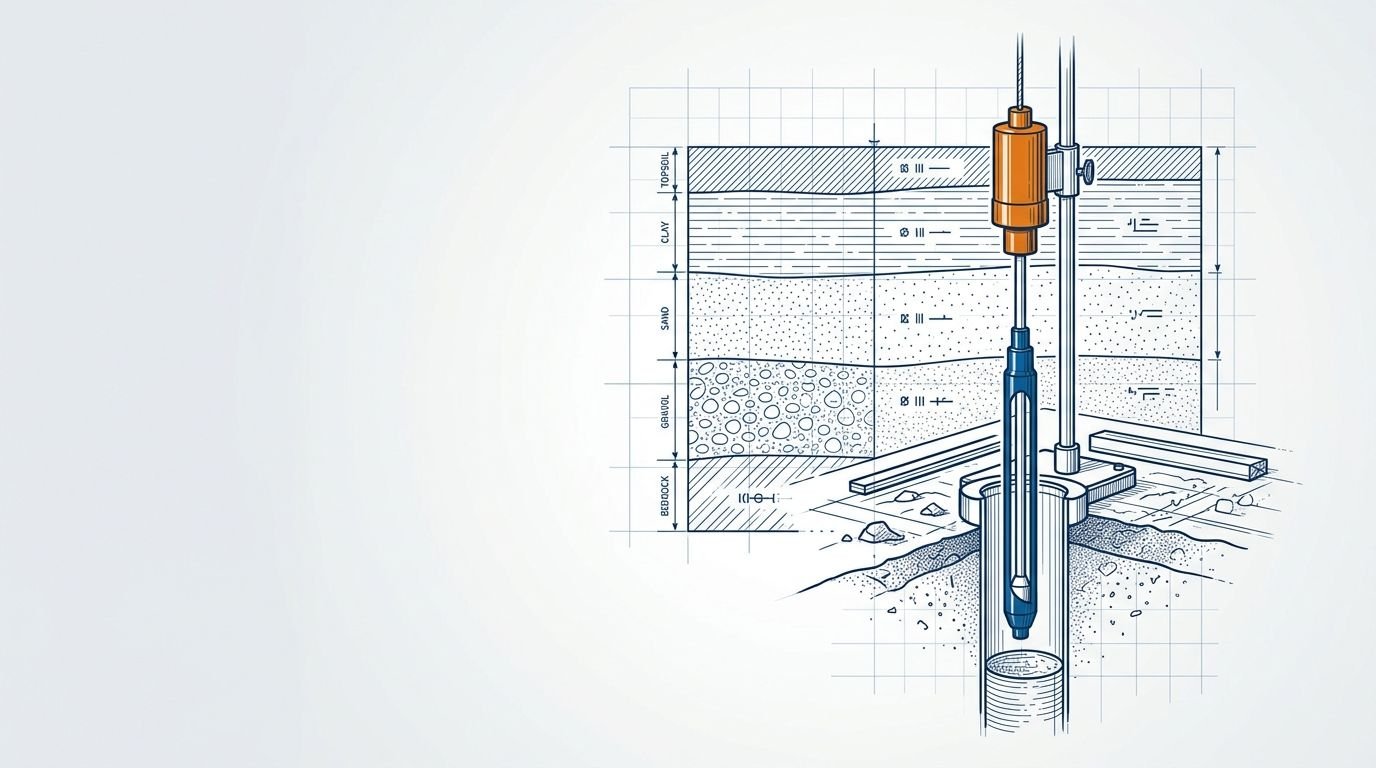
Standard Penetration Test (SPT)
Updated
The standard penetration test is the most common in-situ soil test performed during a geotechnical investigation, giving what's called the N-value — the number of hammer blows genuinely needed to drive a standard sampler a set distance into the soil at the bottom of a borehole. The N-value directly grades how dense a sand deposit is or how stiff a clay layer is, at that exact depth, and it feeds directly into the safe bearing capacity calculation used to size foundations. The procedure follows IS 2131, and it remains the workhorse test of Indian geotechnical practice precisely because it's comparatively quick, inexpensive, and directly usable at the borehole rather than requiring extensive lab processing before a result is available.
63.5 kg hammer, 750 mm drop
The standardised, repeatable blow
N = blows for the last 300 mm
The N-value definition
Density & bearing capacity
What the N-value ultimately grades
What the test physically measures, and why it works as a proxy
At the bottom of a borehole drilled to the desired test depth, a hollow split-spoon sampler — a sampler that splits lengthwise for easy recovery of the soil it collects — is driven into the undisturbed soil below by a standard, repeatable hammer blow. How hard the surrounding soil resists that driving — measured directly as the blow count needed — genuinely correlates with how dense a sandy soil is or how stiff a clay layer is, because denser or stiffer soil physically resists the sampler's penetration more than loose or soft soil does for the identical hammer energy input. That correlation, established empirically over decades of geotechnical practice and correlated against independent strength tests, is what makes the SPT such a widely trusted proxy for soil strength despite its underlying simplicity.
The procedure, step by step (IS 2131)
- 1
Bore to test depth
Bore down to the required test depth and clean the base of the hole thoroughly
- 2
Lower the sampler
Lower the split-spoon sampler to rest on the cleaned base of the borehole
- 3
Drive with the standard hammer
Drive the sampler using a 63.5 kg hammer falling freely through 750 mm
- 4
Drive in three 150 mm increments
Drive a total of 450 mm, recording the blow count for each 150 mm increment separately
- 5
Discard the seating drive
The blows for the first 150 mm (seating drive) are recorded but excluded from the N-value
- 6
Calculate the N-value
N-value = blows for the second increment + blows for the third increment (the last 300 mm)
- 7
Recover the sample
Recover the soil sample from the split spoon for visual identification and further lab testing
The first 150 mm is deliberately excluded from the N-value calculation because that initial increment disturbs loosened soil at the bottom of the borehole from the drilling process itself, not the undisturbed soil being tested.
What the N-value actually tells a foundation engineer
Broad, widely-used classification bands — actual foundation design always uses the site-specific corrected N-value and a proper bearing capacity correlation, not this classification alone.
- Higher N-values → denser sand or stiffer clay at that depth → generally higher bearing capacity and less anticipated settlement under a given foundation load.
- Low N-values (single digits) → loose or soft soil at that depth → low bearing capacity, greater anticipated settlement, and possibly a need for deep foundations or piles rather than ordinary shallow footings.
Why the raw field N-value isn't used directly in design
A detail that matters in practice: the raw field N-value recorded at the borehole is never used directly in a bearing-capacity calculation without correction first. It's corrected for overburden pressure — the confining effect of the soil weight above the test depth, which genuinely affects blow count independent of the soil's inherent density — and, specifically in fine saturated sands, for dilatancy, a correction that accounts for pore-water pressure effects that can otherwise distort the raw reading in that particular soil condition. Skipping these corrections and using the raw field number directly is a recognised source of real design error, which is exactly why a proper geotechnical report always presents both the field and the corrected N-value rather than the field figure alone. The corrected N-value is one of the primary inputs to estimating the safe bearing capacity and to the broader decision of which foundation type actually suits the site.
Frequently asked questions
What is the standard penetration test? It is an in-situ soil test in which a split-spoon sampler is driven into the base of a borehole by a standard 63.5 kg hammer, and the number of blows needed to drive it a set distance gives the N-value, a measure of the soil's relative density or stiffness at that depth.
How is the SPT N-value calculated? The sampler is driven a total of 450 mm in three separate 150 mm increments. The blows for the first 150 mm (the seating drive, which disturbs loosened soil from drilling) are recorded but excluded, and the N-value is the sum of the blows for the second and third increments — the last 300 mm driven.
What hammer is used in the SPT, and why is it standardised? A 63.5 kg hammer falling freely through exactly 750 mm is the standard, delivering a precisely repeatable energy input to drive the split-spoon sampler — the standardisation is exactly what makes N-values comparable across different sites, operators and equipment.
What does a high N-value mean for foundation design? A high N-value indicates dense sand or stiff clay at that depth, generally meaning higher bearing capacity and less anticipated settlement. A low N-value indicates loose or soft soil, which may point toward a raft or pile foundation rather than an ordinary shallow footing.
Why is the raw field N-value corrected before it's used in design? Because the raw reading is affected by the confining pressure of overlying soil (overburden) and, in fine saturated sands, by pore-water pressure effects (dilatancy) — both of which distort the blow count independent of the soil's true underlying density or stiffness. A proper geotechnical report always applies these corrections before the N-value is used in a bearing-capacity calculation.
CivilSite Editorial Team✓ Engineer reviewed
Written and reviewed by practising civil engineers with 10+ years of Indian residential construction experience.