Workability of Concrete
Updated
Workability is how easily fresh concrete can be mixed, transported, placed, compacted and finished without segregating — and getting it right is a genuine balancing act, since the easiest fix for poor workability (adding more water) is also the single most damaging thing you can do to the concrete's final strength. Understanding what actually controls workability, separate from the tempting shortcut of the water tap, is one of the more consequential pieces of site knowledge in concrete work.
Ease of placing & compacting
What it means
Water is the easy lever
But it cuts strength
Measured by slump
The standard site test
What workability actually requires, precisely
Workable concrete has to do several things at once: flow enough to completely fill the formwork (including tight corners and around congested reinforcement), compact fully under the vibration or tamping effort actually available on site, and do all of this without segregating — without the heavier aggregate settling out from the cement paste, or excess water rising to the surface as bleeding. It's genuinely a three-way balance, and a mix that's merely "wet enough to pour easily" can still fail badly at the compaction or segregation-resistance requirement.
The trap: water fixes workability but destroys strength
✓The right way to raise workability
- •Add a plasticiser or superplasticiser admixture
- •Improve aggregate grading (well-graded, rounded where possible)
- •Increase the fine-aggregate (sand) content slightly, within mix-design limits
- •Use a slightly richer cement content if the design allows
✕Why simply adding water is the wrong fix
- •Raises the water–cement ratio, directly cutting final compressive strength
- •Increases drying shrinkage and cracking risk
- •Promotes segregation and bleeding as the mix becomes too fluid
- •Reduces durability by leaving more capillary pores in the hardened paste
This is precisely why "just add a bit of water, it'll pour easier" is one of the most common and most damaging habits on Indian sites — it solves today's placing problem by quietly weakening the concrete for the next fifty years.
The factors that genuinely affect workability
- Water content — the most powerful lever by far, which is exactly why it must be controlled through mix design rather than adjusted freely on site. See the water–cement ratio guide for how tightly this is actually specified.
- Aggregate shape and grading — rounded, well-graded aggregate flows more easily than angular or poorly graded (single-size) aggregate, for the same reason M-sand vs river sand behave differently.
- Fine aggregate (sand) proportion — more sand improves cohesion and flow up to a point, beyond which the mix becomes sticky and harder to compact.
- Admixtures — plasticisers and superplasticisers are specifically designed to raise workability without adding water, by chemically dispersing cement particles more effectively.
- Cement content and type — richer mixes tend to be more cohesive and workable; finer or blended cements (PPC) can also shift workability slightly.
- Ambient temperature and elapsed time — concrete stiffens progressively from the moment it's mixed, and heat accelerates that stiffening, so workability measured at the mixer can be noticeably different from workability at the point of placing, especially on a hot day or after a long haul.
How workability is actually measured
| Method | Best suited to | What it measures |
|---|---|---|
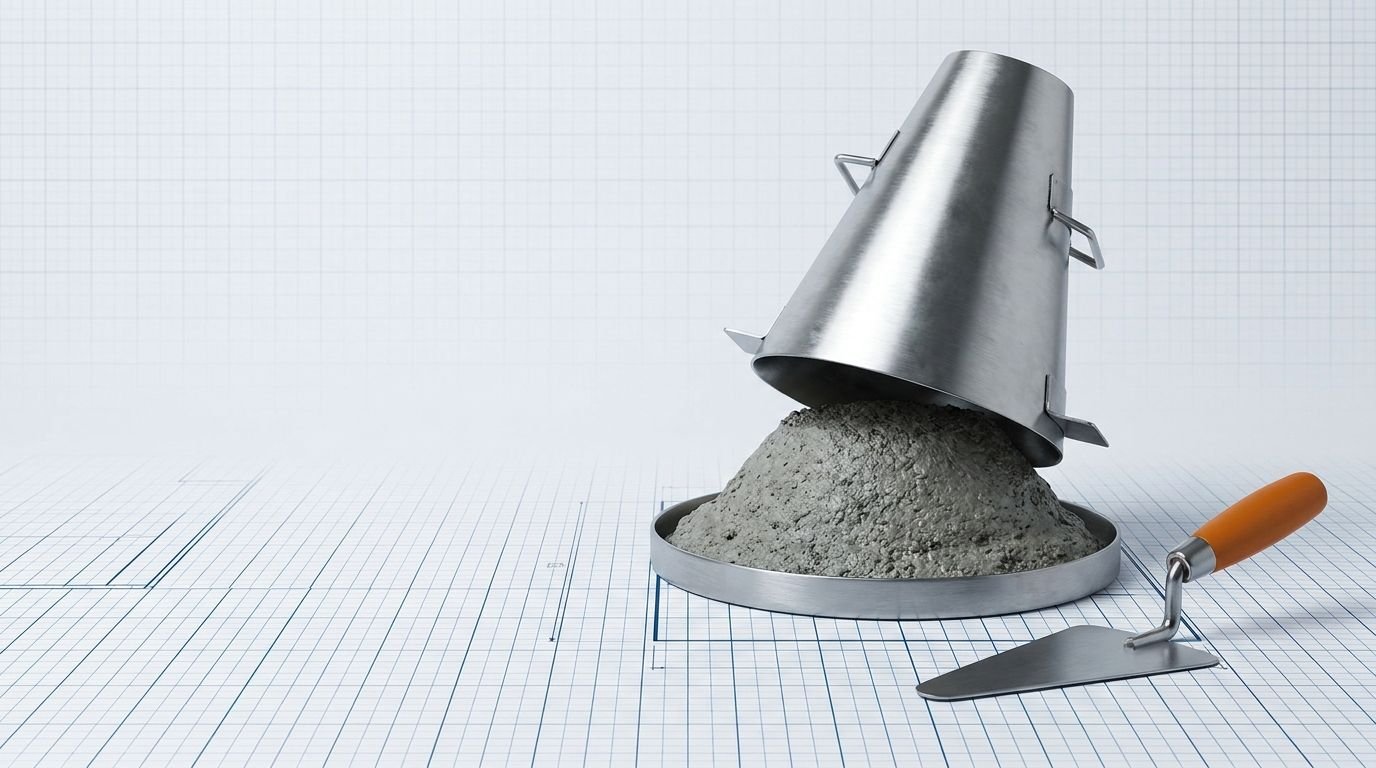
| Slump test | General site use — the standard everyday test | How far a cone of fresh concrete settles under its own weight |
| Compaction factor test | Lower-workability, drier mixes | The degree of compaction achieved under a standard effort |
| Vee-Bee consistometer | Very dry, stiff mixes (e.g. some paving/precast work) | Time for a shaped mass to remould into a cylindrical form under vibration |
The slump test dominates ordinary site practice because it's fast, needs minimal equipment, and gives an immediately actionable number — but the other two methods exist because slump becomes less discriminating at the very dry or very wet ends of the workability range, where a compaction-factor or Vee-Bee reading gives a more meaningful comparison.
Typical slump values by application
Higher slump generally requires a plasticiser to achieve without simply adding extra water — see the concrete mix & slump reference for the full picture by mix grade.
Matching the target slump to the actual placing method and reinforcement congestion — not just picking a number that "looks easy to pour" — is what the concrete mix & slump reference is built around. Congested reinforcement genuinely needs a more flowable mix to fully encase every bar without voids; a lightly reinforced mass foundation can use a much stiffer, drier mix perfectly safely.
Frequently asked questions
What is workability of concrete? It is how easily fresh concrete can be mixed, transported, placed, compacted and finished without segregating. Workable concrete flows enough to fill the formwork and fully surround the reinforcement, and compacts completely under the available effort, without bleeding or the aggregate settling out.
What factors affect the workability of concrete? Water content (the strongest single factor), aggregate shape and grading, sand content, chemical admixtures (plasticisers), cement content and type, and ambient temperature and elapsed time since mixing all affect workability.
How is workability of concrete measured? Mainly by the slump test on site, which is fast and needs minimal equipment. The compaction factor test suits stiffer, lower-workability mixes, and the Vee-Bee consistometer suits very dry mixes, where slump alone becomes less discriminating.
What is a good slump for concrete? Around 50–100 mm suits most ordinary RCC slabs, beams and columns; 25–75 mm suits foundations and mass concrete; and 100–150 mm (achieved with a plasticiser, not extra water) suits heavily reinforced or pumped concrete.
Does adding water improve workability? It does raise workability in the short term, but at a real cost — it increases the water–cement ratio, which directly cuts final strength and durability, and increases shrinkage and segregation risk. A plasticiser or superplasticiser is the correct way to raise workability without this trade-off.
Why does workability drop before concrete is placed? Fresh concrete stiffens progressively from the moment water contacts cement, and this process accelerates with heat — so concrete measured at the batching plant can genuinely lose workability by the time it reaches the pour, especially in hot weather or after a long transport time, which is why slump is often re-checked at the point of placing on larger pours.
Can workability be too high? Yes. Excessively fluid concrete (very high slump achieved by over-watering rather than admixtures) is prone to segregation, where coarser aggregate settles and excess water bleeds to the surface — this produces a weaker, less durable and less uniform hardened concrete despite looking easy to place.
CivilSite Editorial Team✓ Engineer reviewed
Written and reviewed by practising civil engineers with 10+ years of Indian residential construction experience.