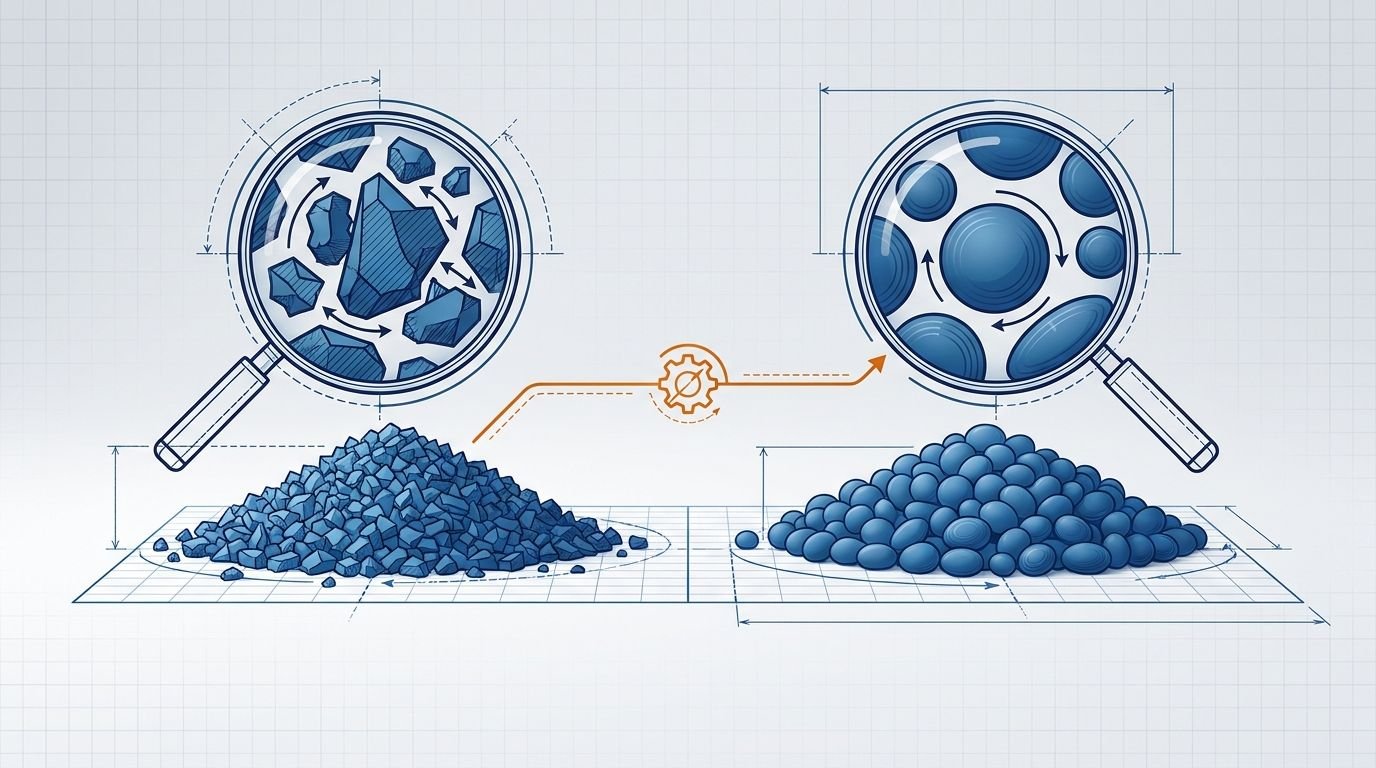
M Sand vs River Sand
Updated
M-sand (manufactured sand) is crushed from hard rock; river sand is natural sand dredged from riverbeds — and with river sand increasingly banned, taxed and scarce, M-sand has become the practical default on most Indian sites today. This page compares the two in depth for concrete, plaster and masonry — how each is made, what the science of grain shape actually changes, and where each still has a legitimate place.
M-sand = crushed rock
Manufactured, angular
River sand = natural
Dredged, rounded
Both need silt < 3%
For concrete
How each sand is actually produced
River sand forms over geological time as rivers erode rock upstream and carry the fragments downstream, where years of tumbling in flowing water wears every grain smooth and rounded. It is mined by dredging riverbeds and banks — a process that, done without control, destroys aquatic habitats, lowers water tables and undermines bridges and embankments, which is why most Indian states now heavily restrict or outright ban it.
M-sand is manufactured in a crusher plant: hard rock (typically granite or basalt) is fed through jaw and cone crushers, then washed and screened through vibrating sieves to the size range required for construction sand. Because it is made to order from a controlled process, its grading, moisture and silt content can be far more consistent batch to batch than a natural material dug from a riverbed.
Why grain shape actually matters
This is the physical fact behind every practical difference between the two: river sand grains are rounded and smooth, while M-sand grains are angular and rough-textured (a direct result of being fractured by mechanical crushing rather than worn by water).
- Rounded grains slide past each other easily, which is why river sand needs less water to reach a given workability — it flows more freely in a wet mix.
- Angular grains interlock mechanically, which gives the hardened concrete or mortar better particle-to-particle bond and higher strength for the same cement content — but the mix needs slightly more water (or a plasticiser) to achieve the same workability, because the rough surfaces resist flow.
Neither shape is "better" in the abstract — angularity trades a little workability for more strength and interlock, which is usually the right trade for structural concrete.
M-sand vs river sand at a glance
| Property | M-sand | River sand |
|---|---|---|
| Source | Crushed hard rock (granite/basalt) | Natural riverbed, dredged |
| Grain shape | Angular, rough | Rounded, smooth |
| Silt / impurities | Low, controlled at the plant | Often high; varies by source and season |
| Water demand | Slightly higher | Lower |
| Workability | Good; may need plasticiser | Very good, naturally flows |
| Bond / interlock strength | Better (angular grains lock together) | Lower |
| Consistency batch-to-batch | Uniform, quality-controlled | Variable |
| Availability & legality | Widely available, unrestricted | Restricted or banned in many states |
| Cost | Usually lower and stable | Rising, and increasingly hard to source legally |
| Environmental impact | Uses quarry waste, no river damage | Riverbed/bank erosion, habitat loss |
Silt and impurities — the quality test that actually matters
Whichever sand you use, silt content is the single number that predicts whether it will weaken your concrete. Silt (fine clay and dust) coats the sand grains and prevents cement paste from bonding to them properly, and it also absorbs mix water without contributing any strength. A simple field test gives a fast check:
- Fill a clear bottle to about a third with sand, then add water until it's three-quarters full.
- Shake vigorously and let it settle for an hour.
- A layer of silt separates on top of the sand — its thickness as a percentage of the sand layer below is the approximate silt content.
Silt content should generally stay under 3% for concrete work. River sand from an unregulated source can run considerably higher and should be washed before use; M-sand from a reputable plant is usually well within this limit as delivered.
Which is better — by use, in detail
- RCC / structural concrete — M-sand is now the standard choice. Its angular interlock gives good strength, it's consistently graded to IS 383, and it's the only realistic option in most states given river-sand restrictions.
- Plastering — both work well. River sand gives a marginally smoother trowel finish because of its rounded grains, but well-graded plastering-grade M-sand (a finer cut specifically screened for plaster) is now widely available and gives comparable results at lower cost.
- Masonry mortar — either is acceptable; keep silt content low and match the grading to the joint thickness.
- Fine architectural finishes / kota polishing beds — some contractors still prefer river sand's natural rounding for very specific decorative work, but this is a minority use case.
A quick way to tell them apart on site
Rub a handful between your fingers: M-sand feels gritty and slightly abrasive because of its angular edges, while river sand feels smooth and almost silky. Under a magnifying glass, M-sand grains show sharp facets and fracture planes; river sand grains are rounded like tiny pebbles. Neither test replaces a proper sieve analysis, but both are useful first checks when receiving a delivery.
For most Indian construction today, M-sand conforming to IS 383 is the practical, legal, and consistent choice for concrete, with river sand reserved for finishing work where it remains legally available. Work out quantities with the concrete calculator and the brass converter, and check the full grading requirements in the IS 383 aggregates standard.
Frequently asked questions
Which is better, M sand or river sand? For concrete, M-sand is now the practical choice — consistent, low-silt, legal and usually cheaper, with better particle interlock from its angular grains. River sand is smoother and slightly more workable but variable and increasingly restricted. Many sites use M-sand throughout and river sand only for fine finishing work where available.
Is M sand good for concrete? Yes. M-sand conforming to IS 383 is well suited to concrete; its angular grains bond well with cement paste and give good strength. It may need slightly more water or a plasticiser for the same workability as river sand.
Why is river sand banned in many Indian states? Unregulated river-sand mining damages riverbeds, banks and groundwater, undermines bridges and embankments, and destroys aquatic habitats — which is why many states restrict or ban it. This, plus rising cost and scarcity, is why M-sand has become the practical standard.
Does M sand need more water than river sand? Slightly. M-sand's angular grains resist flow more than smooth river sand, demanding a little more water or a plasticiser to reach the same workability — but the water–cement ratio must still be kept low for strength, so a plasticiser is the better fix than simply adding water.
What is the silt content limit for sand in concrete? For concrete, silt should generally be under about 3% by volume. Excess silt coats the sand grains, weakens the bond with cement paste, and increases water demand — so sand exceeding the limit should be washed before use.
Can I mix M-sand and river sand together? It's not standard practice and offers no real benefit — use one graded sand consistently for a given pour or plaster batch so the mix behaves predictably. If you must blend for availability reasons, keep the proportions consistent across the whole job.
Is plastering-grade M-sand different from concrete-grade M-sand? Yes. Plastering-grade M-sand is screened to a finer particle size specifically for smooth wall finishes, while concrete-grade M-sand retains a coarser grading suited to structural mixes — always ask your supplier for the correct grade for the job.
CivilSite Editorial Team✓ Engineer reviewed
Written and reviewed by practising civil engineers with 10+ years of Indian residential construction experience.