What Is Shoring
Updated
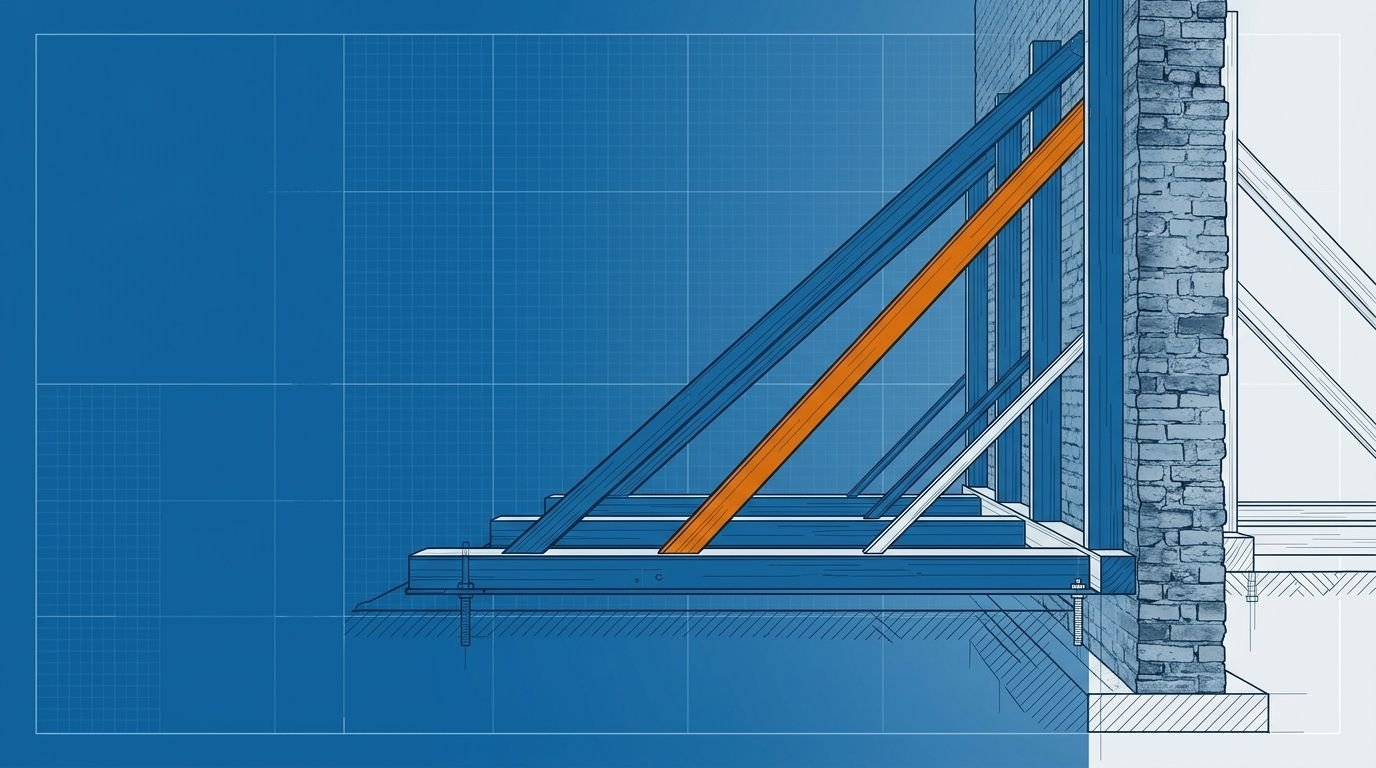
Shoring is the temporary support propped against, between, or under a wall or structure to hold it safely in place while it's being repaired, altered, or while related work goes on nearby. Its whole purpose is to keep an unsafe or temporarily-unsupported structure standing until the permanent structure is built and can carry itself again. This page covers the three recognised types of shoring, where each is used, and how shoring differs from the related operations of underpinning and scaffolding, which are frequently confused with it.
Temporary structural support
For a wall or structure
Raking · flying · dead
The three recognised types
Holds it up while you work
The single purpose
When shoring is used
- A wall showing signs of failure — bulging, leaning or seriously cracking, propped and held stable until it can be repaired or rebuilt.
- Alterations — removing a lower wall, forming a large new opening, or rebuilding a portion of a structure, all while the structure above is held safely in place.
- Deep excavation nearby — supporting an adjacent building whose foundation could otherwise be undermined by the excavation (a situation closely related to underpinning).
- Controlled dismantling — providing controlled support during the demolition of part of a structure, so the remaining portion stays stable.
The three types of shoring
| Type | What it is | Where used |
|---|---|---|
| Raking shore | Inclined props (rakers) leaning against the wall down to a ground sole plate | Supporting a wall laterally during repair |
| Flying (horizontal) shore | Horizontal struts spanning between two parallel walls | Where there's no ground to rake to — between closely spaced buildings |
| Dead (vertical) shore | Vertical props carrying loads from above straight down to the ground | When a lower wall or opening is removed and the load above must be carried |
Raking shores lean in at an angle to hold a wall against sideways movement, transferring the lateral thrust down to a sole plate bearing on the ground. Flying shores brace horizontally directly between two parallel walls — genuinely useful in narrow streets or tight gaps where an inclined raker simply couldn't reach the ground to bear against. Dead shores stand vertically to carry weight from above straight down when the wall beneath is being opened up or removed — for instance, holding up the entire structure above while a new large opening is formed at ground level and its permanent lintel or beam is built.
Shoring vs underpinning vs scaffolding — three genuinely different things
These three terms are routinely confused on site, but they solve genuinely different problems, and mixing them up leads to real misunderstandings about what's actually being done:
- Shoring temporarily supports an existing structure, holding it stable while work is carried out.
- Underpinning permanently strengthens or deepens the foundation itself — it's a permanent fix to the substructure, not temporary support.
- Scaffolding is a working platform for people and materials to reach height — it carries workers and their materials, and is emphatically not structural support for the building itself.
The clean way to hold the distinction: shoring holds the building up temporarily; underpinning permanently fixes the foundation; scaffolding holds the workers up. Shoring is genuinely engineered temporary works — designed and sized for the actual loads it must carry, and removed only once the permanent structure can safely carry itself without it.
Frequently asked questions
What is shoring in construction? Shoring is temporary support propped against, between or under a wall or structure to hold it safely in place while it's repaired, altered, or while related work goes on nearby — keeping it stable until the permanent structure can carry itself again.
What are the types of shoring? Raking (inclined) shores, flying (horizontal) shores and dead (vertical) shores. Raking shores support a wall laterally, flying shores brace horizontally between two parallel walls, and dead shores carry loads from above straight down to the ground.
What is the difference between shoring and underpinning? Shoring temporarily supports an existing wall or structure while work is done; underpinning permanently strengthens or deepens its foundation. Shoring holds things up during the work; underpinning is the permanent fix to the foundation itself.
When is dead shoring specifically used? When a lower wall is being removed or a large opening formed, dead (vertical) shores carry the load from the structure above straight down to the ground while the new permanent support — a lintel or beam — is built to take over.
Is shoring the same as scaffolding? No. Shoring provides genuine structural support to hold a building or wall safely in place; scaffolding provides a working platform for workers and materials to reach height. They serve entirely different purposes and shouldn't be conflated.
CivilSite Editorial Team✓ Engineer reviewed
Written and reviewed by practising civil engineers with 10+ years of Indian residential construction experience.