What Is Creep in Concrete
Updated
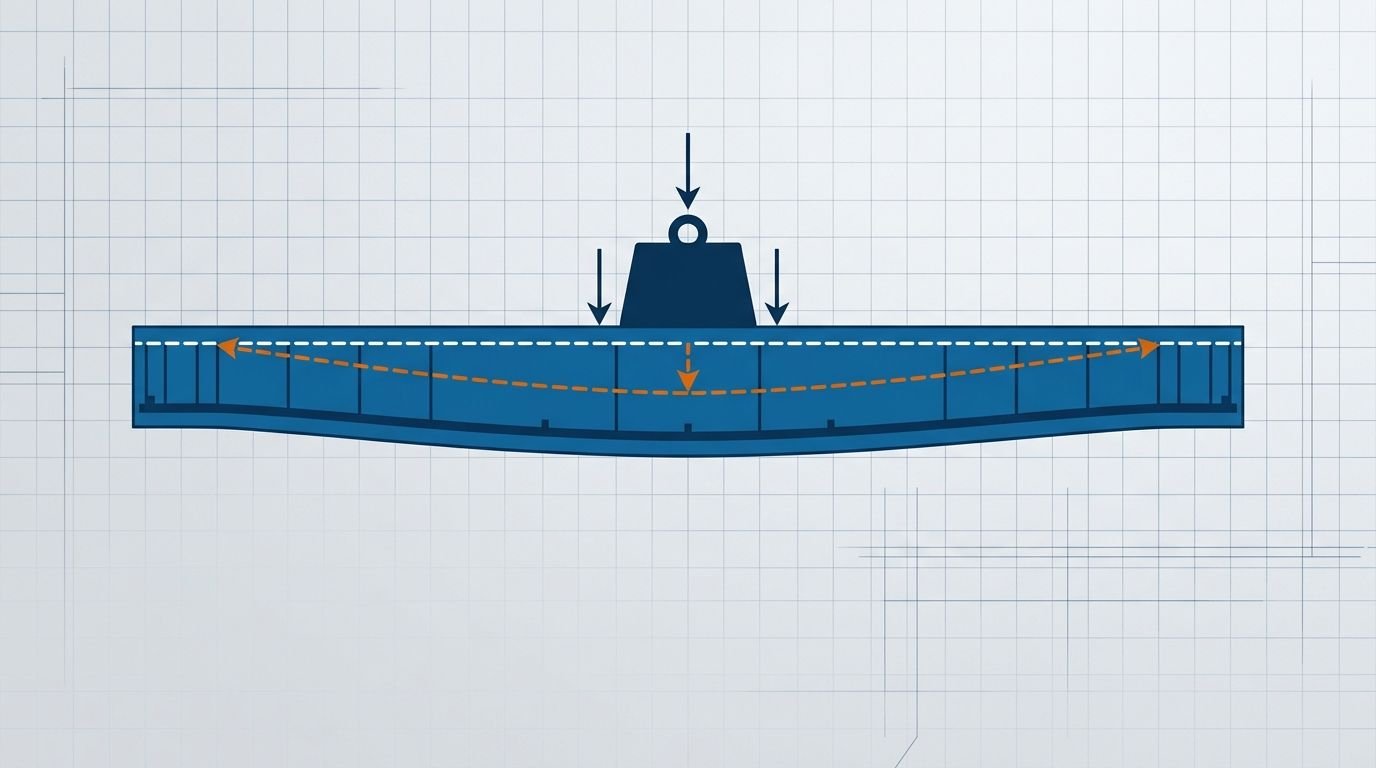
Creep is the slow, ongoing increase in concrete's deformation under a load that stays applied to it — the concrete keeps deflecting for months and even years after the load first goes on, without any increase whatsoever in the load itself. It's a genuinely time-dependent phenomenon, distinct from the immediate elastic deflection that happens the moment a load is applied, and it matters most for long-term deflection of slabs and beams and for the gradual loss of prestress in prestressed concrete. This page explains what creep is, what drives it, and how it's allowed for in design.
Deformation grows over time
Under a sustained, constant load
No extra load required
Purely time-dependent
Adds to long-term deflection
The main practical effect
What creep actually is
When a load is first applied to concrete, it deforms immediately — this instant response is the elastic strain, and it's fully recoverable if the load is removed straight away. But if that load stays applied, as the self-weight of a structure and its permanent loads always do, the concrete keeps deforming slowly over time, and this additional, gradually-accumulating strain is creep. Physically, creep occurs as the water held within the hardened cement paste is gradually squeezed and rearranged under the sustained internal stress — a slow, viscous-like flow within the material's microstructure. Creep is largest early in a structure's life, when the sustained load is freshly applied, and it tapers off progressively over the following years, but it never entirely stops.
What increases creep
A relative comparison of how strongly each factor drives creep — not an absolute engineering scale. Sustained stress and early loading are the two dominant drivers.
- Higher sustained stress — the more load kept permanently on the member, the more it creeps; creep scales with the sustained stress level.
- Loading at an early age — young, incompletely-hydrated concrete creeps considerably more than mature concrete, which is exactly why props and formwork shouldn't be struck, and heavy loads shouldn't be applied, before the concrete has gained adequate strength.
- High water–cement ratio and a high proportion of cement paste in the mix — since it's the paste, not the aggregate, that actually creeps.
- Dry, warm conditions — where creep and drying shrinkage act together to increase total long-term deformation.
- Less or weaker aggregate — strong, stiff aggregate physically restrains the surrounding paste and reduces overall creep.
Effects of creep on a structure
- Increased long-term deflection — the eventual long-term deflection of a slab or beam is often substantially larger than its immediate elastic deflection, which is precisely why design codes apply a multiplier to account for long-term creep and shrinkage effects rather than using the immediate value alone. See beam deflection.
- Loss of prestress — in prestressed and post-tensioned slabs, creep gradually shortens the concrete under the sustained compression, which relaxes the tensioned tendons and causes a genuine loss of some of the applied prestress over time — a loss the design must anticipate and compensate for from the outset.
- Redistribution of stress between the concrete and the reinforcing steel over time, as the concrete slowly creeps and sheds some of its share of the sustained load onto the steel.
Why creep isn't purely a problem to be eliminated
It's worth being clear that creep isn't universally harmful — in some situations it genuinely helps, by allowing a structure to slowly relieve stress concentrations that would otherwise remain locked in, as the concrete gently flows and redistributes stress toward a more even state. The engineering goal is therefore not to eliminate creep (which is impossible) but to allow for it correctly in deflection and prestress calculations, so its effects are anticipated rather than discovered as unexpected long-term sagging or prestress loss. Creep is genuinely distinct from shrinkage: creep is deformation driven by sustained load, while shrinkage is a volume reduction from water loss that happens with or without any load at all — though the two act together to increase a structure's total long-term deflection.
Frequently asked questions
What is creep in concrete? Creep is the slow, time-dependent increase in concrete's deformation under a sustained (constant) load. The concrete keeps deflecting over months and years after the load is first applied, without any increase in the load itself.
What causes creep in concrete? It's caused by the gradual movement and rearrangement of water within the hardened cement paste under sustained internal stress. Higher sustained stress, loading at an early age, a high water–cement ratio, and dry conditions all increase it.
What is the difference between creep and shrinkage? Creep is deformation under a sustained load and depends directly on the stress level; shrinkage is a reduction in volume as concrete dries and happens whether or not there's any load at all. Both act together to increase long-term deflection, but they have genuinely different causes.
How does creep affect a structure? It increases the long-term deflection of slabs and beams beyond their immediate elastic value, and causes a gradual loss of prestress in prestressed and post-tensioned members — which is why design applies long-term multipliers and anticipates prestress losses from the start.
How can creep be reduced? By using a low water–cement ratio, strong and stiff aggregate, allowing adequate cement hydration before applying heavy load or striking props (not loading too early), and keeping the sustained stress levels moderate rather than working the concrete near its limit under permanent load.
CivilSite Editorial Team✓ Engineer reviewed
Written and reviewed by practising civil engineers with 10+ years of Indian residential construction experience.