What Is Bulking of Sand
Updated
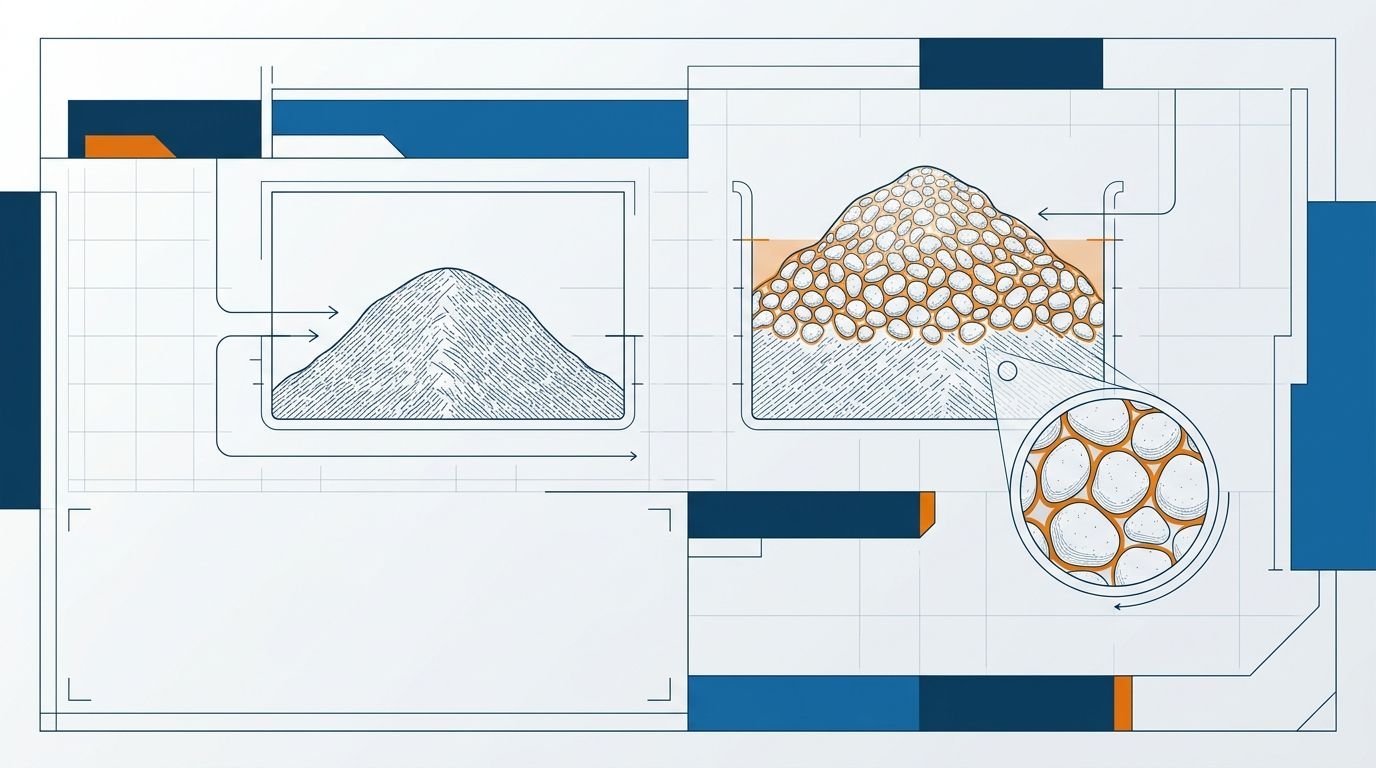
Bulking of sand is the increase in its apparent volume when it's damp — a thin film of water pushes the individual grains apart, so the exact same weight of sand physically takes up more space than it would dry. It sounds like a harmless curiosity, but on any site that still batches concrete by volume (gauge boxes rather than a weighbridge), it quietly under-sands every single mix without anyone noticing until the concrete comes out harsh and weaker than intended. This page explains the actual mechanism, the field test used to measure it, and how experienced site engineers correct for it.
Damp sand swells
Up to 20–30% in volume
Peaks at ~4–6% moisture
Then falls sharply
Silently under-sands volume batching
The real practical problem
Why sand bulks at all — the actual mechanism
A small amount of moisture forms a thin film of water around each individual sand grain. Surface tension in that film holds neighbouring grains apart from each other, rather than letting them settle into their natural, tightly-packed dry arrangement. The result is that a given weight of damp sand occupies noticeably more volume than the same sand would occupy dry — the grains themselves haven't changed size at all, only the air gaps between them have grown.
Bulking rises sharply with initial moisture, peaks around 4–6% moisture content, then collapses back toward near-zero once the sand is fully flooded.
The effect grows steadily with moisture content up to roughly 4–6% moisture, where the volume increase can reach as much as 20–30%, and then it falls away sharply — genuinely saturated (flooded) sand returns to nearly its dry volume, because at full saturation the water films between grains merge into one continuous body of water and the grains settle back together under their own weight, no longer held apart by surface tension. This is the counter-intuitive part that trips up people encountering bulking for the first time: it isn't "more water, more bulking" in a straight line — partially wet sand bulks far more than either bone-dry or completely flooded sand. Fine sand also bulks noticeably more than coarse sand for the same moisture content, since it has a much larger total surface area per unit weight for the water film to act across.
Why this actually matters on a real site
If concrete is batched by volume using gauge boxes, and the sand used is damp (as construction sand almost always is, having been stored in the open or delivered with residual moisture) but the gauge box was calibrated assuming dry sand, each box of "sand" actually contains less real sand by weight than intended — the extra volume is water film and air gaps, not additional material. The resulting concrete mix ends up genuinely short of sand relative to the design proportions, producing a mix that's harsher to work, more prone to segregation, and measurably under-strength compared to what the mix design intended. This is a quiet, invisible error precisely because the gauge box still "looks full" — nothing about the process visibly signals that anything has gone wrong. Batching by weight sidesteps the entire problem, since weight is unaffected by bulking regardless of moisture content — which is one practical reason design mixes for anything beyond small nominal-mix work are specified as weigh-batched rather than volume-batched.
The field test for bulking
A simple, low-cost field test measures the actual bulking percentage for the sand on hand, rather than relying on a textbook average that may not match the specific sand and moisture on that day:
- Fill a container to a known height with the damp sand, placed loosely without tamping, and note the level (h1).
- Empty the container completely, then flood the same sand with water in a bucket and refill the container loosely with the now-saturated sand — the individual grains settle to their true, tightly packed volume. Note the new level (h2).
- Bulking (%) = (h1 − h2) ÷ h2 × 100.
Running this test periodically through a project — sand moisture content genuinely varies with weather, storage, and delivery batch — is far more reliable than assuming a fixed textbook bulking percentage for every batch of sand that arrives on site.
How to correct for it in practice
- Batch by weight wherever accuracy genuinely matters — this sidesteps bulking entirely, since it's a volume effect that simply doesn't apply to a weight measurement.
- If batching by volume out of necessity (smaller sites, informal work), add extra sand to the gauge box to make up for the measured bulking percentage from the field test above, or use the bulking input built into the concrete calculator so the quantities it generates already allow for it rather than being quietly short.
See also the volume and unit conversions reference and the comparison of M-sand vs river sand, since the two sand types can bulk somewhat differently given their different grain shapes and gradations.
Frequently asked questions
What is bulking of sand? It is the increase in the apparent volume of sand when it's damp — a thin film of water around each grain pushes the grains apart, so the exact same weight of sand takes up noticeably more space than it would dry.
How much does sand bulk? Bulking can increase the apparent volume by about 20–30%, typically peaking at around 4–6% moisture content. Fully saturated (flooded) sand returns to nearly its dry volume once the water films merge and the grains settle together again.
Why is bulking of sand important in concrete work? Because sites that batch concrete by volume using damp sand end up genuinely short of sand relative to the mix design — the resulting mix becomes harsher and measurably weaker than intended. Batching by weight avoids the problem entirely, or extra sand is deliberately added to correct for the measured bulking.
How is bulking of sand measured on site? With a simple field test: measure the loose volume of the damp sand in a container, then flood that same sand with water so it settles to its true, tightly packed volume, and calculate the percentage increase between the two readings.
Does fully saturated sand still bulk? No. Fully saturated (flooded) sand returns to nearly its dry volume because the individual water films around each grain merge into one continuous body of water, letting the grains settle back together. Bulking is at its greatest at partial moisture content, not at full saturation.
CivilSite Editorial Team✓ Engineer reviewed
Written and reviewed by practising civil engineers with 10+ years of Indian residential construction experience.