Brick Masonry vs Block Masonry
Updated
Bricks are small units laid many to a wall; blocks — AAC or concrete — are large units that build the same wall faster with far fewer joints, and they're lighter and better insulating, while bricks remain familiar, strong and forgiving to work with. This page compares the two systems in depth for the walls of a modern RCC-framed house, where masonry only ever fills the frame and carries its own weight.
Brick = small unit
~500 per m³
Block = large unit
Fewer, faster
AAC = light + insulating
For apartments
Two different building logics
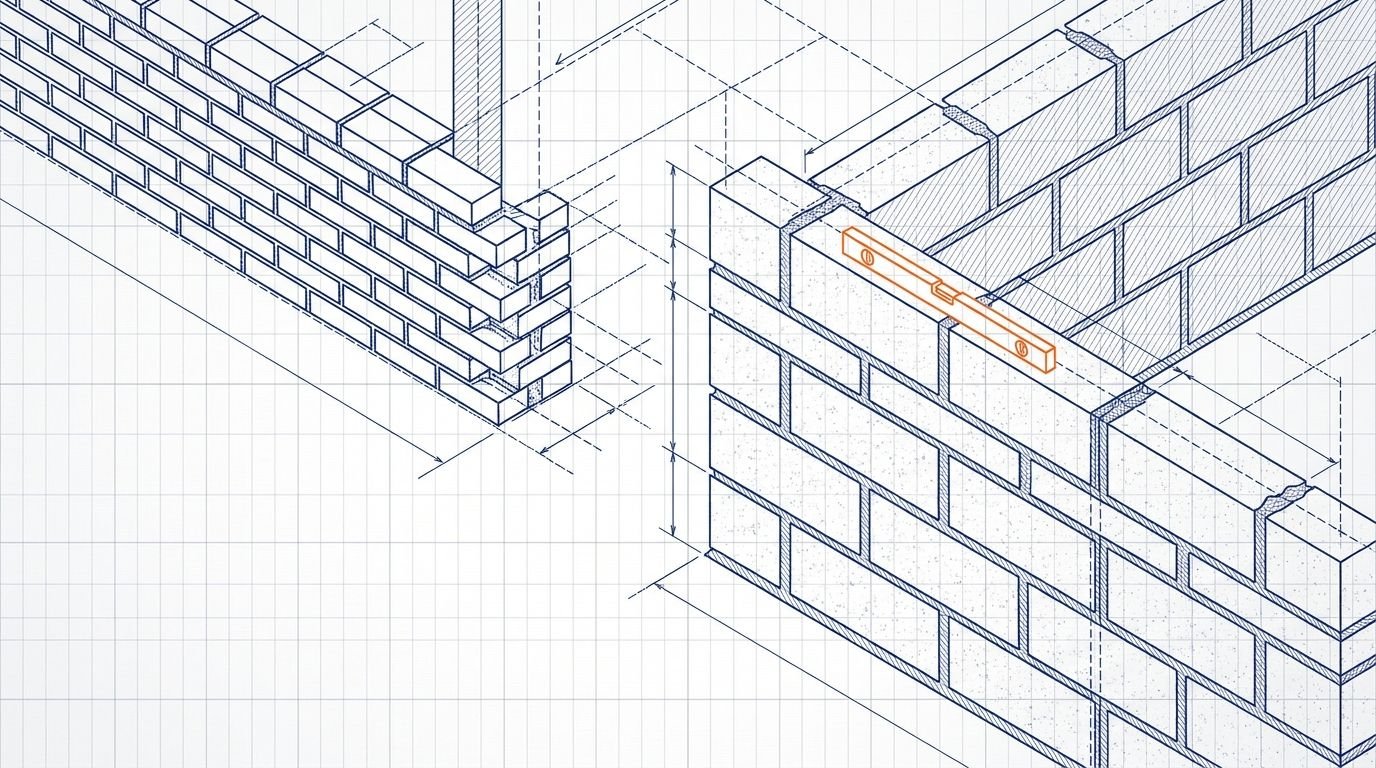
Brick masonry and block masonry aren't just different sizes of the same idea — they represent two different logics for building a wall. Brick masonry relies on a large number of small, uniform units bonded in an overlapping pattern (see brick bond types) — the wall's strength comes partly from the sheer number of overlapping joints distributing load. Block masonry relies on far fewer, much larger units — a single AAC block can replace roughly eight to ten standard bricks — so the wall has dramatically fewer joints, and speed and weight savings dominate the calculation rather than joint-pattern strength.
Unit sizes compared
Traditional brick230×110×70 mm
Concrete block400×200×200 mm
AAC block600×200×200 mm
Illustrative comparison of typical unit lengths — actual block sizes vary by manufacturer, and this compares length only, not the full 3D volume difference.
Brick vs block masonry at a glance
| Property | Brick masonry | Block masonry (AAC) | Block masonry (concrete) |
|---|---|---|---|
| Unit size | Small (230×110×70 mm) | Large (600×200×200 mm) | Large (400×200×200 mm) |
| Units per m³ of wall | ~500 | ~14 | ~30 |
| Build speed | Slower | Fastest | Fast |
| Mortar / joints per wall | High | Very low | Low |
| Dead weight on frame | Heaviest | Lightest (≈1/3 of brick) | Medium |
| Thermal insulation | Moderate | Best (cellular, aerated) | Moderate-low |
| Fire resistance | Good | Excellent | Good |
| Sound insulation | Good (dense) | Lower (unless thicker) | Good |
| Structural use | Load-bearing capable | Non-load-bearing infill only | Load-bearing capable |
| Cost per m² of wall | Variable | Often lower installed cost | Variable |
Why AAC blocks changed apartment construction
Autoclaved aerated concrete (AAC) blocks are made from fly ash or sand, cement and a foaming agent that creates millions of tiny air cells throughout the block, then cured under high-pressure steam (autoclaving). Those air cells are the whole story: they make the block roughly one-third the weight of an equivalent-volume brick wall while giving genuinely better thermal insulation, since trapped air is a poor conductor of heat. For a multi-storey framed apartment building, that weight saving compounds floor by floor — lighter infill walls mean smaller, cheaper columns and foundations to carry the same building, which is why AAC has become close to a default choice for apartment infill walls across urban India.
The trade-off is that AAC blocks have no real place in a load-bearing wall — their compressive strength, while adequate for carrying their own weight and light finishes, is well below what a load-bearing masonry wall needs to carry floor and roof loads directly.
Where each system is used, in detail
- Framed apartment / partition walls (most common modern case) — AAC blocks. Light, fast to lay, genuinely better insulated, and the lower dead load is a real structural saving passed down to the frame and foundation.
- Boundary walls, compound walls, and load-bearing walls — concrete blocks or brick, chosen for strength; concrete blocks are usually faster to lay for a given wall length.
- General residential walls where the mason is more familiar with the material, or where a very traditional look is wanted — brick, still entirely sound and widely used.
- Sound-critical partitions (between flats, near a road) — dense brick or concrete block generally outperforms AAC unless the AAC wall is built noticeably thicker.
The mortar consumption difference, worked out
Because block masonry has so many fewer joints, it genuinely uses less mortar for the same wall area — and AAC blocks can even be laid with a thin-bed adhesive instead of conventional mortar, cutting material and labour further. For a rough sense of scale: a brick wall might have a joint every 70–110 mm in both directions, while an AAC block wall has a joint roughly every 600 mm horizontally — an order of magnitude fewer joints to fill, point and later plaster over.
Estimate either system with the masonry calculator, which handles bricks and blocks, mortar and openings in one tool. See also AAC blocks, brick sizes and types, and the material comparison in fly ash vs red bricks.
Frequently asked questions
Which is better, brick or block masonry? It depends on the wall's job. AAC block masonry is faster, lighter and better insulating for non-load-bearing framed apartment walls; concrete blocks or brick suit load-bearing and boundary walls; brick remains familiar, strong and forgiving for general walls. Most modern multi-storey buildings use AAC blocks for infill specifically to save weight on the frame.
Are AAC blocks stronger than bricks? AAC blocks have adequate compressive strength for non-load-bearing framed walls and carry their own weight and finishes safely, but they are not designed or rated for load-bearing use, unlike solid concrete blocks and good-quality bricks. Choose by whether the wall actually carries structural load.
Does block masonry use less mortar than brick? Yes, substantially. Large blocks have far fewer joints per square metre of wall than small bricks, so block masonry uses noticeably less mortar — and AAC blocks are often laid with a thin-bed adhesive instead of conventional mortar altogether, cutting material use further.
Which is faster to build, brick or block? Block masonry is significantly faster because each large block replaces roughly eight to ten bricks, so a wall reaches height with far fewer units laid and joints filled — a meaningful schedule saving on a multi-storey project.
Which is lighter, brick or block walls? AAC block walls are dramatically lighter than equivalent brick walls (roughly a third of the weight), which reduces the dead load the RCC frame and foundation must carry — a key structural reason apartments favour AAC over brick.
Can AAC blocks be used for a boundary wall? Not ideally on their own — AAC's lower density and moisture sensitivity make it less suited to weather-exposed, load-bearing boundary walls compared with solid concrete blocks or brick, which handle outdoor exposure and structural load better.
Do AAC blocks need special mortar? Yes, they're typically laid with a specific thin-bed AAC block adhesive rather than conventional cement mortar, applied in a much thinner joint than brick masonry — using ordinary thick mortar joints undermines the speed and material savings AAC is chosen for.
CivilSite Editorial Team✓ Engineer reviewed
Written and reviewed by practising civil engineers with 10+ years of Indian residential construction experience.