Difference Between Column and Beam
Updated
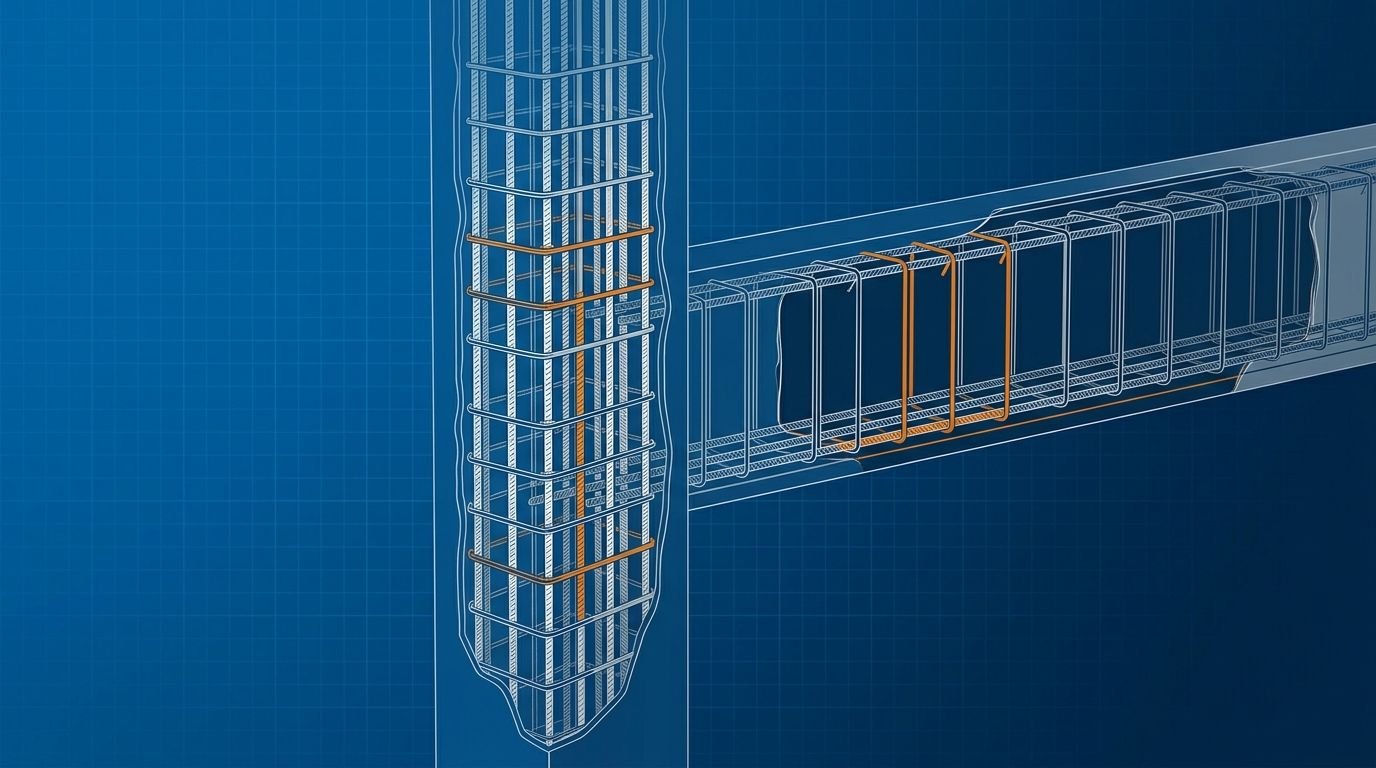
A column stands vertical and carries load down to the foundation almost entirely in compression; a beam lies horizontal and carries load across a span by bending — and this single difference in loading direction is why the two members are reinforced completely differently, fail completely differently, and are never interchangeable in a design. They are the two fundamental members of any RCC frame.
Column = vertical, compression
Carries load straight down
Beam = horizontal, bending
Spans across, resists bending
Different reinforcement logic
Ties vs stirrups
Why the loading direction changes everything downstream
A column carries the accumulated weight of every floor above it straight down to the footing, working mainly in axial compression — pure squeezing force along its length, with some additional bending depending on how loads are actually applied. A beam spans horizontally between supports and carries the slab and wall loads across that span through bending — its bottom fibre goes into tension, its top into compression, exactly the way any horizontal span under load behaves. This single difference in how each member is actually stressed dictates everything else about how it's built.
Column vs beam at a glance
| Column | Beam | |
|---|---|---|
| Orientation | Vertical | Horizontal |
| Primary action | Compression (axial) | Bending (flexure) plus shear |
| Load direction | Carries load straight down | Carries load across a span |
| Main reinforcement | Vertical (longitudinal) bars | Bottom (tension) and top bars |
| Lateral steel | Ties, confining the core | Stirrups, resisting shear |
| Typical failure mode | Crushing or buckling | Bending failure or shear failure |
Reinforcement follows the stress, not convention
A column's vertical main bars sit in its corners and faces, held together by closed ties spaced along its height — the whole assembly resists compression and, in taller columns, buckling (see slenderness ratio for exactly when that becomes a real design consideration). A beam's main bars run along the bottom where tension actually occurs, with stirrups spaced along its length specifically to carry shear — see cutting length of stirrups for how those are detailed in practice. Size a column with the column dimension calculator and check a beam's depth against its span with the beam deflection calculator.
What happens when the two are confused in design or execution
This isn't a purely academic distinction — genuine site mistakes happen when the column/beam distinction is treated loosely. A common error is a mason or junior supervisor assuming a beam can be detailed "the same way" as a column because both are just "RCC members with steel in them" — but a beam built with column-style symmetric reinforcement (equal steel top and bottom, closely spaced ties rather than properly spaced stirrups) wastes material where it isn't needed and can be genuinely under-reinforced for shear where it is. Similarly, a column mistakenly detailed like a beam — with light, widely-spaced lateral ties instead of a confining tie pattern — loses much of its resistance to buckling and to the sudden crushing failure a column must specifically be protected against. The visual similarity between a column and a beam cross-section on a drawing hides a real functional difference that the reinforcement has to reflect precisely.
Frequently asked questions
What is the actual difference between a column and a beam? A column is a vertical member carrying load in compression down to the foundation; a beam is a horizontal member carrying load across a span through bending. They differ fundamentally in orientation, loading direction, and reinforcement.
Does a column carry compression or bending? A column carries load primarily in axial compression, though it also resists some bending depending on how loads are applied. A beam, by contrast, works primarily in bending across its span.
Which member has stirrups, a column or a beam? Both have lateral steel, but a beam uses stirrups spaced along its length to resist shear, while a column uses ties to hold its vertical bars in position and resist buckling — the naming and spacing logic differ even though both are lateral reinforcement.
Which is generally considered more critical, column or beam failure? Column failure is generally considered more dangerous because a single failed column can bring down every floor above it, whereas a beam failure tends to be more localised — which is exactly why columns receive extra design conservatism, particularly in seismic detailing.
How does column reinforcement actually differ from beam reinforcement? A column has vertical main bars held by ties; a beam has horizontal main bars at the bottom and top held by stirrups. The direction the steel runs simply follows the direction of the tension each member actually experiences under load.
CivilSite Editorial Team✓ Engineer reviewed
Written and reviewed by practising civil engineers with 10+ years of Indian residential construction experience.