What Is Slenderness Ratio
Updated
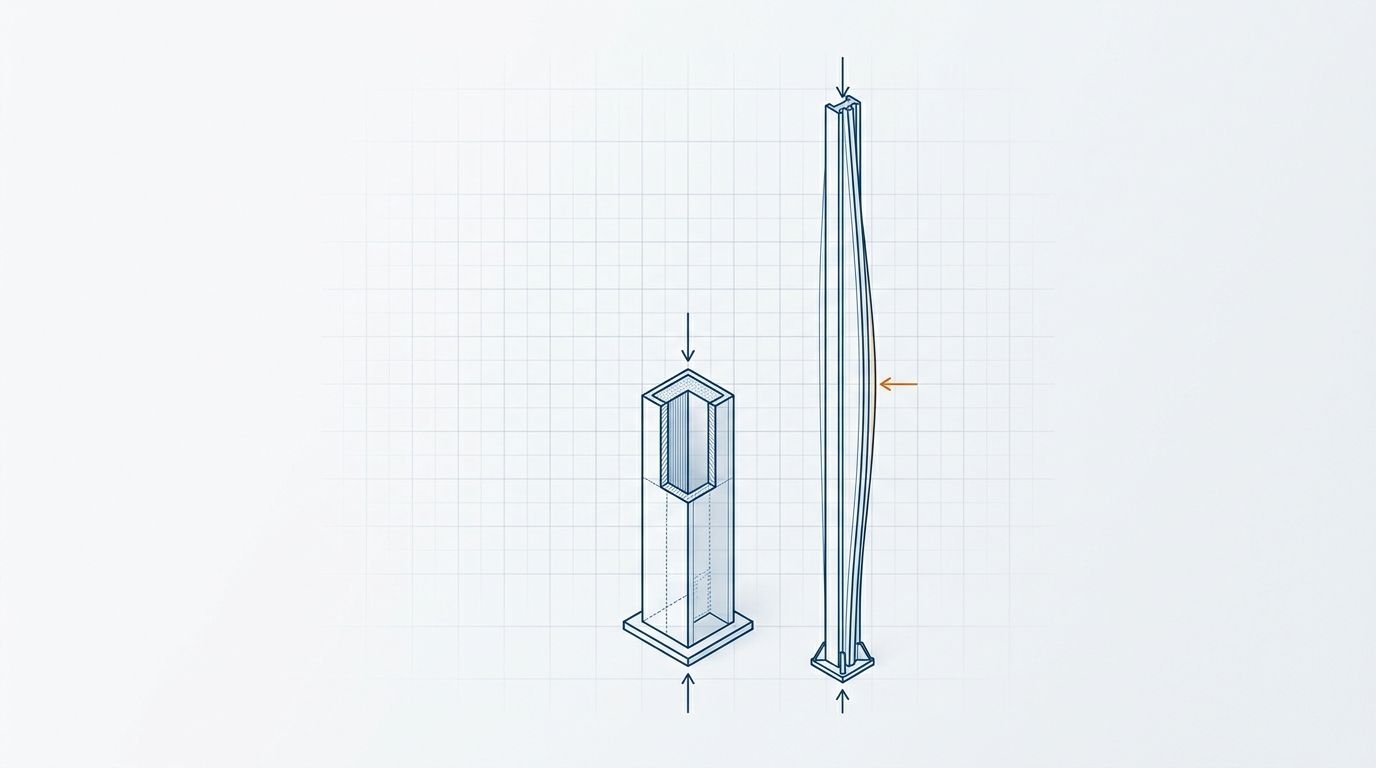
The slenderness ratio is a single number that captures how tall and thin a column is — and the higher it climbs, the more the column tends to fail by buckling sideways before it ever reaches the load that would crush it. It's the ratio that decides whether a column is treated as "short" or "long" in design, and that classification genuinely changes how the column is designed and how much load it's allowed to carry. This page explains what the slenderness ratio is, how it separates short from long columns, and why that distinction matters structurally.
Effective length ÷ least dimension
The defining ratio
Short column vs long column
What it decides
High ratio → buckling risk
The failure mode it flags
What it is, and the two failure modes it distinguishes
A short, stocky column fails by crushing — the material simply reaches its compressive limit and gives way. A tall, thin column, by contrast, can fail by buckling — bowing out sideways and losing stability — genuinely before the material ever reaches its crushing strength. The slenderness ratio is the number that captures a column's tendency toward that second, buckling failure mode:
Slenderness ratio = Effective length ÷ least lateral dimension (as used for RCC columns in IS 456)
The effective length isn't simply the column's physical height — it depends on both the height and, crucially, on how the column's ends are restrained (whether they're effectively fixed, pinned, or free to move). More generally in structural mechanics, slenderness is defined as the effective length divided by the least radius of gyration of the section, but for RCC columns IS 456 works with the least lateral dimension directly.
Short vs long column — the IS 456 classification
The value 12 is the dividing threshold — at or below it the column is short; above it the column is slender and its capacity is reduced. Bar heights are illustrative of the two regimes, not exact capacities.
IS 456 uses the slenderness ratio to classify a column into one of two categories:
- Short column — slenderness ratio ≤ 12 (in both directions). It's governed by crushing of the material, and its full section capacity can be relied upon in design.
- Long (slender) column — slenderness ratio > 12. Here buckling genuinely matters, so the column's usable capacity is reduced, and additional bending moments (arising from the buckling tendency itself) must be explicitly considered in its design.
The practical consequence is direct: a slender column carries less load than a short column of the identical cross-section, purely because part of its potential strength is lost to its tendency to buckle. This is exactly why keeping columns reasonably stocky — with an adequate least dimension and appropriate bracing to limit unsupported height — keeps them in the efficient "short" category where their full capacity is available.
Why the effective length, not just height, is what matters
A subtle but genuinely important point is that two columns of identical physical height can have very different slenderness ratios, purely because of how their ends are restrained. A column rigidly fixed at both ends has a much shorter effective length — and therefore a lower slenderness ratio and higher usable capacity — than an otherwise identical column that's free to sway at one end. This is precisely why bracing and end restraint aren't afterthoughts but genuine design tools: adding bracing that restrains a column's ends or reduces its unsupported height directly lowers its effective length, which lowers its slenderness ratio, which can move it from the penalised "slender" category back into the efficient "short" one without changing the column's cross-section at all. Size a column with the column dimension calculator.
Frequently asked questions
What is slenderness ratio? It's the ratio of a column's effective length to its least lateral dimension (or, more generally, to its least radius of gyration). It measures how tall and thin the column is, and hence how strongly it tends to fail by buckling rather than crushing.
What is the difference between a short and long column? A short column has a slenderness ratio of 12 or less and fails by crushing, so its full section capacity can be used. A long (slender) column has a ratio above 12, can fail by buckling, and so has a reduced usable capacity with additional moments considered in its design.
Why does slenderness ratio matter in design? Because a slender column can buckle sideways before it crushes, so it genuinely carries less load than a stocky column of the same cross-section. The slenderness ratio tells the designer whether buckling has to be explicitly allowed for, and how much capacity to deduct if so.
What is effective length, and why isn't it just the column's height? The effective length is the length of an equivalent pin-ended column that would buckle at the same load — it depends not just on the physical height but on how the column's ends are restrained (fixed, pinned or free), which can make the effective length shorter or longer than the actual height.
How can slenderness be reduced? By increasing the column's least lateral dimension, reducing its unsupported height, or adding bracing that restrains its ends — all of which lower the effective length relative to the section, reducing the slenderness ratio and keeping the column in the efficient "short" category.
CivilSite Editorial Team✓ Engineer reviewed
Written and reviewed by practising civil engineers with 10+ years of Indian residential construction experience.