What Is Guniting & Shotcrete
Updated
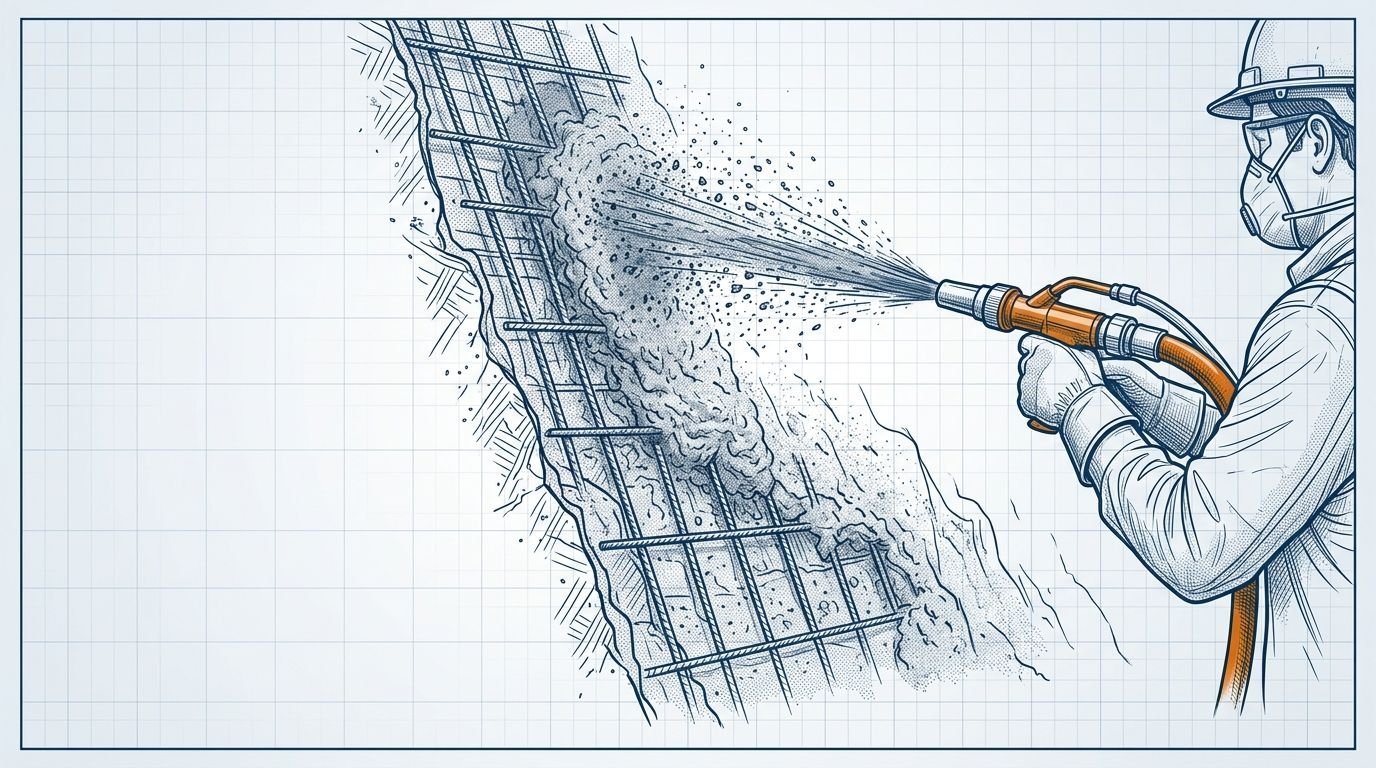
Guniting and shotcrete both describe spraying concrete or mortar onto a surface at genuinely high pressure so the material compacts on impact and builds up into a dense, strong layer — used to repair damaged concrete and to line tunnels, pools and slopes where conventional formwork would be impractical or impossible. The real, meaningful difference between the two terms is simply when the mixing water is actually added to the dry material. This page explains both processes properly and exactly where each is used on Indian sites.
Sprayed under high pressure
Compacts densely on impact
Guniting = dry-mix
Water added at the nozzle
Shotcrete = wet-mix
Water already in the mix
Guniting vs shotcrete — the actual process difference
Both processes blast a cement-based mix through a hose and a spray nozzle onto the prepared surface, where it strikes at speed and builds up in successive passes into a dense, well-compacted layer without needing any formwork to hold it in place while it sets. The genuine difference lies entirely in the mixing sequence:
- Guniting (dry-mix / gunite) — a completely dry mix of cement and sand is conveyed through the hose by compressed air, and water is introduced only at the nozzle itself, right as the material sprays out onto the surface. This is generally used for thinner mortar layers and smaller-scale repair work, since the operator has direct control over water content at the point of application.
- Shotcrete (wet-mix) — the concrete, including any coarse aggregate, is fully mixed with water beforehand, exactly like ordinary concrete, and is then pumped through the hose and sprayed onto the surface as a already-wet mix. This handles significantly larger volumes and coarser aggregate than guniting can, and generally delivers more consistent mix quality since the water-cement ratio is fixed and controlled before spraying rather than judged by the nozzle operator in real time.
- 1
Surface preparation
Remove loose, damaged or spalled concrete; expose sound substrate
- 2
Clean and roughen
Water-jet or sandblast the surface free of laitance and dust
- 3
Reinforcement check
Clean, treat or add reinforcement mesh/bars where corrosion is present
- 4
Spray application
Apply the gunite/shotcrete in successive layers/passes to the required thickness
- 5
Curing
Cure the sprayed layer exactly as ordinary concrete, protecting against early drying
Surface preparation quality — removing every trace of laitance and loose material — governs bond strength more than any other single step in the process.
Both processes share their biggest practical advantage: the material can be sprayed directly into place without any formwork at all, which is precisely why they're chosen over conventional cast-in-place concrete for irregular, curved, or hard-to-form surfaces.
Where guniting and shotcrete are actually used
- Repairing damaged or spalled concrete — restoring adequate cover over corroded reinforcement bars, and patching honeycombed or otherwise deteriorated structural members where cutting away and re-forming the original section would be far more disruptive.
- Linings — tunnels, mine shafts, canals, swimming pools and water tanks, where the curved or continuous geometry makes conventional formwork genuinely impractical.
- Slope and rock stabilisation — coating cut slopes and retaining rock or soil faces to prevent erosion and loose material falling, often combined with anchors or mesh.
- Curved and thin shell structures — architectural or structural shells where the geometry itself would make conventional formwork prohibitively expensive or simply impossible to build accurately.
Why the sprayed application actually produces strong, dense concrete
Because the mix strikes the surface at genuine velocity rather than being poured and vibrated, it self-compacts on impact — the kinetic energy of each particle hitting the surface does much of the compaction work that vibration would otherwise be needed for in conventional concreting. This gives sprayed concrete a naturally dense, low-permeability structure and lets it bond strongly to a properly prepared substrate. That bond, however, depends entirely on the underlying surface being genuinely clean and sound — any residual laitance or loose material left on the substrate before spraying creates a weak plane the sprayed layer will eventually debond from, regardless of how well the spraying itself was executed. For broader repair context on the underlying defects this technique addresses, see types of cracks in concrete.
Frequently asked questions
What is guniting? Guniting is spraying a dry mix of cement and sand through a hose at high pressure, with water added only at the nozzle as it sprays, so the material compacts densely on impact. It's used for repairs and relatively thin mortar linings.
What is the actual difference between guniting and shotcrete? In guniting (dry-mix), the cement-sand mix stays dry inside the hose and water is added only at the nozzle. In shotcrete (wet-mix), the concrete — including coarse aggregate — is fully mixed with water before being pumped and sprayed. Shotcrete handles larger volumes and coarser aggregate with more consistent mix quality.
Where is shotcrete typically used? For repairing damaged concrete, lining tunnels, pools, canals and tanks, stabilising cut rock or soil slopes, and building thin curved shell structures — essentially anywhere spraying concrete directly into place without formwork offers a genuine practical advantage over conventional casting.
Why does sprayed concrete end up stronger and denser? Because it strikes the surface at high velocity, the impact itself compacts the material densely without needing separate vibration, and it bonds strongly to a properly prepared substrate — giving a hard, low-permeability finished layer when the underlying surface preparation is done correctly.
Does guniting or shotcrete need formwork? No — that's their central practical advantage over conventional concreting. The material is sprayed directly onto the prepared surface and builds up in successive passes, so no formwork is needed to hold the sprayed layer while it sets.
CivilSite Editorial Team✓ Engineer reviewed
Written and reviewed by practising civil engineers with 10+ years of Indian residential construction experience.