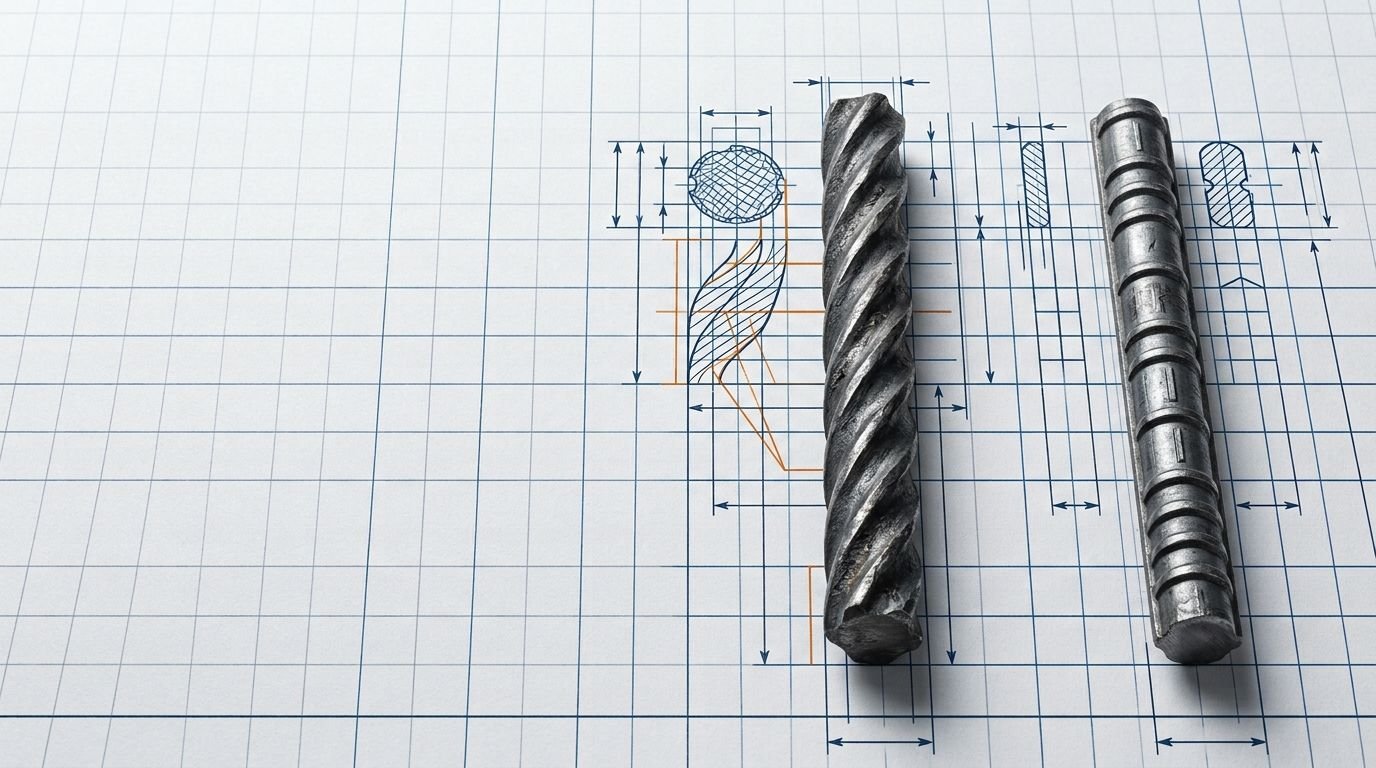
TOR Steel vs TMT Steel
Updated
TOR steel is made stronger by cold-twisting a hot-rolled bar; TMT is made stronger by a heat treatment that leaves it with a hard outer rim wrapped around a soft, ductile core — and that manufacturing difference is why TMT has almost completely replaced TOR in modern Indian construction, not merely market preference. This page compares the two properly and explains exactly why the switch happened.
TOR = cold-twisted
The older CTD bar
TMT = heat-treated
The modern bar
TMT: ductile + weldable
Why it displaced TOR
What actually differs in the manufacturing
TOR (cold-twisted deformed / CTD) steel starts as an ordinary hot-rolled bar and is then twisted cold to increase its strength — the twisting genuinely works, raising yield strength, but the mechanical cold-working also leaves the bar more brittle and carrying residual internal stresses. TMT (thermo-mechanically treated) steel takes a completely different path: the still-hot bar's surface is rapidly water-quenched immediately after rolling, while the core is allowed to cool slowly on its own — producing a bar with a genuinely hard, high-strength outer ring wrapped around a soft, ductile core. No cold-twisting is involved at all, and the bar ends up both strong and tough simultaneously, rather than trading one for the other.
TOR vs TMT at a glance
| Property | TOR steel | TMT steel |
|---|---|---|
| Manufacturing process | Cold twisting of a hot-rolled bar | Thermo-mechanical (quench + self-temper) |
| Internal structure | Uniform, but cold-worked | Hard outer rim, ductile inner core |
| Ductility / elongation | Lower | Meaningfully higher |
| Weldability | Poor | Good |
| Corrosion resistance | Lower | Better (no residual cold-work stress) |
| Seismic performance | Weaker | Better — genuinely more ductile |
| Current status | Essentially obsolete | The standard reinforcement bar |
Why the ductile core matters more than raw strength
TMT's soft, ductile inner core lets the bar bend and absorb energy without snapping under sudden or extreme load — exactly the behaviour a structure needs during an earthquake, where members must deform without brittle fracture. TOR steel, being cold-twisted throughout its cross-section, is inherently more brittle and offers far less of this energy-absorbing margin. TMT is also genuinely weldable (useful for splicing and connections) and more corrosion-resistant, since it carries no residual cold-work stress to accelerate rusting — both real, practical advantages TOR never offered. Modern TMT is graded Fe415, Fe500, Fe500D and Fe550 under IS 1786; check bar weights with the steel bar weight tool and current rates on the steel price list.
What the hard-rim/ductile-core structure actually looks like
If you were to cut a cross-section through a genuine TMT bar and etch it to reveal the underlying metal structure, you would see two visually distinct zones: a thin, dense, hard outer ring (the rapidly quenched martensitic layer) and a softer, more ductile core (the slowly self-tempered interior). This isn't a coating or a surface treatment applied afterward — it's a genuine change in the steel's internal crystalline structure produced entirely by the controlled cooling rate during manufacture, which is exactly why the property can't be replicated by simply cold-twisting an ordinary bar the way TOR steel is made. The two manufacturing philosophies produce genuinely different materials, not just different degrees of the same treatment.
Frequently asked questions
What is the actual difference between TOR steel and TMT steel? TOR steel is cold-twisted deformed bar, strengthened by mechanical cold-working but left more brittle. TMT steel is thermo-mechanically treated — quenched and self-tempered to combine a hard outer rim with a genuinely ductile core, making it tougher, weldable and more corrosion-resistant. TMT has essentially replaced TOR.
Is TMT genuinely better than TOR? Yes, on every practical measure that matters structurally — TMT bars are more ductile, weldable, corrosion-resistant and perform significantly better in earthquakes than cold-twisted TOR bars, which is exactly why TMT is now the universal standard for reinforcement.
Why is TOR steel not really used anymore? Its cold-twisting leaves it more brittle, harder to weld, and less corrosion-resistant. TMT bars offer higher strength alongside genuinely better ductility, so TMT has effectively displaced TOR across virtually all modern construction.
What does TMT actually stand for? Thermo-Mechanically Treated — describing the process of rapidly quenching the bar's surface immediately after rolling and letting the core cool slowly, producing the characteristic hard-rim, ductile-core structure.
Which steel is genuinely best for earthquake-prone zones? TMT steel, particularly the higher-ductility Fe500D grade, is specifically preferred in seismic zones — its ductile core lets the bar deform and absorb seismic energy without the brittle fracture a cold-worked bar like TOR would be more prone to under the same extreme, sudden loading.
CivilSite Editorial Team✓ Engineer reviewed
Written and reviewed by practising civil engineers with 10+ years of Indian residential construction experience.