Precast vs Cast-in-Situ Concrete
Updated
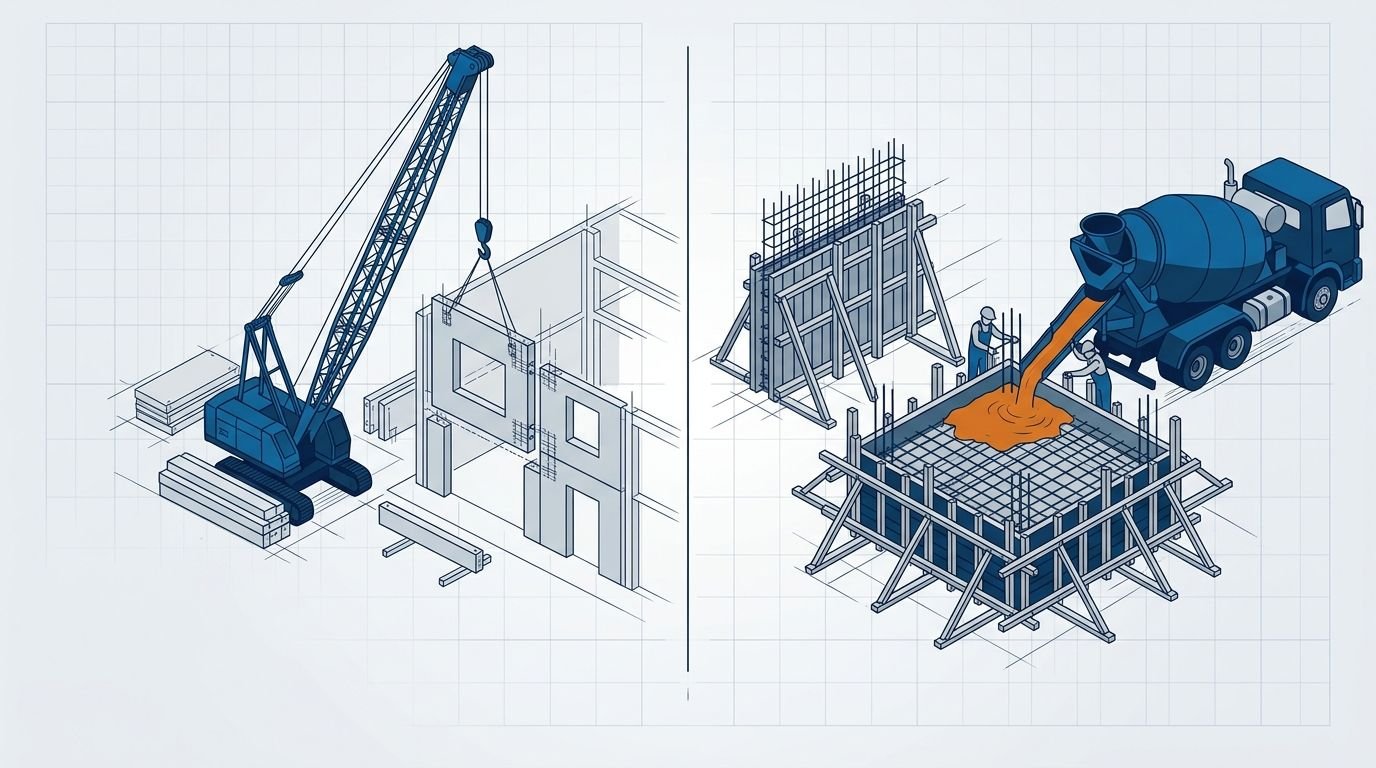
Precast concrete is cast in a controlled factory or casting yard and then transported to site to be erected; cast-in-situ concrete is cast in its final position directly on site. The two approaches represent a genuine engineering trade-off — one buys speed and consistent factory quality control at the cost of needing careful joints and heavy lifting, while the other buys monolithic structural continuity and layout flexibility at the cost of slower, weather-dependent on-site work. This page compares them properly and explains which genuinely suits which kind of project.
Precast = made in a factory
Then transported and erected
Cast-in-situ = cast in place
Directly on site, in final position
Speed vs monolithic continuity
The fundamental trade-off
The core difference, and why continuity matters
Cast-in-situ (in-place) concrete is poured into formwork at its final location on site, so the members end up genuinely monolithic — beams, columns and slabs are cast continuous with each other and physically joined through their overlapping reinforcement, and it's exactly this continuity that gives an RCC frame much of its rigidity and its ability to redistribute load if one part is overstressed. Precast members — slabs, beams, wall panels, staircases — are instead cast under controlled factory conditions, cured properly, then transported to site and lifted into position and connected. The precast approach delivers fast, consistent, high-quality members, but the finished structure's continuity depends entirely on how well the joints between those separate members are designed and executed, since the members aren't monolithically cast together the way cast-in-situ elements are.
Precast vs cast-in-situ at a glance
| Precast | Cast-in-situ | |
|---|---|---|
| Where cast | Factory / casting yard | On site, in final position |
| Quality control | High — controlled factory conditions | Depends on site supervision and conditions |
| Speed | Fast erection; work proceeds in parallel | Slower — each stage must cure before the next |
| Structural continuity | Jointed members | Genuinely monolithic frame |
| Formwork reuse | Very high (repeated moulds) | Limited (formwork per pour) |
| Transport / cranes | Needed — heavy lifting on site | Not needed |
| Weather dependence | Low (casting is indoors) | Higher (pouring and curing exposed) |
| Best suited to | Repetitive, large-volume projects | Houses and irregular one-off layouts |
Where each genuinely suits the project
- Individual houses and irregular layouts → cast-in-situ, chosen for its flexibility with non-repeating geometry, its monolithic frame, and the fact that it needs no cranes or heavy-lift transport — all of which matter far more on a one-off house than raw speed does.
- Large, repetitive projects (housing blocks, commercial developments, infrastructure) → precast, chosen for its speed, its highly consistent factory-controlled quality, and the genuine economy of reusing the same moulds hundreds of times across identical repeating members.
Why so many real projects are actually hybrid
In practice, a great many projects don't choose one method exclusively but combine both — a hybrid approach that uses a cast-in-situ frame (for its monolithic continuity where the structure most needs it) together with precast slabs, staircases or wall panels (for the speed and consistency precast offers on the repeating, standardised elements). This isn't a compromise so much as a deliberate optimisation: it puts monolithic continuity exactly where structural behaviour depends on it and factory efficiency exactly where members repeat. The joints in any precast work remain the single most critical detail regardless of how much of the structure is precast, because the whole structure's continuity and load path depend on those joints performing as designed — which is precisely why precast jointing is detailed and supervised with particular care. Estimate a cast-in-situ pour with the concrete calculator.
Frequently asked questions
What is the difference between precast and cast-in-situ concrete? Precast concrete is cast in a controlled factory and then erected on site; cast-in-situ concrete is cast directly in its final position on site. Precast is fast and consistent but relies on carefully detailed joints; cast-in-situ is genuinely monolithic and flexible for irregular layouts.
Which is better, precast or cast-in-situ? Cast-in-situ suits individual houses and irregular one-off layouts and gives a monolithic frame without needing cranes. Precast suits large, repetitive projects where speed and consistent factory quality matter most. Many real projects deliberately combine both in a hybrid approach.
Is precast concrete stronger than cast-in-situ? Precast members are made under controlled factory conditions, so their individual quality is very consistent — but the overall structure's strength and continuity depend on the joints between members, which is exactly why precast jointing is detailed so carefully rather than treated as a minor detail.
Why is cast-in-situ concrete used for individual houses? Because it's flexible for the irregular, non-repeating layouts typical of houses, it gives a monolithic frame without needing cranes or heavy-lift transport, and it avoids the transport and lifting logistics that precast's heavy factory-cast members would require on a small site.
What is hybrid construction? Hybrid construction deliberately combines a cast-in-situ frame with precast elements such as slabs or staircases — gaining precast's speed and consistency on the repeating members while keeping cast-in-situ's monolithic continuity exactly where the structure's behaviour depends on it.
CivilSite Editorial Team✓ Engineer reviewed
Written and reviewed by practising civil engineers with 10+ years of Indian residential construction experience.