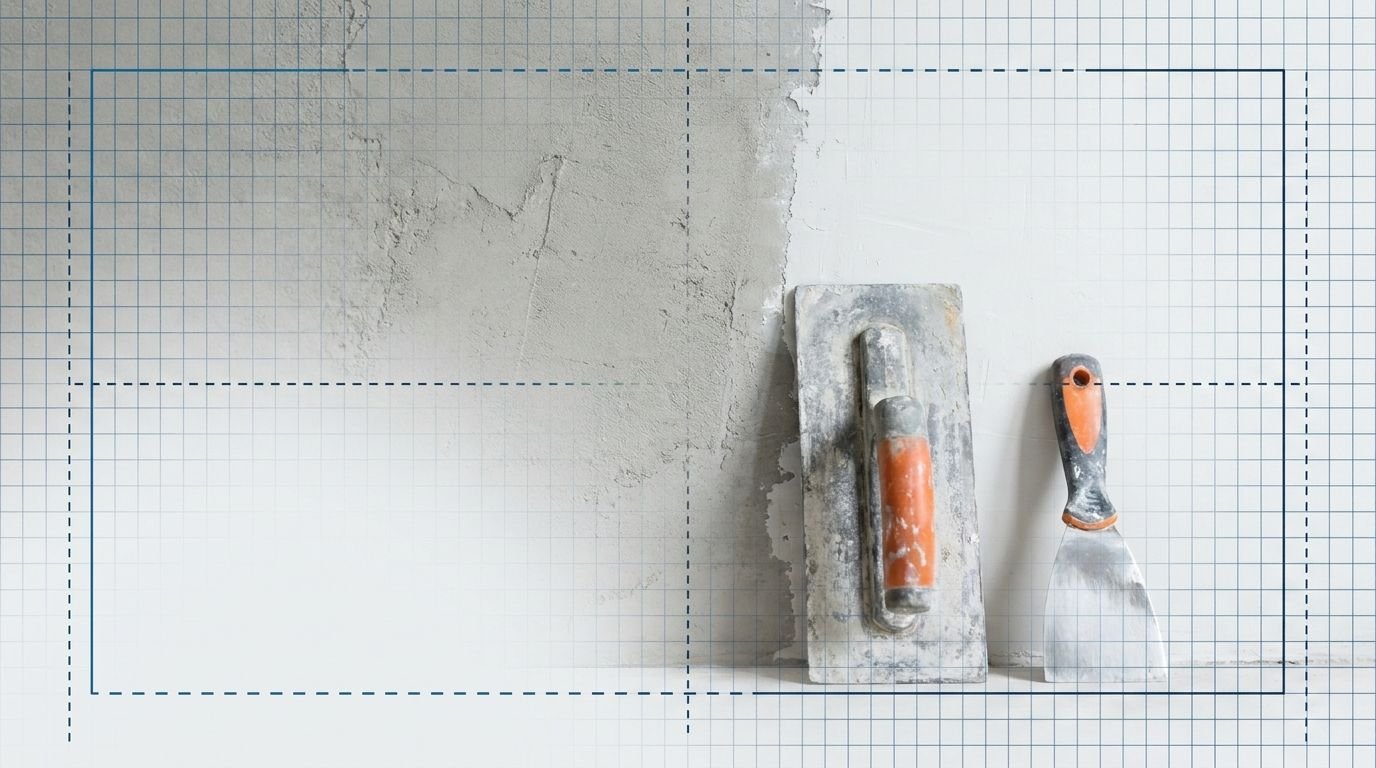
Plaster vs Putty
Updated
Plaster is the cement–sand coat that levels and covers the masonry; putty is the thin white-cement skim that smooths the plaster before paint. They aren't competing choices — they're two different stages of the same wall, each doing a job the other cannot, and understanding exactly what each one fixes is the difference between a wall that looks good for a decade and one that shows every trowel mark within a year.
Plaster = cement + sand
12–20 mm coat
Putty = white-cement skim
1–1.5 mm finish
Plaster → putty → paint
The order
What plaster is actually correcting
Raw brick or block masonry is never flat or smooth enough to paint directly. Individual units vary by a few millimetres, mortar joints are recessed, and the overall wall face can wander several millimetres out of plane over its length. Plaster's job is to correct all of that — a 12–20 mm coat of cement, sand and water applied over the masonry, screeded and floated to a true, flat plane. It is thick enough to bury the irregularity of the masonry beneath it, but it is not, and was never meant to be, a finished paint-ready surface on its own — a freshly plastered wall still shows fine trowel marks, minor undulations, and a slightly porous, matte texture.
What putty is actually correcting
Putty's job is different and much finer-grained: it smooths out the last, small-scale imperfections that plaster's coarser sand grains leave behind — trowel marks, tiny pinholes, minor porosity — so paint sits on a genuinely uniform, hard, low-porosity surface. Made from fine white cement or acrylic polymer powder mixed to a paste, it is applied in two very thin coats (roughly 1–1.5 mm total), each sanded smooth after it sets, before the surface is ready for primer and paint.
Plaster vs putty at a glance
| Plaster | Wall putty | |
|---|---|---|
| Made of | Cement + sand + water | White cement / acrylic powder + water |
| Thickness | 12–20 mm | 1–1.5 mm (in two coats) |
| Job | Level and cover the masonry | Fine-smooth the plaster before paint |
| Applied on | Bare brick / block wall | Cured, sound plaster |
| Grain size | Coarse (sand-based) | Very fine (near-powder) |
| Correction scale | Centimetres of masonry irregularity | Millimetres of trowel and surface texture |
| Followed by | Putty (then primer, paint) | Primer, then paint |
| Curing time before next step | Several days minimum | A day or so between coats |
The correct sequence, step by step
- 1
Plaster the masonry
Apply a 12–20 mm cement-sand coat, screed and float it flat, then let it cure properly for at least 7 days before proceeding.
- 2
First putty coat
Apply a thin (0.5–0.75 mm) coat of white-cement or acrylic putty over the cured, dry plaster and let it dry.
- 3
Sand and second coat
Lightly sand the first coat, apply a second thin putty coat perpendicular to the first, then sand again once dry for a glass-smooth surface.
- 4
Prime the wall
Apply a primer coat, which seals the porous putty surface and helps the topcoat paint bond evenly and cover in fewer coats.
- 5
Paint (two coats)
Apply the finish paint in two coats for full, even coverage and colour depth — see the paint choices in types of paint.
Skipping or rushing any step here is the most common cause of premature paint failure — peeling, cracking or an uneven sheen — on Indian residential sites.
Why the order can't be shortened
Each step depends on the one before it being genuinely finished, not just "dry to the touch":
- Putty applied over uncured plaster is the single most common cause of wall failure. Plaster keeps shrinking slightly as it cures over the first few weeks; if putty is applied too early, that ongoing shrinkage cracks the thin putty layer above it, and those cracks telegraph straight through the paint.
- Paint applied without putty works, but the paint film sits directly on the plaster's coarser, more porous texture — the wall absorbs more paint unevenly, needs more coats for full coverage, and never achieves the same smooth, uniform sheen that a puttied wall does.
- Paint applied without primer — even over putty — means the topcoat paint is doing the sealing job primer is meant to do, which typically means patchy absorption and a duller, less even final colour.
Frequently asked questions
What is the difference between plaster and putty? Plaster is a thick cement–sand coat (12–20 mm) that covers and levels the masonry itself. Putty is a much thinner white-cement or acrylic skim (1–1.5 mm) applied over cured plaster to smooth out fine-scale imperfections before painting. Plaster corrects centimetres of masonry irregularity; putty corrects millimetres of surface texture.
Which comes first, plaster or putty? Plaster comes first, applied directly onto the masonry, and must cure for at least about a week. Putty is applied afterward, over the cured plaster, in two thin sanded coats, followed by primer and then paint.
Can I apply putty without plaster? No — putty is a thin finishing skim designed to smooth an already-flat surface, not to level or cover raw masonry. It cannot correct the centimetre-scale irregularity of bare brickwork, which is plaster's job specifically.
Is putty necessary before painting? Not strictly required, but it is standard practice for a genuinely good finish. Putty fills the fine pores and trowel marks in the plaster and gives a smooth, hard, low-porosity base, so the paint applies evenly, needs fewer coats, and looks and lasts noticeably better.
What is the thickness of plaster and putty? Plaster is usually about 12 mm on internal walls and 15–20 mm on external or uneven walls. Putty is applied in two very thin coats totalling roughly 1–1.5 mm — it is meant to be a fine skim, not a levelling layer.
How long should plaster cure before applying putty? At least about 7 days, and ideally with proper moist curing during that period. Applying putty over plaster that hasn't finished its shrinkage is the most common cause of cracks appearing in the paint finish later.
Can I skip primer if I've already applied putty? It's not recommended. Primer seals the putty's porosity and gives the topcoat paint a uniform surface to bond to — skipping it usually means patchier coverage and more paint needed to achieve an even finish, even over well-applied putty.
CivilSite Editorial Team✓ Engineer reviewed
Written and reviewed by practising civil engineers with 10+ years of Indian residential construction experience.