Nominal Mix vs Design Mix Concrete
Updated
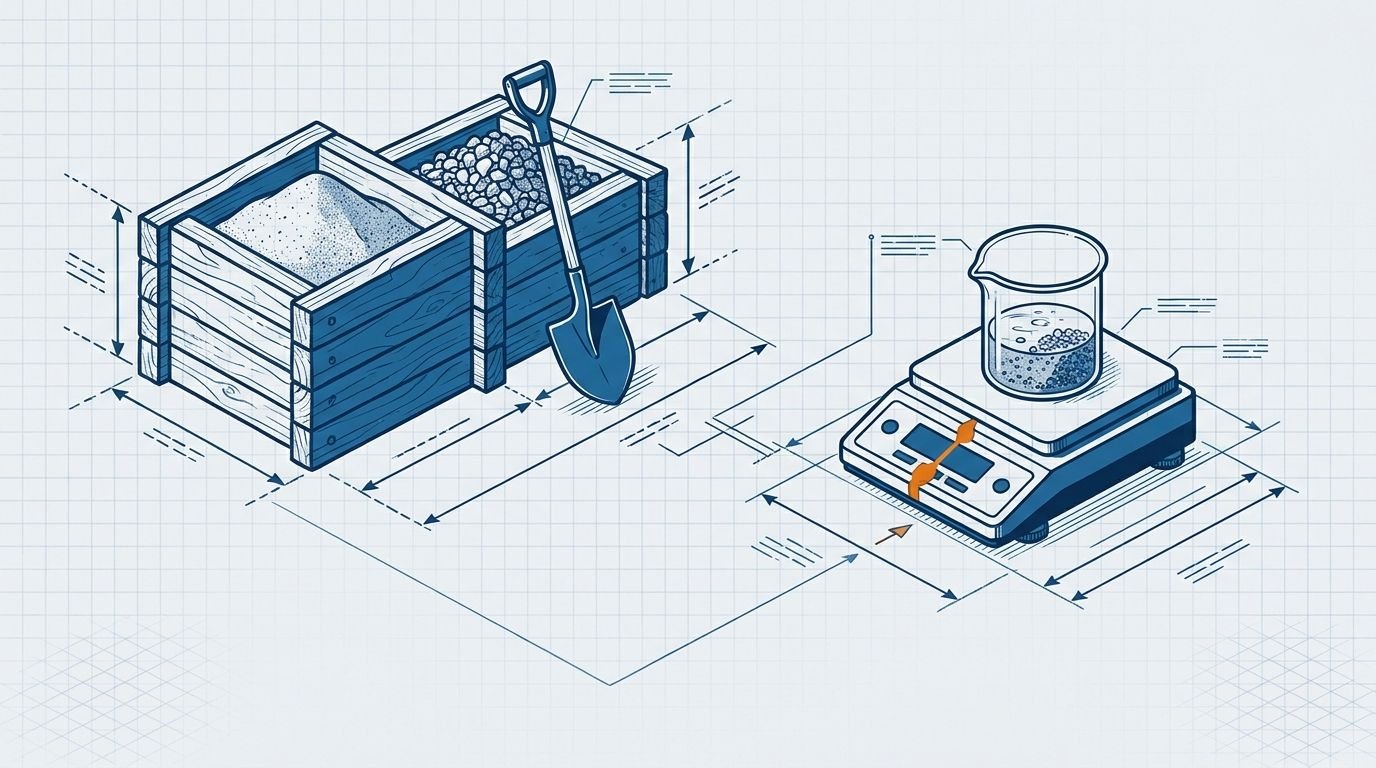
A nominal mix uses fixed volume ratios like 1:1.5:3 regardless of the actual materials on hand; a design mix is proportioned by calculation and confirmed by trial batches from your specific cement, sand and aggregate to reliably hit a target strength. IS 456 draws a hard line between the two — and knowing exactly where that line is, and why it exists, matters more than the definitions alone.
Nominal = fixed ratio
1:1.5:3 (M20)
Design = proportioned
By trial to a target
Design mix above M20
IS 456 rule
Two philosophies of proportioning
A nominal mix answers the question "how much cement, sand and aggregate?" with a fixed, published recipe that has been found to work adequately across a wide range of typical materials — it doesn't know or care exactly how strong your specific sand is, how well-graded your aggregate is, or what your cement's actual strength class delivers on the day. It's a safe, conservative average, and its great virtue is that a small site with a gauge box and no laboratory access can batch it reliably by volume.
A design mix answers the same question completely differently: it starts from a target strength and works backward, using the measured properties of the actual cement, sand and aggregate that will be used, refined through trial batches cast and tested in advance of the real pour. The proportions that come out are specific to that combination of materials — swap the sand source and the design mix proportions may need to be re-derived. This precision is exactly what lets a design mix use less cement than an equivalent nominal mix would demand for the same strength, because it isn't paying a "safety tax" for not knowing its materials.
Nominal mix vs design mix at a glance
| Nominal mix | Design mix | |
|---|---|---|
| Proportioning basis | Fixed volume ratio, published in code | Calculated + confirmed by trial batches |
| What it accounts for | A generic, conservative average | The specific cement, sand and aggregate used |
| IS 456 permitted up to | M20 only | Required for M20 and above by design procedure* |
| Batching method | Usually by volume (gauge box) | Always by weight, for accuracy |
| Quality control needed | Low — no lab required | High — testing, trial mixes, weigh-batching |
| Cement efficiency | Conservative — often uses more cement than strictly needed | Optimised — uses only what the target strength requires |
| Reliability | Adequate for small, low-rise works | High, and quality-assured by testing |
| Typical use case | Individual houses, PCC, low-grade work | Structural RCC of M25+, larger or engineered projects |
*IS 456 actually permits nominal-mix proportions to be used up to and including M20 as a simplification; strictly, a design mix approach is preferable at any grade where quality assurance matters, but it becomes mandatory practice above M20.
The nominal mixes, in full (IS 456 Table 9)
| Grade | Nominal ratio (cement : sand : aggregate) | Typical use |
|---|---|---|
| M5 | 1 : 5 : 10 | Very lean, levelling courses |
| M7.5 | 1 : 4 : 8 | PCC, blinding layers |
| M10 | 1 : 3 : 6 | PCC under footings |
| M15 | 1 : 2 : 4 | Light structural, PCC |
| M20 | 1 : 1.5 : 3 | House RCC — the practical ceiling for nominal mixes |
This table stops at M20 for a reason. The "1:1:2" ratio commonly quoted around site for M25 is site shorthand, not a code provision — it is not in IS 456's nominal-mix table at all. M25 and above genuinely require a design mix, tested and proportioned specifically, because at higher strength grades the margin for error in a generic ratio becomes too large to accept for a structural member.
Why a design mix is actually more economical
It sounds counter-intuitive that adding a testing step saves money, but the logic is straightforward: a nominal mix has to be conservative enough to work across a wide range of possible material qualities, so it typically over-provides cement to guarantee the target strength even with slightly below-average sand or aggregate. A design mix, having actually measured the real materials' properties through trial batches, can dial the cement content down to precisely what's needed — no more, no less — for the specific batch of sand and stone actually being used. On a large project buying hundreds of tonnes of cement, that optimisation is a real cost saving that easily justifies the lab work.
What "trial batches" actually involves
A design mix isn't just a calculation on paper — it's confirmed by physically casting and testing sample batches before the real pour:
- Calculate a trial proportion based on the target strength and the known properties of the materials (specific gravity, grading, water absorption).
- Cast trial cubes at that proportion and test them at the standard ages (see the cube test).
- If the strength falls short of the target, adjust the proportions (usually the cement content or water–cement ratio) and cast another trial batch.
- Once trial cubes consistently meet the target with an appropriate margin, that proportion becomes the approved design mix for the project.
Frequently asked questions
What is the difference between nominal mix and design mix? A nominal mix uses a fixed volume ratio (like 1:1.5:3 for M20) that doesn't account for the specific materials being used. A design mix is proportioned by calculation and confirmed through trial batches from the actual cement, sand and aggregate on the job, to reliably reach a target strength with better economy and reliability.
Up to which grade is nominal mix allowed? IS 456 permits nominal-mix proportions up to and including M20. Concrete of M25 and above must be approached as a design mix, proportioned and confirmed by trial batches for the specific materials.
Is 1:1:2 a valid mix ratio for M25? No. The 1:1:2 ratio often quoted for M25 on site is informal shorthand, not a provision in the IS 456 nominal-mix table, which stops at M20. M25 and above should be properly designed and tested as a design mix.
Why is a design mix more economical than a nominal mix? A nominal mix has to be conservative to cover a wide range of possible material qualities, so it typically uses more cement than strictly necessary. A design mix, having measured the actual materials through trial batches, uses only the cement needed to reliably hit the target strength for that specific combination of ingredients.
Is nominal mix batched by weight or volume? Nominal mixes are usually batched by volume using gauge boxes on small sites, which is simpler but less precise. Design mixes are always batched by weight, because the accuracy that reliable, tested strength requires isn't achievable with volume-based measurement of variable-density materials.
Does a design mix need a laboratory on site? Not necessarily on the construction site itself — trial batches are often tested at an approved materials-testing lab, and the resulting proportions are then supplied to the site as a fixed design mix recipe that the batching plant or site team follows for the actual pour.
Can I use a design mix even below M20? Yes — nothing in the code prevents using a design mix approach for lower grades, and it's good practice wherever quality assurance and cement economy matter, even though a nominal mix is permitted as a simpler alternative for grades up to M20.
CivilSite Editorial Team✓ Engineer reviewed
Written and reviewed by practising civil engineers with 10+ years of Indian residential construction experience.