Lap Length vs Development Length
Updated
Development length anchors a single bar into concrete so the bond between steel and concrete can transfer its full design stress; lap length is the overlap between two separate bars so that stress passes continuously from one bar, through the surrounding concrete, into the next. They are closely related — lap length is literally derived from development length — but confusing the two in site detailing is a real, recurring mistake that this page exists to clear up.
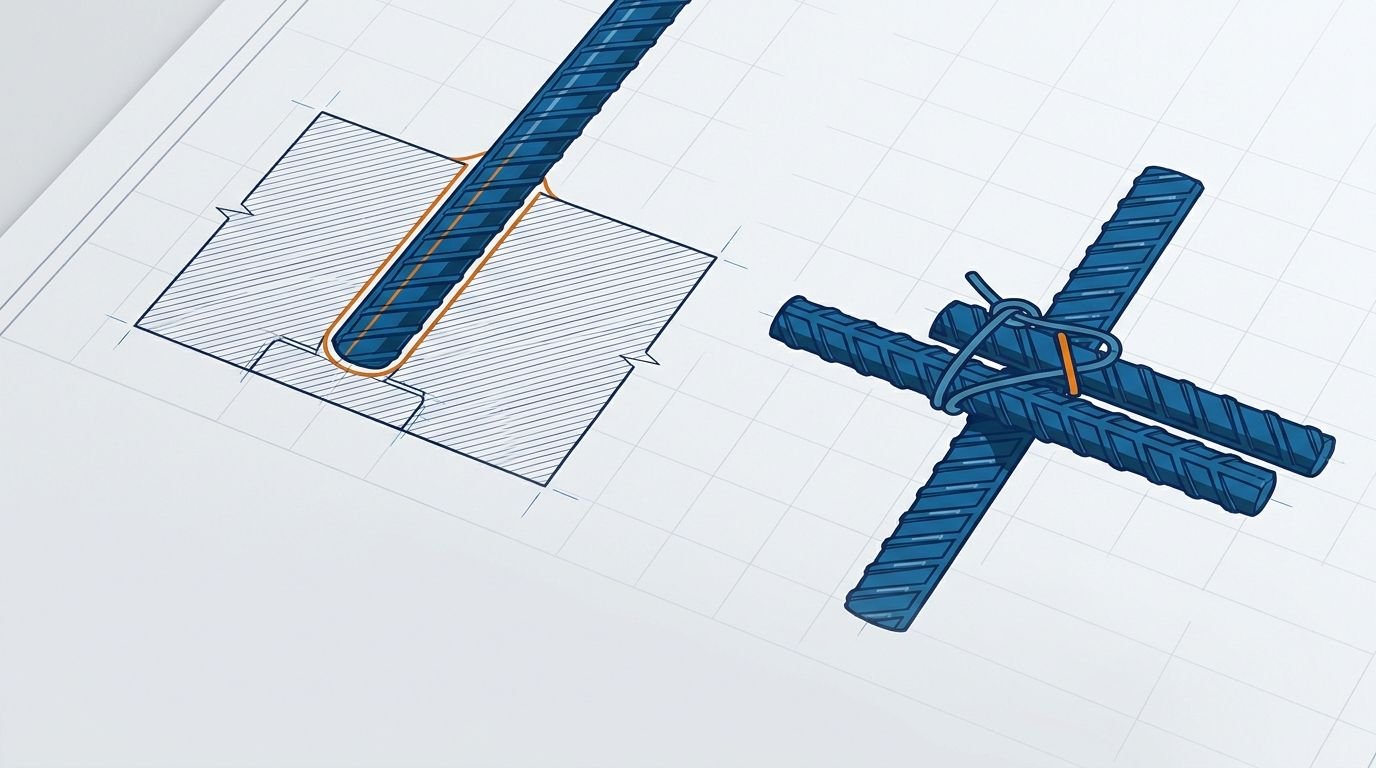
Ld = anchoring into concrete
One bar, one end
Lap = overlap of two bars
Two bars, one splice
Lap ≈ Ld (often more)
The link between them
The physics behind development length
Steel reinforcement only works because concrete grips it through bond stress — the friction and mechanical interlock (from the ribs on a deformed bar) between the steel surface and the surrounding concrete. If you tried to pull a bar straight out of a block of concrete, it would resist up to a point, then slip and pull free. Development length (Ld) is the minimum embedment length needed so that this bond, acting over that length, can develop the bar's full design stress before it would slip — anchoring the bar securely rather than relying on it just being "long enough by eye."
It's given by the IS 456 formula: Ld = φ·σs ÷ (4·τbd), where φ is the bar diameter, σs is the design stress in the bar (typically 0.87 × fy for tension), and τbd is the design bond stress for the concrete grade — a value the code tabulates based on how well that particular concrete grips a deformed bar. Every input in this formula is exactly why development length varies with steel grade, concrete grade, and bar type (deformed bars get a 60% bump in permissible bond stress over plain round bars, which is precisely why deformed TMT bars allow shorter development lengths).
The physics behind lap length
Reinforcement bars come in standard lengths — commonly 12 m — but a column might run 30 m tall or a long beam might need 40 m of continuous bottom steel. Lap length is how two bars are joined end to end when one length isn't enough: rather than butt them together (which would transfer zero force directly, since steel-to-steel contact with no weld carries nothing), the two bars are overlapped by a calculated distance, and the force is transferred through the concrete's bond with each bar across that overlap zone. Both bars must individually develop enough bond over the lap for the force to successfully "hop" from one into the other via the surrounding concrete — which is exactly why lap length is built directly from the development length calculation, usually equal to it or somewhat more.
Lap length vs development length at a glance
| Development length (Ld) | Lap length | |
|---|---|---|
| Purpose | Anchor one bar into a concrete member | Continue one bar's force into a second bar |
| Number of bars involved | One | Two, overlapping |
| Where it occurs | Bar ends entering columns, beams, footings | Anywhere along a bar's length where it must be spliced |
| Governing formula | Ld = φ·σs ÷ (4·τbd) | Based on Ld, usually Ld to 1.5×Ld depending on stress condition |
| Typical value (deformed bar, tension) | ~40–50 × bar diameter | ~40–60 × bar diameter, depending on the lap zone |
| Increases with | Higher steel grade, lower concrete grade, tension vs compression | Same factors, via its dependence on Ld |
Here d (or φ) is the bar diameter throughout. Both lengths increase for a higher steel grade (more force to anchor) and a lower concrete grade (weaker bond), and both are noticeably larger in tension than in compression, because compression gets extra help from the bar's end bearing against the concrete. Compute exact values for your specific bars with the development length calculator and the lap length calculator.
Detailing rules that follow directly from the physics
- Stagger laps — don't splice every bar in a section at the same point. If all bars lap simultaneously, that single cross-section becomes the weakest point in the member, relying entirely on lapped (rather than continuous) steel. Offsetting the laps means most of the section still has full, continuous bars at any given cut.
- Prefer low-stress zones for laps where the design allows it — for instance, avoiding lapping bottom bars exactly at mid-span of a simply supported beam, where bending stress (and therefore the demand on the lap) is highest.
- Never lap large-diameter bars — generally above 36 mm — because the lap length required becomes impractically long and the bond area needed is hard to guarantee reliably; welding or mechanical couplers are used instead for very large bars.
- Provide correct cover around any lapped section, since the lap relies entirely on the surrounding concrete's bond and confinement — inadequate cover weakens exactly the mechanism the lap depends on.
A worked example, side by side
Consider a 16 mm Fe500 bar anchored into an M20 footing (development length) versus the same bar spliced mid-length in a column (lap length):
| Scenario | Formula basis | Typical result (illustrative) |
|---|---|---|
| Development length into M20 footing | Ld = φ·σs ÷ (4·τbd) | Roughly 45–47 × 16 mm ≈ 720–750 mm |
| Lap length in tension zone | ~1.0–1.3 × Ld | Roughly 720–975 mm, per the applicable IS 456 lap-zone factor |
Always compute the exact figure for your actual bar diameter, steel grade and concrete grade using the calculators linked above rather than reusing a rule of thumb from a different job — the formula is sensitive enough to grade changes that "the last site used 40d" is not a safe substitute for the actual calculation.
Frequently asked questions
What is the difference between lap length and development length? Development length is the embedment needed to anchor a single bar into concrete so it develops its full design strength through bond. Lap length is the overlap between two separate bars that continues the reinforcement, transferring force from one bar into the next through the concrete's bond with both.
Is lap length equal to development length? Lap length is derived from development length and is usually equal to it or somewhat more, depending on the stress condition and the specific lap zone defined in IS 456. In tension it's often taken as approximately Ld to 1.5×Ld.
What is the typical lap length in slabs and beams? Lap length commonly runs around 40 to 60 times the bar diameter, depending on the steel grade, concrete grade, and whether the bar is in tension or compression at that location. Always compute it for the actual grades involved rather than assuming a fixed multiplier.
Why must laps be staggered? Lapping all the bars in a member at one cross-section concentrates the entire splice at a single weak point, relying on lapped rather than continuous steel exactly there. Staggering the laps spreads the joints along the member's length so no single section depends on all the splices simultaneously.
Can development length apply to bars in compression? Yes. Bars anchored in compression — for example, column bars extending down into a footing — still need a development length, but it is shorter than the equivalent tension value because both bond and direct end bearing of the bar against the concrete help transfer the force.
Do lap length and development length use the same design bond stress? Yes, both are derived from the same underlying bond-stress value (τbd) for the concrete grade in question — lap length simply applies a multiplier or additional factor on top of the base development length calculation, per the specific splice condition.
What happens if a lap length is too short? An under-length lap can slip under load before the full design force transfers between the two bars, effectively leaving the member under-reinforced at that section — which is exactly why calculating the correct lap length (rather than eyeballing it) matters for structural safety.
CivilSite Editorial Team✓ Engineer reviewed
Written and reviewed by practising civil engineers with 10+ years of Indian residential construction experience.