Durability of Concrete
Updated
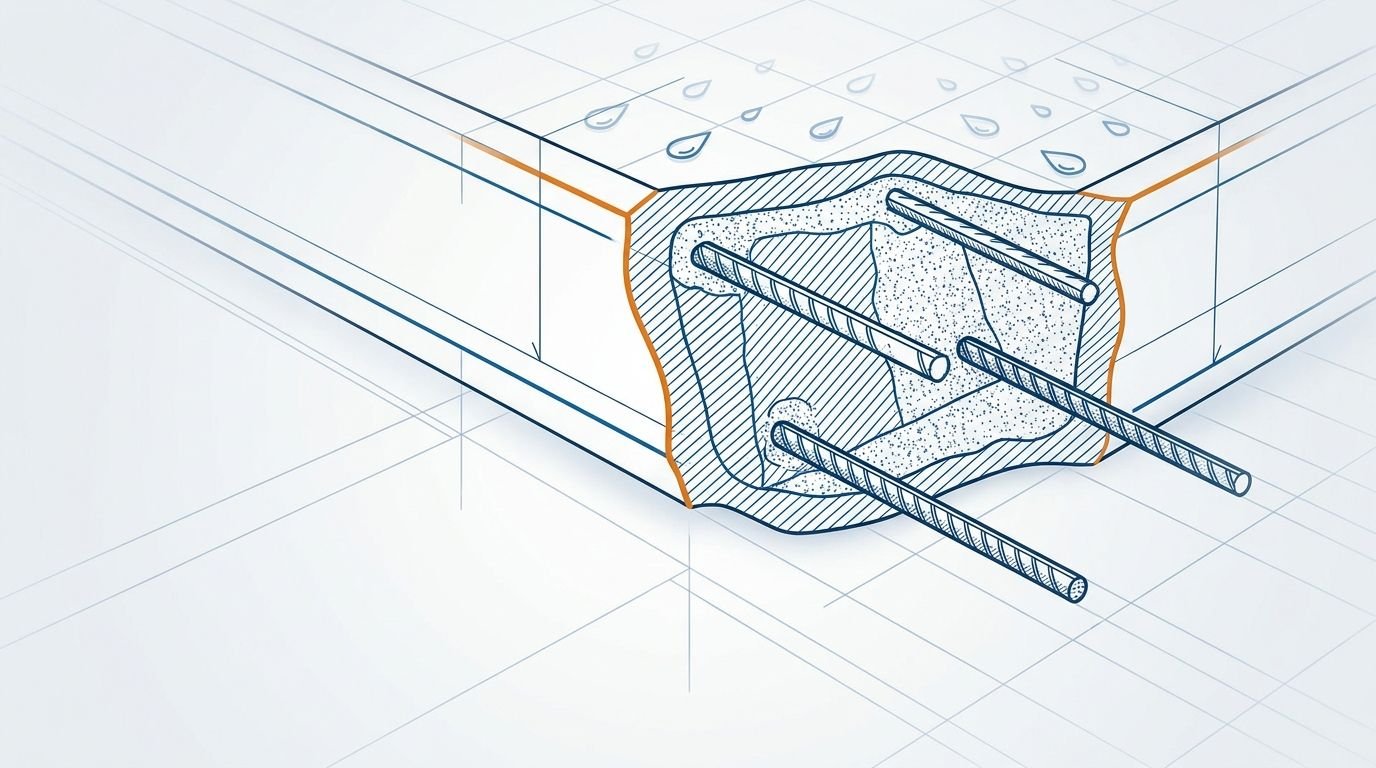
Durability is concrete's ability to serve its full intended life without deteriorating — and the uncomfortable truth most people don't realise is that durability is decided far more by keeping water and aggressive chemicals out than by raw compressive strength. A high-grade M30 mix with thin cover and poor curing will fail years before a modest M20 mix built with genuine attention to cover, water content and curing. This page explains what actually drives durability and how the code controls it.
Keeping water & salts out
The core mechanism
Low w/c + cover + curing
The three levers
By exposure class
How IS 456 controls it
Why strength and durability are not the same thing
It's a genuinely common misconception that a "stronger" concrete is automatically a more durable one. Compressive strength measures how much load the hardened material can carry. Durability measures how resistant the material is to chemical and physical attack over decades — corrosion of the embedded steel, chemical breakdown of the cement paste, and physical damage from weathering. A concrete can easily reach its design strength at 28 days and still be on a slow, invisible path to premature failure if its pore structure is too open, letting water and dissolved salts migrate in over the following years. This is precisely why durability requirements in IS 456 are specified separately from strength requirements, not derived from them.
What actually decides durability
- Water–cement ratio — the single biggest factor by a wide margin. A low water–cement ratio produces dense, low-permeability concrete with few connected capillary pores for water and salts to travel through; a high ratio leaves an open network of capillary pores that acts almost like a sponge for anything dissolved in groundwater or rain.
- Cover to reinforcement — the depth of concrete between the outer surface and the embedded steel. Adequate cover physically delays how long it takes for water, chlorides or carbon dioxide to reach the steel and start corrosion. Thin cover is one of the single most common, and most preventable, causes of early structural distress.
- Curing — proper, sustained curing densifies specifically the outer layer of concrete (sometimes called the "cover-crete"), which is exactly the zone doing all the protective work for the reinforcement underneath. Skimping curing weakens durability disproportionately at the surface, even if the bulk concrete still reaches its design strength.
- Cement content and type — a code-mandated minimum cement content ensures enough paste to fully coat and bind the aggregate; blended cements (PPC, PSC) offer genuinely better chemical resistance for aggressive exposure conditions.
- Full compaction — thoroughly compacted concrete has no trapped air voids or honeycombing, both of which are direct, ready-made pathways for water and salts to penetrate.
The four main ways concrete actually fails over time
- 1
Reinforcement corrosion
Chlorides (from coastal air, de-icing salts or contaminated water) or carbonation (CO2 reacting with the alkaline paste) reach the embedded steel through the pore network. The steel rusts, and rust occupies far more volume than the original steel, cracking and spalling the surrounding cover from the inside out. This is by far the most common real-world durability failure.
- 2
Sulphate attack
Sulphates present in some soils or groundwater react chemically with hydrated cement compounds, forming new expansive products that crack and disintegrate the concrete — a genuine risk for foundations in certain Indian soil conditions.
- 3
Alkali–aggregate reaction
Certain reactive aggregate minerals react slowly with the alkalis in cement over years, forming an expansive gel that swells and cracks the concrete from within — avoided mainly by careful aggregate selection and testing.
- 4
Freeze-thaw damage
Water trapped in surface pores freezes, expands, and spalls the surface — a significant issue in cold-climate regions, less common across most of India but relevant in hill areas.
How IS 456 actually controls durability
Rather than leaving durability to chance, IS 456 defines it by exposure condition — mild, moderate, severe, very severe and extreme — and for each exposure class, it prescribes specific, binding requirements:
| Exposure condition | What it typically covers | What IS 456 controls |
|---|---|---|
| Mild | Fully sheltered from weather and aggressive conditions | Higher permitted w/c, lower minimum cement |
| Moderate | Exposed to weather, sheltered from severe wetting | Progressively tighter limits |
| Severe / very severe | Coastal, industrial, or in contact with aggressive soil/water | Lower maximum w/c, higher minimum cement, higher minimum grade |
| Extreme | Very aggressive chemical or abrasive exposure | The strictest limits across the board |
For each exposure class, the code fixes a maximum permitted water–cement ratio, a minimum cement content, a minimum concrete grade, and a minimum cover thickness. The key insight is that meeting these exposure-driven requirements — not just achieving the design strength grade — is what actually makes concrete last. A structural engineer specifying "M25 for severe exposure" is really specifying an entire durability package, of which the strength grade is only one part.
Frequently asked questions
What is durability of concrete? It is concrete's ability to resist deterioration and serve its full intended life under its specific exposure conditions — resisting reinforcement corrosion, chemical attack and weathering — as distinct from simply carrying its design load, which is what strength alone measures.
What factors affect durability of concrete? The water–cement ratio (the most important single factor), cover to reinforcement, quality and duration of curing, cement content and type, and full compaction free of voids and honeycombing. A low water–cement ratio and adequate cover are consistently the two most decisive factors.
How can concrete durability be improved? Keep the water–cement ratio low, provide the full specified cover to reinforcement, cure thoroughly for the recommended period, use adequate cement content (and a blended cement like PPC for aggressive exposure), and compact fully to eliminate voids.
What is the main cause of concrete deterioration in real structures? Corrosion of the reinforcement is overwhelmingly the most common cause — when chlorides or carbonation reach the embedded steel through permeable or thinly covered concrete, the steel rusts and expands, cracking and spalling the surrounding cover from the inside, which is both structurally serious and visually obvious once it starts.
How does IS 456 control durability? For each defined exposure class (mild through extreme), IS 456 sets a maximum permitted water–cement ratio, a minimum cement content, a minimum concrete grade, and a minimum cover thickness — so durability is deliberately designed into the specification, rather than left to hope that a high strength grade alone will be enough.
Is a higher-strength concrete automatically more durable? Not automatically. Strength and durability are related but distinct properties — a high-strength concrete built with inadequate cover or cured poorly can still fail early from corrosion, while a modest but properly covered and well-cured concrete can significantly outlast it in aggressive exposure conditions.
Does the type of cement affect durability? Yes, meaningfully. Blended cements like PPC and PSC generally offer better resistance to sulphate attack and chloride ingress than plain OPC, because their pozzolanic reaction densifies the pore structure — which is exactly why they're the standard recommendation for foundations, marine work and other aggressive exposure conditions.
CivilSite Editorial Team✓ Engineer reviewed
Written and reviewed by practising civil engineers with 10+ years of Indian residential construction experience.