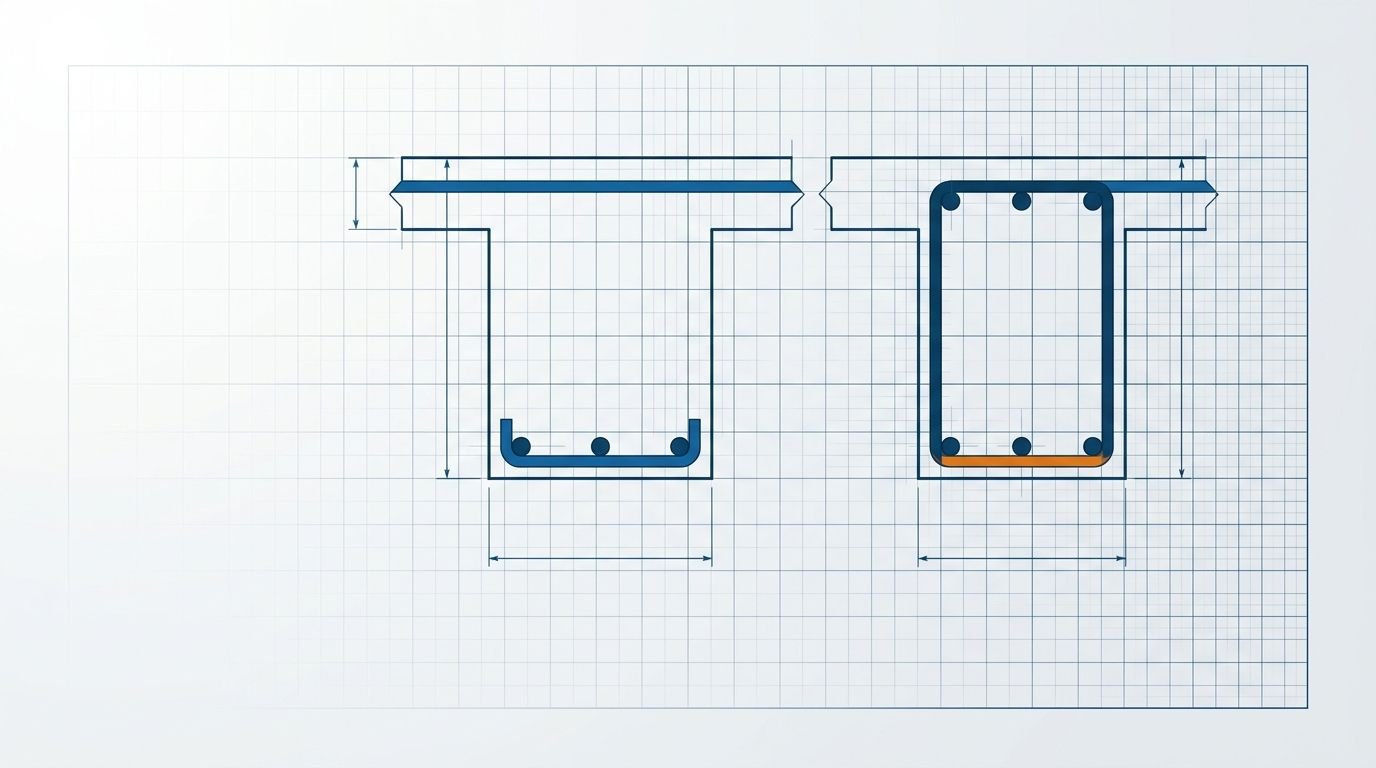
Singly vs Doubly Reinforced Beam
Updated
A singly reinforced beam carries its bending load with steel placed only in the tension zone; a doubly reinforced beam adds designed steel in the compression zone too — specifically when the beam can't be made deep enough, or the load is too high, for tension steel alone to do the whole job at that depth. This page explains the actual mechanics behind the difference and exactly when the extra steel becomes genuinely necessary rather than optional.
Singly = tension steel only
The standard, default beam
Doubly = + compression steel
Added when depth is limited
Both still need stirrups
For shear, regardless
The mechanics — why compression steel is ever needed at all
A beam bends under load so its bottom fibre stretches (tension) and its top fibre compresses. Concrete handles compression well on its own but is essentially useless in tension, which is exactly why steel always goes at the bottom — a singly reinforced beam. The concrete at the top, in compression, is normally left to carry that load unaided. But when a beam's depth is architecturally restricted — limited headroom, a false ceiling constraint — or the span and load genuinely demand more moment capacity than a singly reinforced section of that restricted depth can deliver, the plain concrete at the top alone isn't enough. Adding designed compression steel there lets the beam carry meaningfully more moment without increasing its depth — this is a doubly reinforced beam.
Singly vs doubly reinforced at a glance
| Singly reinforced | Doubly reinforced | |
|---|---|---|
| Tension steel (bottom) | Yes | Yes |
| Compression steel (top) | Nominal hanger bars only | Yes, fully designed |
| Used when | Depth and section are adequate for the load | Depth is architecturally restricted, or load is high |
| Moment capacity for a given depth | Set by the tension steel alone | Higher, for the same depth |
| Relative cost | Lower | Higher — more steel |
When a doubly reinforced beam genuinely becomes necessary
- Architecturally restricted depth — a false ceiling or headroom constraint caps how deep the beam can physically be, so extra compression steel compensates for the capacity a deeper section would otherwise have provided.
- Heavy loads or long spans — where the required moment simply exceeds what a singly reinforced section at that specific depth can carry.
- Moment reversal — continuous beams or seismic-designed frames, where bending direction can actually reverse under different load cases, genuinely need steel on both faces to handle both directions.
Both types still need stirrups along their length regardless — that requirement doesn't change based on whether compression steel is present. Check a beam's depth against its span with the beam deflection calculator.
A practical way to spot which type you're looking at on a drawing
On a structural drawing or an actual reinforcement cage, the tell is straightforward: a singly reinforced beam shows substantial main bars only along the bottom, with just thin, widely-spaced hanger bars visible at the top (there purely to hold the stirrups in shape, not to carry load). A doubly reinforced beam shows genuinely substantial bars at both the top and bottom — comparable in size and number to what you'd expect on the tension face, not the thin hanger bars of a singly reinforced section. This visual check is a useful sanity test when reviewing a bar bending schedule against the structural drawing: if the "top steel" quantity looks suspiciously close to the "bottom steel" quantity for what should be an ordinary beam, it's worth confirming with the structural engineer whether that beam is genuinely doubly reinforced by design, or whether a schedule error has crept in.
Frequently asked questions
What is the actual difference between a singly and doubly reinforced beam? A singly reinforced beam has main steel only in the tension (bottom) zone. A doubly reinforced beam adds fully designed steel in the compression (top) zone as well, used specifically when depth is restricted or the load demands more moment capacity than tension steel alone can provide.
When does a beam genuinely need to be doubly reinforced? When the beam's depth is architecturally restricted (headroom or a false ceiling constraint) or the load and span demand more moment capacity than a singly reinforced section of that depth can carry, and where moments can reverse direction under different load cases.
Does a singly reinforced beam have any steel at all on the top face? It typically has nominal top bars (hanger bars) purely to hold the stirrups in position — these aren't designed to carry compression load, unlike the fully designed top steel in a doubly reinforced beam.
Which is more economical, singly or doubly reinforced? A singly reinforced beam is more economical since it uses less steel overall. A doubly reinforced beam costs more and is used only where depth restriction or load genuinely makes it structurally necessary.
Do both beam types need stirrups regardless? Yes. Both singly and doubly reinforced beams need stirrups spaced along their length to resist shear, entirely independent of whether the beam carries additional compression steel.
CivilSite Editorial Team✓ Engineer reviewed
Written and reviewed by practising civil engineers with 10+ years of Indian residential construction experience.