Table of Contents
Steel prices in India have experienced significant fluctuations in early 2026, with primary mills increasing rates by up to ₹3,000 per tonne due to rising raw material costs and strong construction demand. Understanding current steel rates, pricing factors, and market trends is essential for contractors, builders, and homeowners planning construction projects in 2026.
Current Steel Price Trends
The Indian steel market has shown remarkable resilience in February 2026, with the BigMint India Steel Composite Index rising 1.7% week-on-week to reach ₹45,010 per metric tonne. This upward trajectory reflects multiple market dynamics including reduced inventories at primary mills, which have declined by 40% month-on-month, and sustained demand from the infrastructure and construction sectors. The longs composite index, which includes TMT bars and rebars, has experienced a 1.9% increase, while the flats index has risen by 1.4%, indicating broad-based price strengthening across product categories.
Primary steel manufacturers have implemented strategic price increases to protect margins against escalating raw material costs, particularly iron ore and coking coal. Mills are maintaining firm pricing despite global market volatility, supported by government infrastructure initiatives and robust residential construction activity. The implementation of safeguard duties has effectively reduced import competition, allowing domestic producers to maintain pricing power. Market analysts predict continued upward pressure on prices through the first half of 2026, with potential stabilization in the third quarter depending on monsoon patterns and rural demand.
| Product Category | Current Index (₹/MT) | Weekly Change | Monthly Trend |
|---|---|---|---|
| Steel Composite Index | ₹45,010 | +1.7% | Rising |
| Longs (TMT/Rebar) | ₹48,500 | +1.9% | Strong Growth |
| Flats (Sheets/Coils) | ₹52,200 | +1.4% | Moderate Growth |
| Wire Rods | ₹49,800 | +1.5% | Rising |
| Billets | ₹46,000 | +2.1% | Strong Growth |
| HRC (Hot Rolled Coil) | ₹53,500 | +1.3% | Rising |
| CRC (Cold Rolled Coil) | ₹58,400 | +1.2% | Steady Growth |
| GP Sheets | ₹80,000 | +1.8% | Rising |
🏗️ Steel Quantity & Cost Calculator
Calculate exact steel requirements and estimated costs for your construction project
Structure Dimensions
Steel Specifications
Price & Location
📋 Calculation Results
TMT Bar Prices Across Major Cities
Regional price variations reflect transportation costs, local demand patterns, and proximity to manufacturing hubs. Eastern regions, particularly West Bengal and Odisha, generally offer lower prices due to concentrated steel production facilities in Durgapur, Rourkela, and Jamshedpur. Western markets including Mumbai and Gujarat command premium prices driven by high construction activity and logistics costs. Northern markets have witnessed significant price increases in February 2026, with Delhi experiencing a ₹700 per tonne rise for 12mm TMT bars, while southern cities maintain relatively stable pricing.
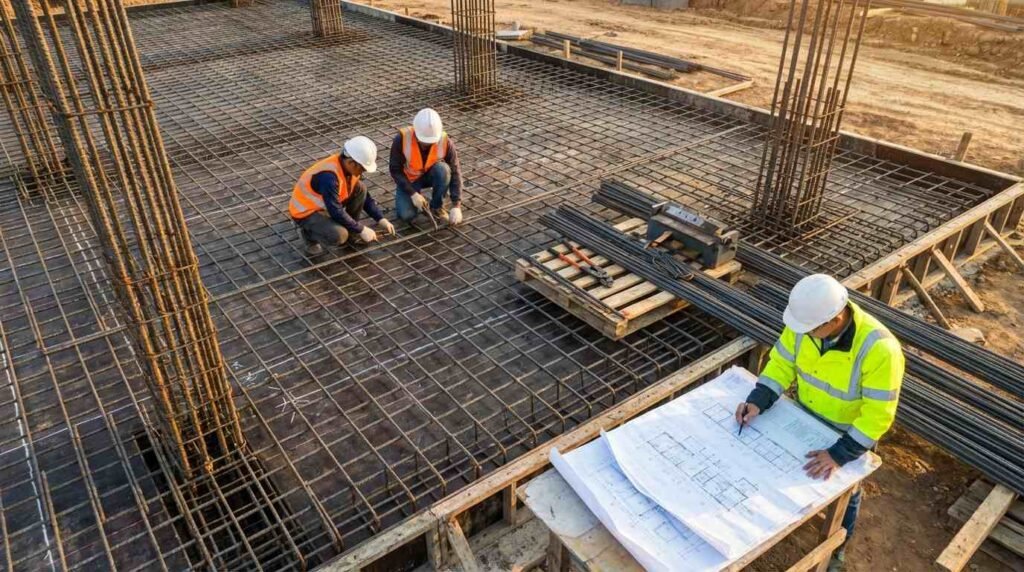
Mumbai's TMT bar prices stand at ₹49,600 per metric tonne for 12mm grade as of February 7, 2026, showing a marginal decline of ₹100 from the previous week. This slight correction comes after sustained price increases in January when 10mm TMT bars surged by ₹8,320 per tonne. Tier-2 cities are experiencing more volatile price movements, with Raigarh seeing a substantial ₹1,300 per tonne increase and Rourkela witnessing an ₹1,100 per tonne rise, indicating strong regional demand and supply chain adjustments.
| City | State | 12mm TMT (₹/MT) | 10mm TMT (₹/MT) | 16mm TMT (₹/MT) | Change |
|---|---|---|---|---|---|
| Mumbai | Maharashtra | ₹49,600 | ₹50,800 | ₹48,400 | ▼₹100 |
| Delhi | Delhi | ₹48,900 | ₹50,100 | ₹47,800 | ▲₹700 |
| Kolkata | West Bengal | ₹45,500 | ₹46,700 | ₹44,600 | Stable |
| Chennai | Tamil Nadu | ₹48,700 | ₹49,900 | ₹47,600 | ▲₹200 |
| Hyderabad | Telangana | ₹48,000 | ₹49,200 | ₹46,900 | ▲₹500 |
| Bangalore | Karnataka | ₹49,200 | ₹50,400 | ₹48,100 | ▲₹400 |
| Mandi Gobindgarh | Punjab | ₹49,900 | ₹51,100 | ₹48,800 | ▲₹400 |
| Jaipur | Rajasthan | ₹47,500 | ₹48,700 | ₹46,400 | ▲₹200 |
| Raipur | Chhattisgarh | ₹44,600 | ₹45,800 | ₹43,700 | ▲₹300 |
| Indore | Madhya Pradesh | ₹49,500 | ₹50,700 | ₹48,400 | ▲₹300 |
| Bhavnagar | Gujarat | ₹48,600 | ₹49,800 | ₹47,500 | ▲₹300 |
| Durgapur | West Bengal | ₹45,000 | ₹46,200 | ₹44,100 | Stable |
Brand-Wise Steel Pricing
Premium brands command higher prices due to superior quality control, consistent chemical composition, and established market reputation. SAIL (Steel Authority of India Limited), Tata Steel, and JSW Steel are considered top-tier brands offering FE 500D and FE 550D grades with enhanced ductility and seismic resistance properties. Mid-tier brands like Kamdhenu, Jindal Panther, and Vizag Steel provide reliable quality at competitive prices, making them popular choices for residential construction projects.
Regional brands often offer attractive pricing for bulk purchases but may lack consistent quality certification and technical support. Brand selection should consider project requirements, structural engineering specifications, and budget constraints. Premium brands typically provide comprehensive test certificates, dedicated technical support, and warranty coverage, justifying their 5-10% price premium over regional alternatives. Secondary steel from local rolling mills offers the lowest prices but requires rigorous quality testing to ensure compliance with IS 1786:2008 standards.
| Brand | Grade | 8mm (₹/KG) | 10mm (₹/KG) | 12mm (₹/KG) | 16mm (₹/KG) | 20mm (₹/KG) | 25mm (₹/KG) |
|---|---|---|---|---|---|---|---|
| SAIL | FE 500D | ₹60 | ₹58 | ₹57 | ₹57 | ₹56 | ₹56 |
| Tata Tiscon | FE 550D | ₹63 | ₹61 | ₹60 | ₹59 | ₹58 | ₹58 |
| JSW Neosteel | FE 500D | ₹61 | ₹59 | ₹58 | ₹58 | ₹57 | ₹57 |
| Kamdhenu | FE 500 | ₹60 | ₹58 | ₹57 | ₹56 | ₹55 | ₹55 |
| Jindal Panther | FE 500D | ₹60 | ₹58 | ₹57 | ₹57 | ₹56 | ₹56 |
| Electrosteel | FE 500 | ₹60 | ₹58 | ₹57 | ₹56 | ₹55 | ₹55 |
| Vizag Steel | FE 500 | ₹59 | ₹57 | ₹56 | ₹56 | ₹55 | ₹55 |
| SBF Rapid | FE 500 | ₹60 | ₹58 | ₹57 | ₹56 | ₹55 | ₹55 |
| Amba Shakti | FE 500 | ₹59 | ₹57 | ₹56 | ₹55 | ₹54 | ₹54 |
| Regional Secondary | FE 415/500 | ₹55 | ₹53 | ₹52 | ₹51 | ₹50 | ₹50 |
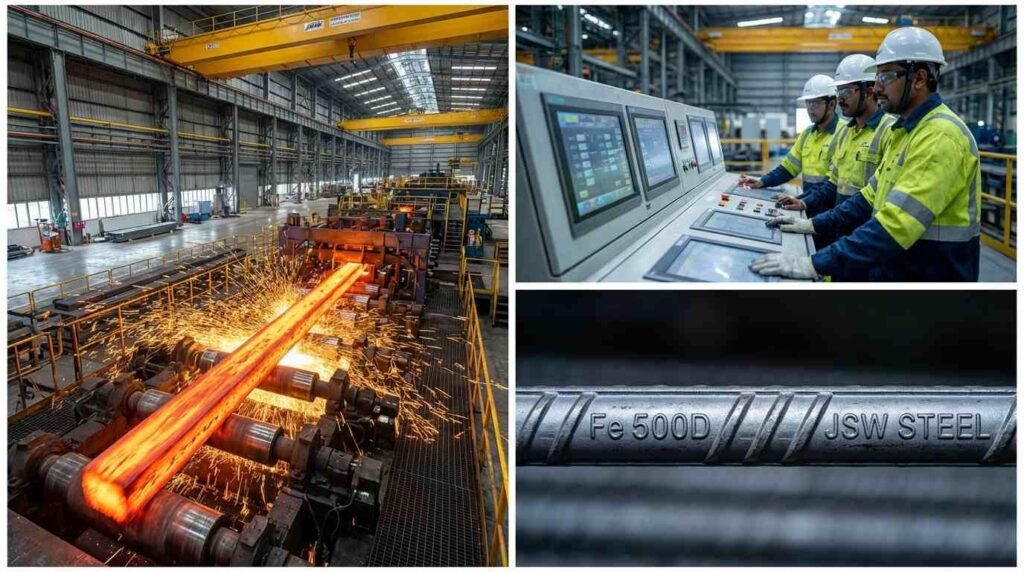
Steel Product Categories and Applications
Hot Rolled Coils serve as primary raw material for downstream steel products and are extensively used in automobile manufacturing, pipe production, and structural applications. Cold Rolled Coils offer superior surface finish and dimensional accuracy, making them ideal for consumer appliances, furniture, and automotive body panels. Galvanized Plain sheets provide basic corrosion protection for roofing and cladding applications, while Galvanized Corrugated sheets offer enhanced structural strength for industrial roofing systems.
TMT bars remain the backbone of concrete reinforcement in residential, commercial, and infrastructure projects, with 8mm, 10mm, and 12mm sizes commonly used for slabs and beams, while 16mm, 20mm, and 25mm bars serve columns and deep foundation applications. Steel plates find applications in shipbuilding, pressure vessels, and heavy fabrication work. Joists and channels provide structural framing support in commercial buildings, warehouses, and industrial structures. Wire rods serve as raw material for nails, wire mesh, and fastener manufacturing.
| Product Type | Size/Specification | Primary Application | Price Range (₹/MT) | GST Rate |
|---|---|---|---|---|
| TMT Bars | 8mm-32mm | RCC reinforcement | ₹48,000-₹62,000 | 18% |
| HRC (Hot Rolled Coil) | 1.2mm-12mm | Manufacturing, pipes | ₹51,000-₹56,000 | 18% |
| CRC (Cold Rolled Coil) | 0.3mm-3mm | Appliances, automotive | ₹58,000-₹64,000 | 18% |
| GP Sheets | 0.40mm-0.63mm | Roofing, cladding | ₹77,820-₹82,420 | 18% |
| GC Sheets | 0.40mm-0.63mm | Industrial roofing | ₹80,770-₹84,610 | 18% |
| Steel Plates | 6mm-100mm | Fabrication, shipbuilding | ₹61,000-₹68,000 | 18% |
| Angles | 25x25mm-200x200mm | Structural framing | ₹55,000-₹62,000 | 18% |
| Channels | 75mm-400mm | Building frames | ₹58,000-₹65,000 | 18% |
| Joists | 100x50mm-300x150mm | Floor support systems | ₹60,000-₹67,000 | 18% |
| Beams | ISMB 100-600 | Heavy structural work | ₹62,000-₹70,000 | 18% |
| Wire Rods | 5.5mm-12mm | Wire, nail manufacturing | ₹49,000-₹53,000 | 18% |
| Billets | 120x120mm-160x160mm | Raw material for rolling | ₹44,000-₹48,000 | 18% |
Price Forecast for 2026
Market analysts project steel prices will maintain an upward trajectory through Q2 2026, with Hot Rolled Coils expected to reach ₹52,000-₹62,000 per metric tonne by June 2026, representing a potential 10-12% increase from current levels. TMT rebar prices are forecasted to stabilize in the ₹50,000-₹58,000 range as new production capacity comes online and inventory levels normalize. Billet prices, a key cost indicator for long products, may climb to ₹45,000-₹54,000 per tonne driven by sustained domestic demand and export opportunities.
The January-March 2026 quarter will likely see continued price firmness supported by government infrastructure spending, real estate sector recovery, and limited import competition. April-June 2026 could witness increased volatility as monsoon season approaches, potentially moderating demand from rural construction markets. However, ongoing mega infrastructure projects including highways, metro rail expansions, and industrial corridors will provide sustained demand support. Raw material costs, particularly coking coal imports, will remain a critical variable influencing price movements.
| Period | HRC (₹/MT) | TMT Rebar (₹/MT) | Billets (₹/MT) | GP Sheets (₹/MT) | GC Sheets (₹/MT) |
|---|---|---|---|---|---|
| Jan 2026 | ₹51,000-₹54,000 | ₹50,000-₹52,000 | ₹44,000-₹46,000 | ₹78,000-₹82,000 | ₹81,000-₹85,000 |
| Feb 2026 | ₹52,000-₹55,000 | ₹50,500-₹52,500 | ₹45,000-₹47,000 | ₹79,000-₹83,000 | ₹82,000-₹86,000 |
| Mar 2026 | ₹53,000-₹56,000 | ₹51,000-₹54,000 | ₹46,000-₹48,000 | ₹80,000-₹84,000 | ₹83,000-₹87,000 |
| Apr 2026 | ₹53,500-₹58,000 | ₹51,500-₹55,000 | ₹46,500-₹50,000 | ₹81,000-₹85,000 | ₹84,000-₹88,000 |
| May 2026 | ₹54,000-₹60,000 | ₹52,000-₹56,000 | ₹47,000-₹52,000 | ₹82,000-₹86,000 | ₹85,000-₹89,000 |
| Jun 2026 | ₹52,000-₹62,000 | ₹50,000-₹58,000 | ₹45,000-₹54,000 | ₹80,000-₹88,000 | ₹83,000-₹91,000 |
Factors Influencing Steel Prices
Raw material costs constitute 60-70% of total steel production expenses, with iron ore and coking coal being primary components. Recent iron ore price increases in international markets have directly impacted domestic steel manufacturing costs, forcing mills to pass on cost escalations to end consumers. Coking coal imports from Australia and Indonesia face freight cost volatility and supply disruptions, adding uncertainty to pricing forecasts. Scrap steel availability and pricing also influence production economics, particularly for secondary steel manufacturers using electric arc furnaces.
Energy costs, especially electricity and natural gas, represent 15-20% of production costs for integrated steel plants. Government policies including export duties, import tariffs, and safeguard measures significantly impact domestic pricing dynamics. The current 15% import duty on finished steel products and anti-dumping duties on specific origins protect domestic producers but limit price competition. Demand seasonality creates predictable patterns, with peak construction activity during October-March driving higher prices, while monsoon months typically see softer demand and potential price corrections.
Global steel prices, particularly Chinese export prices and international benchmark rates, influence Indian domestic markets through arbitrage opportunities and import competition. Capacity utilization rates at domestic mills indicate supply-side constraints, with current utilization around 85-90% suggesting limited ability to absorb demand surges without price increases. Transportation and logistics costs add ₹500-₹2,000 per tonne depending on distance from manufacturing hubs, creating significant regional price variations.
| Factor | Impact on Prices | Current Status | 2026 Outlook |
|---|---|---|---|
| Iron Ore Costs | High (60-65% of cost) | Rising | Moderate Increase |
| Coking Coal | High (15-20% of cost) | Volatile | Supply Concerns |
| Energy Costs | Moderate (15% of cost) | Stable | Gradual Increase |
| Import Duties | High protection | 15% on finished steel | Likely to continue |
| Export Duties | Moderate impact | Selective application | Policy dependent |
| Demand Season | High variance | Strong Q1-Q2 2026 | Peak until March |
| Global Prices | Moderate influence | Stable to rising | Moderate growth |
| Transportation | Moderate (₹500-₹2000/MT) | Fuel price dependent | Stable to rising |
| Inventory Levels | High impact | Down 40% MoM | Tight supply |
| Production Capacity | Supply constraint | 85-90% utilization | Near capacity |
Quality Standards and Grades
Indian steel products must comply with Bureau of Indian Standards specifications to ensure structural integrity and safety. IS 1786:2008 specifies requirements for high strength deformed steel bars and wires used for concrete reinforcement, defining mechanical properties including yield strength, tensile strength, and elongation percentages. FE 415 grade offers 415 N/mm² yield strength suitable for general residential construction, while FE 500 and FE 500D grades provide 500 N/mm² yield strength with enhanced ductility for seismic zones.
FE 550D represents the highest grade with superior earthquake resistance properties, mandatory for critical structures in high seismic zones. The 'D' designation indicates higher elongation values ensuring better ductility and bendability during structural movements. IS 2062 covers structural steel sections including angles, channels, beams, and plates, specifying three grades: E250 (ordinary quality), E350 (medium quality), and E450 (high-quality structural steel). Quality certifications should include mill test certificates, chemical composition reports, and mechanical property test results.
Third-party quality testing is recommended for bulk purchases, especially from regional manufacturers, to verify compliance with specified grades. Visual inspection should check for uniform rib patterns, absence of surface defects, and proper grade marking on TMT bars. Weight verification against theoretical weight tables helps identify substandard products with inadequate cross-sectional area. Reputable brands provide BIS certification marks, grade identification, and manufacturer details rolled onto the bar surface.
| Steel Grade | Yield Strength (N/mm²) | Tensile Strength (N/mm²) | Elongation % | Application | Price Premium |
|---|---|---|---|---|---|
| FE 415 | 415 | 485 | 14.5 | General construction | Base price |
| FE 415D | 415 | 500 | 18.0 | Seismic zones | +3-5% |
| FE 500 | 500 | 545 | 12.0 | Medium structures | +4-6% |
| FE 500D | 500 | 565 | 16.0 | High-rise, seismic | +6-8% |
| FE 550 | 550 | 585 | 10.0 | Heavy structures | +8-10% |
| FE 550D | 550 | 600 | 14.5 | Critical structures | +10-12% |
| E250 (Structural) | 250 | 410 | 23.0 | Light fabrication | Base price |
| E350 (Structural) | 350 | 490 | 22.0 | Medium fabrication | +5-7% |
| E450 (Structural) | 450 | 550 | 20.0 | Heavy fabrication | +10-12% |
Bulk Purchase Strategies
Volume discounts typically range from 3-8% for orders exceeding 10 metric tonnes, with larger discounts negotiable for orders above 50 tonnes. Direct mill purchases eliminate dealer margins of 5-10%, offering significant savings for large projects but requiring full truckload quantities (typically 20-25 tonnes) and advance payment terms. Establishing relationships with authorized dealers provides flexibility in order quantities, credit facilities, and assured supply during market shortages.
Timing purchases during seasonal demand lulls, particularly during monsoon months (July-September), can yield 3-5% lower prices compared to peak construction season rates. Forward contracts or advance booking during price dips lock in favorable rates but require accurate quantity estimation and storage arrangements. Group buying through contractor associations or builder cooperatives leverages collective bargaining power to negotiate better terms. Price negotiation should consider total landed cost including transportation, unloading, and storage expenses rather than just ex-mill or ex-godown rates.
Payment terms significantly impact effective pricing, with cash payments potentially securing 2-3% additional discounts over credit purchases. However, 30-60 day credit terms improve cash flow management for ongoing projects despite marginally higher costs. Quality assurance should never be compromised for price advantages, as substandard steel can lead to structural failures and costly remediation. Maintaining supplier relationships ensures priority allocation during shortage periods and flexible delivery scheduling aligned with project requirements.
| Purchase Strategy | Typical Discount | Minimum Quantity | Payment Terms | Best For |
|---|---|---|---|---|
| Direct Mill Purchase | 5-10% | 20-25 MT | Advance 100% | Large contractors |
| Authorized Dealer | 3-5% | 5-10 MT | 30-60 days credit | Medium projects |
| Cash & Carry Stockist | 2-4% | 1-5 MT | Immediate payment | Small builders |
| Seasonal Purchase (Monsoon) | 3-5% additional | Any | Standard | Forward planning |
| Forward Contracts | Lock current rate | 10+ MT | Advance booking | Price risk management |
| Group Buying | 4-7% | 50+ MT combined | Negotiable | Builder associations |
| Spot Market | No discount | Any | Immediate | Urgent requirements |
| Long-term Supply Contract | 5-8% + stable pricing | Annual commitment | Monthly billing | Large developers |
Transportation and Logistics Costs
Steel transportation typically adds ₹500-₹2,000 per metric tonne to base mill prices depending on distance and accessibility. Major manufacturing hubs including Jamshedpur, Rourkela, Durgapur, and Bhilai serve as origin points for most interstate movements. Rail freight offers economical long-distance transport for bulk quantities but requires minimum consignment sizes and longer transit times. Road transport provides flexibility and door-to-door delivery but incurs higher per-tonne costs especially for smaller loads.
Regional price variations largely reflect transportation economics, explaining why West Bengal and Odisha maintain lower prices compared to distant markets like Kerala or Himachal Pradesh. Last-mile delivery costs from stockyards to construction sites add ₹200-₹500 per tonne depending on urban traffic conditions and site accessibility. Unloading and handling charges of ₹150-₹300 per tonne should be factored into total procurement costs. Projects in remote or hilly terrain may incur premium freight charges of 20-40% above standard rates.
Optimizing delivery schedules to receive full truckloads (10-12 tonnes for smaller trucks, 20-25 tonnes for larger vehicles) minimizes per-unit transportation costs. Shared freight arrangements with nearby projects can distribute logistics expenses. Advance scheduling during off-peak hours reduces urban congestion delays and potential demurrage charges. Storage planning at sites should accommodate just-in-time delivery to minimize working capital lock-up while ensuring sufficient buffer inventory to prevent construction delays.
| Route Type | Distance | Transportation Cost (₹/MT) | Mode | Transit Time | Suitable For |
|---|---|---|---|---|---|
| Local (within 50km) | <50 km | ₹300-₹500 | Light truck | Same day | Small quantities |
| Intrastate (50-200km) | 50-200 km | ₹600-₹1,000 | Medium truck | 1-2 days | Regional projects |
| Interstate short (200-500km) | 200-500 km | ₹1,000-₹1,500 | Heavy truck | 2-3 days | Medium distance |
| Interstate long (500-1000km) | 500-1000 km | ₹1,500-₹2,000 | Rail/Heavy truck | 4-7 days | Bulk orders |
| Interstate very long (>1000km) | >1000 km | ₹2,000-₹3,000 | Rail preferred | 7-10 days | Large projects |
| Remote/Hilly areas | Variable | +20-40% premium | Specialized | Extended | Difficult terrain |
| Last-mile delivery | <10 km | ₹200-₹400 | Light vehicle | Few hours | Site delivery |
| Unloading charges | N/A | ₹150-₹300 | Manual/Crane | 2-4 hours | Per consignment |
Storage and Handling Guidelines
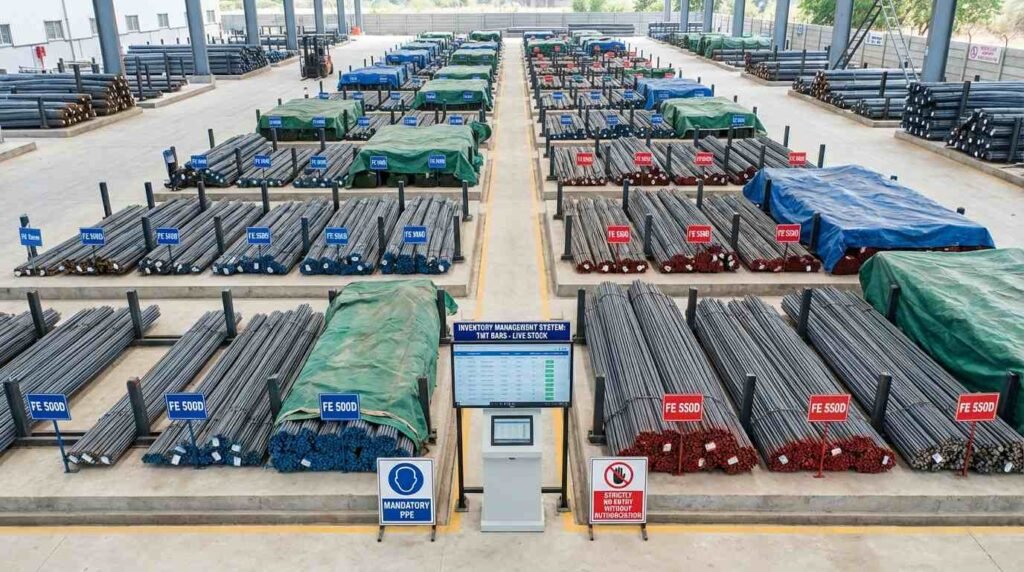
Proper steel storage prevents quality degradation, corrosion, and material losses that can reach 2-3% in poorly managed stockyards. TMT bars should be stored on wooden or concrete platforms elevated 150-200mm above ground level to prevent moisture contact and soil contamination. Systematic stacking by grade, size, and manufacturing batch facilitates inventory management and quality traceability. Weather protection using waterproof tarpaulins or covered sheds is essential in coastal and high-humidity regions where rust formation accelerates.
Maximum stack heights should not exceed 1.5 meters for 8-12mm bars and 2 meters for larger sections to prevent deformation of bottom layers. Color-coded identification tags marking grade, size, supplier, and receipt date enable first-in-first-out inventory rotation. Security measures including fencing, surveillance, and night watchmen prevent theft, a significant concern given steel's high value and easy resale potential. Insurance coverage for stored materials protects against fire, theft, and natural calamities.
Handling procedures should minimize mechanical damage, with careful loading and unloading to prevent bending or cracking of bars. Cutting and bending operations should follow structural drawings precisely, as improper bar manipulation can compromise tensile strength. Periodic inspection of stored steel checks for surface rust development, which should be wire-brushed before concrete casting. Inventory reconciliation comparing physical stock against purchase records identifies discrepancies and controls wastage.
| Storage Aspect | Specification | Purpose | Cost Impact |
|---|---|---|---|
| Platform height | 150-200mm elevated | Prevent ground moisture | Essential |
| Stack height 8-12mm | Maximum 1.5 meters | Prevent deformation | Prevents damage |
| Stack height 16mm+ | Maximum 2.0 meters | Weight distribution | Prevents damage |
| Weather protection | Tarpaulin/shed | Prevent corrosion | ₹500-₹2,000 investment |
| Grading segregation | By size and grade | Quality control | Prevents mixing |
| Batch identification | Color-coded tags | Traceability | Minimal cost |
| Security fencing | Perimeter protection | Theft prevention | ₹10,000-₹50,000 |
| Material loss acceptable | <0.5% | Handling wastage | Target benchmark |
| Inspection frequency | Weekly minimum | Quality assurance | Labor time |
| Insurance coverage | Full material value | Risk mitigation | 0.1-0.3% of value |
Common Purchasing Mistakes
Prioritizing lowest price over quality verification leads to substandard steel purchases that compromise structural integrity and violate building codes. Inadequate quantity estimation results in repeat small-lot purchases losing volume discounts and incurring multiple transportation charges. Accepting steel without proper mill test certificates, grade marking verification, and physical inspection creates quality risks that may not manifest until construction phase or worse, post-occupancy.
Failing to account for total landed costs including GST (18%), transportation, unloading, and storage makes price comparisons misleading and budget estimates inaccurate. Ignoring seasonal price patterns causes purchases during peak-price periods when better rates could be secured through advance planning. Inadequate storage arrangements expose materials to weather damage, theft, and deterioration, negating procurement savings through material losses.
Over-ordering to capture volume discounts locks excessive working capital in inventory and increases storage costs and security risks. Insufficient documentation of purchase specifications, quality certificates, and delivery challans creates accountability gaps and complicates warranty claims. Neglecting relationship building with reliable suppliers prioritizes short-term gains over long-term benefits including preferential allocation, credit terms, and technical support. Skipping independent quality testing for bulk purchases from unfamiliar suppliers risks receiving off-grade material discovered too late for cost-effective remediation.
| Mistake | Consequence | Financial Impact | Prevention Strategy |
|---|---|---|---|
| Price-only focus | Quality compromise | Structural failures | Always verify certificates |
| Poor quantity estimation | Multiple small purchases | 5-10% cost premium | Use accurate calculators |
| No test certificates | Legal/safety risks | Project rejection | Demand ISI certification |
| Ignoring landed costs | Budget overruns | 8-15% unexpected costs | Calculate total expense |
| Peak season buying | Premium pricing | 3-7% higher costs | Plan purchases ahead |
| Inadequate storage | Material losses | 2-5% wastage | Proper infrastructure |
| Over-ordering | Capital lock-up | Interest costs + storage | Match delivery to schedule |
| Poor documentation | Disputes | Legal costs | Maintain complete records |
| Single source dependency | Supply disruptions | Project delays | Develop multiple suppliers |
| Skip quality testing | Substandard material | Remediation 10-20x | Independent lab testing |
GST and Tax Implications
Steel products attract 18% GST on the base invoice value, significantly impacting project costs and requiring careful budgeting. Input tax credit mechanisms allow registered contractors and builders to claim GST paid on steel purchases against their output GST liability, effectively neutralizing the tax burden for compliant businesses. Unregistered buyers or final consumers bear the full 18% GST cost without credit eligibility, making registration beneficial for projects exceeding ₹20 lakh turnover threshold.
E-way bill requirements mandate proper documentation for interstate steel transportation with consignments exceeding ₹50,000 value. Compliance ensures smooth transit through state borders and prevents detention penalties. Reverse charge mechanism applies when purchasing from unregistered suppliers, requiring buyers to deposit GST directly with tax authorities. HSN code classification (7214 for TMT bars, 7208 for HRC, 7209 for CRC) must be accurate on invoices and GST returns.
Tax planning strategies include timing large purchases within optimal financial quarters to manage cash flow and working capital. Ensuring supplier GSTIN validity and claim-eligible invoicing prevents credit denials during tax audits. Maintaining proper documentation including tax invoices, e-way bills, delivery challans, and payment proofs is essential for audit defense and credit claims. Professional tax consultation helps navigate complex interstate purchase scenarios and composition scheme implications.
| Tax Aspect | Rate/Requirement | Applicability | Impact |
|---|---|---|---|
| GST on Steel | 18% | All purchases | Add to base cost |
| Input Tax Credit | 18% claimable | Registered buyers | Reduces effective cost |
| GST Registration threshold | ₹20 lakh turnover | Contractors/Builders | Enables credit claim |
| E-way bill | Mandatory | Consignments >₹50,000 | Interstate transport |
| Reverse Charge | Full GST liability | Unregistered suppliers | Buyer pays GST |
| HSN Code TMT bars | 7214 | Classification | Invoice accuracy |
| HSN Code Sheets/Coils | 7208-7210 | Classification | Tax compliance |
| Invoice retention | 6 years | All purchases | Audit requirement |
| Credit claim deadline | 30 Nov following FY | Time-bound | Claim within period |
2026 Market Outlook
The Indian steel industry is positioned for robust growth in 2026 supported by government infrastructure initiatives including the National Infrastructure Pipeline allocating ₹111 lakh crore over five years. Highway construction, metro rail expansions in tier-2 cities, and dedicated freight corridors will drive sustained steel demand. Real estate sector recovery following interest rate stabilization and affordable housing policy support indicates strong residential construction activity maintaining TMT bar demand.
Manufacturing sector expansion under Production-Linked Incentive schemes boosts industrial steel consumption for factory construction and machinery production. Electric vehicle industry growth increases specialized steel demand for battery manufacturing facilities and charging infrastructure. However, concerns remain regarding global economic uncertainty, potential commodity price volatility, and monsoon impact on rural construction demand affecting seasonal price movements.
Technological advancements including online steel trading platforms increase price transparency and competition, potentially moderating price increases. Environmental regulations pushing toward greener steel production may increase manufacturing costs passed to consumers. Import duty reviews and trade policy changes represent key uncertainties that could significantly alter domestic price dynamics. Overall, the balance tilts toward a strong demand environment supporting current price levels with upward bias through H1 2026.
FAQ'S
Q1: What is the current TMT bar price in India for February 2026?
A1: TMT bar prices in India range from ₹44,600 per metric tonne in Raipur to ₹50,000 in Goa for 12mm grade as of February 2026. Mumbai rates stand at ₹49,600/MT while Delhi prices are ₹48,900/MT. Prices vary by city, brand, grade, and quantity purchased.
Q2: Which is the best TMT bar grade for residential construction?
A2: FE 500D is the recommended grade for residential construction in India, offering 500 N/mm² yield strength with enhanced ductility (16% elongation). It provides superior earthquake resistance for seismic zones and costs 6-8% more than FE 500 grade but ensures better structural safety.
Q3: How much discount can I get on bulk steel purchases?
A3: Bulk steel purchases offer 3-8% discounts for orders exceeding 10 metric tonnes, with larger discounts negotiable above 50 tonnes. Direct mill purchases eliminate 5-10% dealer margins. Additional 2-3% discounts available for cash payments versus credit terms.
Q4: Why are steel prices rising in India in 2026?
A4: Steel prices increased 1.7% week-on-week in February 2026 due to higher iron ore and coking coal costs, mills protecting margins with price hikes, strong infrastructure demand, declining inventories (down 40% month-on-month), and reduced imports from safeguard duties.
Q5: How do I calculate steel requirements for my construction project?
A5: Calculate slab steel by dividing length and width by bar spacing (typically 6 inches/150mm), multiply by dimensions for total length, convert to meters, add 10% wastage, and multiply by weight per meter (0.888 kg/m for 12mm bars) to get total weight needed.